

Short answer: A blended work-and-family trip breaks most standard travel policies in three predictable ways: your laptop and presentation gear can be excluded as “professional use,” the leisure days you bolt on can fall outside your company’s coverage, and a cancellation can get denied because nobody can agree whether the trip was “business” or “leisure.” As of 2026, your credit card (think Chase Sapphire Preferred) likely covers trip cancellation and delay but not your work equipment or your family’s medical care abroad — so for a real bleisure trip you usually want a standalone annual policy with a business-equipment benefit (Allianz AllTrips Executive) or a comprehensive single-trip plan for the whole crew. Always read the actual policy; terms, limits, and prices change, so confirm on the provider’s official documents before you buy.
I once flew to a trade show, stayed three extra days to drag my kids to a theme park, and somewhere between the keynote and the log flume my work laptop got lifted out of a rental car. My company said “that was your leisure portion.” My own card said “we don’t cover business equipment.” I owned a $1,400 paperweight-shaped hole in my budget and a very long flight home to think about it.
Heads up: some links below are affiliate links — I may earn a small commission at no cost to you. I only point you toward stuff I’d actually use.
The Problem Nobody Warns You About
Here’s the dirty secret of the bleisure trip. Insurance was built for two clean buckets: the all-business trip and the all-vacation trip. Your trip is neither. It’s a Tuesday client meeting bolted onto a Saturday at the aquarium with a seven-year-old who has opinions about which fish is the fastest. The insurance world treats that hybrid like a smudged tax form — technically valid, deeply suspicious.
I like stretching a work trip into something the whole family remembers. I’ve written before about why I started adding 2-3 nights to work trips, and the time I turned a 3-day trade show into a 13-day family trip to Japan. But the more you blend, the more cracks open in your coverage. This piece is about those cracks, and which policy actually fills them. No fluff, no “peace of mind” sales pitch. Just the parts that bit me.

The Three Things a Mixed Trip Breaks
Before we get to providers, understand what specifically goes wrong. These are the three failure points I’ve either hit myself or watched a colleague hit, usually while standing at a hotel front desk holding a receipt nobody would honor.
1. Your business equipment isn’t “your belongings”
Standard travel policies cover personal baggage. The moment a laptop, projector, demo unit, or camera gets used for “professional purposes,” a lot of policies quietly exclude it. World Nomads, for instance, limits or excludes items used for business and items you don’t personally own. Read that twice. The work laptop your company technically owns? Possibly uncovered under a personal policy unless you’ve paid for a business add-on. The thing you’re actually traveling to use is the thing least likely to be protected.
2. The leisure-extension days fall in a gap
If your employer carries corporate travel insurance, its duty-of-care obligation generally applies only to the defined business portion of the trip. The personal days you tack on — the theme park, the extra hotel nights, the side flight to see grandma — are usually your own risk. Most corporate plans don’t extend to the leisure tail at all. So the exact days your family is most likely to need a doctor (new food, new water, a kid who face-plants off an unfamiliar curb) are the days you’re least covered. That’s not a coincidence. That’s just how the wind blows on a trip with children in it.
3. The “was this business or leisure?” dispute
This is the one that ruins claims. When you cancel, the adjuster wants to know which bucket the trip lived in. A business-paid flight cancelled for a personal reason — or vice versa — is exactly the ambiguity that gets a claim slow-walked, then denied. Suddenly who paid for what, and why you cancelled, matters enormously. I’ve learned to keep my receipts sorted before I leave, the same way I keep a 24-hour pre-flight checklist so I don’t forget my passport. Boring admin up front beats a fight later.
The Comparison: Three Ways to Cover a Bleisure Trip
Here’s how the three realistic options stack up. Figures are as of 2026 and rounded — confirm exact limits and pricing on each provider’s official policy documents before you buy, because terms vary by plan tier, your age, and your state. Don’t take my table to the bank; take it to the fine print.
| Coverage type | Rough cost | What it covers well | The bleisure gotcha |
|---|---|---|---|
| Annual multi-trip (e.g. Allianz AllTrips Executive) | Higher upfront annual premium; pays off at 3+ trips/year | Trip cancellation/interruption (selectable tiers of $5,000, $7,500, or $10,000 per person per year), plus a real business-equipment benefit (up to $1,000 to repair/replace gear and up to $1,000 to rent a replacement) | The annual cancellation limit is shared across the whole year, not per trip — one big claim can eat your cushion for the next ten months |
| Single-trip comprehensive (e.g. World Nomads, Travelex) | Per-trip; scales with trip cost and traveler count | Medical, evacuation, cancellation, baggage, some adventure activities; covers the family for the whole trip, business days and leisure days alike | Professional-use or company-owned equipment often excluded unless a business upgrade is added |
| Credit-card-included (e.g. Chase Sapphire Preferred) | “Free” with the card’s annual fee | Trip cancellation/interruption (up to $10,000 per person, $20,000 per trip on Sapphire Preferred) and trip-delay reimbursement — if you booked on the card | No primary medical for the family overseas; pre-existing conditions and “change of plans” excluded; business equipment isn’t a covered category at all |
One subscription-style option worth naming: SafetyWing Nomad Insurance is travel medical insurance billed like a Netflix subscription (the under-40 Essential tier runs roughly $56–$63 per 4 weeks as of 2026, and the exact rate has bounced around, so check the live number on the site). It’s genuinely good for long, medical-focused trips. But it isn’t a trip-cancellation product, and it won’t protect your work gear. Know what you’re actually buying before you click.

Standalone Insurance vs. Credit-Card Protection
This trips up a lot of dads, so let me be blunt. Credit-card “travel protection” is real, it’s useful, and it is not the same thing as travel insurance.
- Credit-card protection is mostly about your money — reimbursing pre-paid, non-refundable bookings if your trip is cancelled, interrupted, or delayed, as long as you paid with the card. It typically does not give you primary international medical coverage for you and the kids.
- Standalone travel insurance is about your trip and your body — emergency medical, evacuation, baggage, and, with the right plan, business equipment, covering the whole family across the whole trip.
If you want the full breakdown of what your plastic actually does, I dug into it in the best first travel credit card for occasional travelers and the best airline credit card for the occasional flyer. And for the specific nightmare of a cancelled work flight, see what your rebooking rights are when a business flight gets cancelled — your card’s trip-delay benefit and the airline’s own obligations are two different safety nets, and you want both.
One Chase-specific landmine, as of 2026: Sapphire trip cancellation typically excludes pre-existing conditions (there’s a look-back window — confirm the exact length in your current Guide to Benefits, since it varies by card version), plus war, intentionally self-inflicted injury, and “changes in plans or financial circumstances.” That last one is broad enough to drive a minivan through. “I decided not to go” is not a covered reason. I found this out the polite way, by reading, instead of the expensive way, by filing.
Do You Even Need a Separate Policy? Run This Checklist
Don’t reflexively buy insurance you already have. I’ve done that too, and paying twice for the same coverage stings in a quieter, dumber way. Walk this list before you spend a dime.
- Did you book the flights and hotels on a card with trip-cancellation coverage? If yes, your cancellation money may already be protected. Check the per-trip and per-person caps against your actual trip cost.
- Are you traveling internationally with family? If yes, you almost certainly need standalone medical. US health plans and credit cards rarely give you real primary medical coverage abroad for the whole group.
- Are you bringing work equipment you’d have to replace out of pocket? If yes, you need either an employer policy that explicitly covers it or a personal plan with a business-equipment benefit.
- Are you adding leisure days beyond the business portion? If yes, assume the company policy stops at the business days and cover the rest yourself.
- Is your total non-refundable cost above your card’s cancellation cap? If yes, top up with a standalone policy for the overage.
- Does the trip include adventure activities — skiing, scuba, that “fun” zipline the resort talked you into? If yes, check exclusions. Plenty of standard plans and cards won’t touch them.
If you answered “no” to all of 2 through 6 and “yes” to 1, congratulations — your card may genuinely be enough. For a domestic, short, low-cost trip with no work gear and no leisure tail, buying a separate policy is overkill. Be honest about which trip you’re actually taking, not the heroic version in your head.
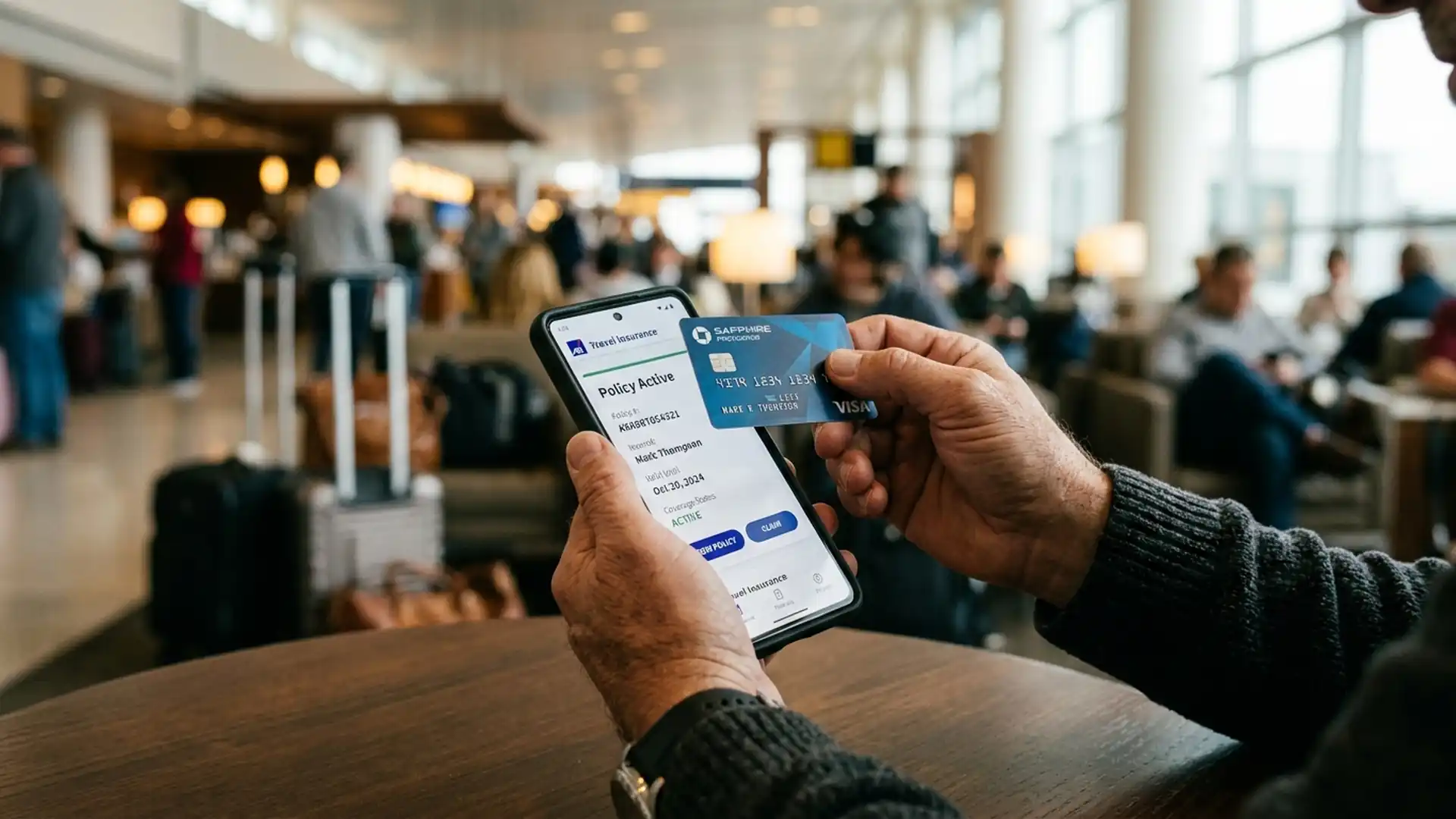
My Actual Recommendation
If you blend work and family more than two or three times a year, an annual multi-trip plan with a business-equipment benefit — Allianz’s AllTrips Executive is the obvious candidate — usually wins on math and on aggravation avoided. It’s the only mainstream option in my table that treats “I travel for work AND drag my family along” as a normal thing rather than an edge case, and it actually names business equipment as a covered category instead of pretending your laptop is a pair of socks.
For a single big blended trip — the once-a-year conference-plus-vacation epic — a comprehensive single-trip plan from a provider like World Nomads covers the family medically across every day, business and leisure alike. Just add the business-equipment upgrade if you’re hauling a work laptop, and don’t assume it’s baked in. It isn’t. I assumed once. See paragraph one.
And if you want the philosophy behind all this — when the extra nights, the points, and the upgrades are genuinely worth it — I laid out the dad math of travel in its own post. Insurance is just the unglamorous footnote that keeps the dad math from blowing up in your face on day four. For the broader case on why a dad should carry coverage at all, my older travel-insurance-as-secret-weapon piece still holds up. This one just zooms in on the work-plus-family wrinkle that nobody tells you about until you’re the one holding the dead laptop.
This article is general information, not insurance advice, and reflects publicly available product positioning as of 2026. Coverage terms, limits, exclusions, and prices change constantly and vary by plan, age, and state. Read the actual policy documents and confirm on the provider’s official site before you buy.
FAQ
Does my credit card cover a business-and-family trip?
Partially. Cards like Chase Sapphire Preferred commonly cover trip cancellation and delay for bookings made on the card (up to $10,000 per person and $20,000 per trip as of 2026), but they typically don’t provide primary international medical coverage for the family and don’t treat business equipment as a covered category. Check your card’s current Guide to Benefits for exact terms before you rely on it.
Is my work laptop covered by standard travel insurance?
Often not. Many standard personal policies exclude equipment used for professional purposes or owned by your employer. If you’re carrying a work laptop or presentation gear, you generally need a business-equipment add-on or a business-oriented plan such as Allianz’s AllTrips Executive, which explicitly covers up to $1,000 to repair or replace gear and up to $1,000 to rent a replacement.
Does my company’s travel insurance cover the family days I add on?
Usually no. A company’s duty-of-care and travel coverage generally applies only to the defined business portion of the trip. The leisure-extension days — and your family, who probably aren’t on the company policy at all — typically fall outside it, which is why a personal policy for the leisure portion is strongly recommended.
What’s the difference between SafetyWing, World Nomads, and Allianz for this?
As of 2026: SafetyWing is subscription-style travel medical insurance, strong on long-stay health coverage but not a trip-cancellation or business-equipment product. World Nomads sells comprehensive single-trip and annual plans good for whole-family leisure coverage (add the business upgrade for gear). Allianz’s AllTrips Executive is an annual multi-trip plan built for frequent work-and-leisure travelers, with a real business-equipment benefit. Confirm current details on each provider’s site.
How do I avoid a “was this business or leisure?” claim dispute?
Keep your bookings and reasons clean. Document which portion of the trip is business and which is personal, keep receipts showing who paid for what, and when you cancel, make sure the reason maps to a covered reason in your policy. A single comprehensive policy covering the entire trip is the simplest way to sidestep the bucket-fight entirely.