

Short answer: I had a 3-day trade show at Intex Osaka, so I bolted 10 family days onto the front of it. We did Tokyo, Kyoto, then Osaka, then I went to work. Family first means I’m over the jet lag and actually present, instead of running on fumes after three days on a show floor.
The Trade Show That Created the Opportunity
This June, I’ll be at Intex Osaka in Osaka for three days. I’ll be staffing the booth, meeting customers, and following the usual work trip routine.
I’ve traveled to Japan twice before for work, both times by myself. Each trip was efficient: fly in, do the job, and fly out. I didn’t waste any time or get distracted. It felt professional, but also a little empty.
This time, the schedule gives me a new chance.
The trade show dates are fixed. If I bring my family 10 days before it starts, we can explore Japan together while we’re all still fresh. By the time the show begins, we’ll be used to the time zone, so I won’t have to deal with jet lag at work. The trip becomes something we share, not just something I do alone.
That’s the plan: spend 10 days with my family in Tokyo, Kyoto, and Osaka, then wrap up with three days of work at the trade show.
I’ve never tried this before, so I’m planning carefully since I know things might not go as expected.
What I Learned From Solo Work Trips to Japan
My last two trips to Japan taught me some important lessons for traveling with family.
Public transit is easier than expected.
I was nervous about using Tokyo’s train system, but it was easier than I expected. There are English signs, clear maps, and announcements at every stop. If I could manage it while jet-lagged and alone, I’m confident I can do it with my family.
The city is incredibly safe and clean.
I walked around Tokyo at night and never worried about safety. The streets are clean, and people are polite. It’s not just good for solo business trips; it’s actually perfect for families. My kids can have more independence here than in most cities.
Specific moments made me think: my kids would love this.
I stood at Shibuya Crossing during rush hour and watched hundreds of people moving in every direction, all in perfect sync. It’s organized chaos that works. My kids would be amazed.
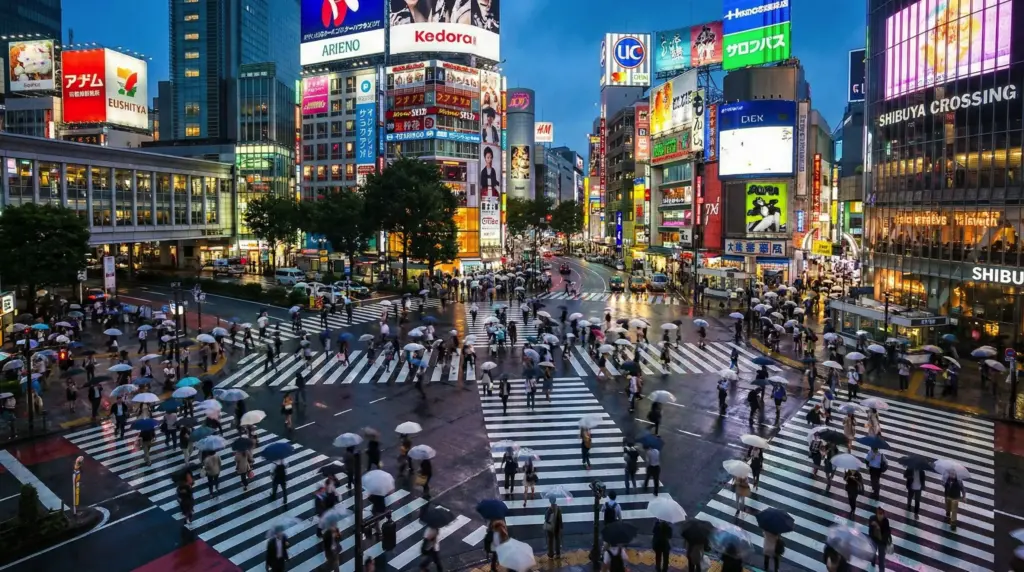
As I walked through different neighborhoods, I noticed how clean everything was. There was no trash on the streets, no graffiti, and parks everywhere. These small, well-kept places are where kids actually play. My 9-year-old would feel safe running around here in ways she can’t in most cities.
I stopped at several bakeries. Japanese bakeries are outstanding; they’ve even won the French bakery championship more than once. The pastries are perfectly made, and the breads look like works of art. My kids will eat well here.
I tried tempura near my hotel in Ginza. It was light and crispy, not like the heavier versions we have at home. It’s easy food for anyone to enjoy, so my kids will want to try it.
My son loves ramen, even though I’m not a big fan. We’ll look for ramen shops together since Tokyo has hundreds. That will be his thing to explore.
My wife will love the Tsukiji Outer Market and the chance to try real sushi, not the Americanized kind. She’s especially looking forward to it.
And then there’s matcha. My kids are curious about it, and it’s everywhere in Tokyo. They’ll definitely want to try it.
I visited the temple dedicated to the 47 Ronin. My 14-year-old son and I watched that movie together, so while I was there alone, I thought he really needs to see this in person.
The story is about honor, dignity, self-sacrifice for the greater good, and standing up to fix injustice. These are qualities I admire and hope he’ll come to appreciate. Walking through that temple with him will be more than just sightseeing; it will be a moment we share about values.
Those solo trips showed me that Japan is great for families. Now I’m putting that idea to the test.
The Structure: 5 Days Tokyo, 3 Days Kyoto, 3 Days Osaka, 3 Days Work
Here’s how the 13 days break down:
Days 1-5: Tokyo (Family Exploration)
We’re staying in an Airbnb in Asakusa. Five-minute walk to Senso-ji Temple. Two bedrooms so the kids have their own space, and we’re not crammed into a single hotel room.
Planned activities: TeamLab, Tokyo Disney, Tsukiji Outer Market, Senso-ji, Shibuya crossing, Shinjuku, and Miraikan science museum. Not all of it – just the anchors. Everything else is flexible.
Tokyo Disney is on the list because my daughter and wife love Disney. It’s their thing. Since we’re already in Tokyo for five days, spending one day at Disney makes sense for them.
Why Asakusa: Central location. Near transit. Walking distance to a major temple. Neighborhood feel instead of a business district. Good base for exploring.
Days 6-8: Kyoto (Culture, Temples, and a Blade Sharpening Class)
Bullet train from Tokyo to Kyoto. We’re staying in a hotel downtown for two nights.
Why Kyoto? I’ve always wanted to visit. On my earlier work trips to Japan, I never had the time. Kyoto was always on my list, but never made it. I could go back alone on a future work trip, but I’d rather experience it with my family the first time. It’s better to make a shared memory than to explore alone.
Kyoto is all about temples, traditional Japan, and cultural history. We haven’t picked which temples to visit yet; we’ll decide that with the kids’ input. But there’s one experience I’ve already planned:
The whetstone museum blade sharpening class.
I run a separate site dedicated to Japanese kitchen knives. I’ve studied blade geometry, steel types, and edge retention, but I’ve never learned to properly sharpen on Japanese whetstones. My 14-year-old son is coming with me to that class. We’ll learn together. It’s a dad-and-son experience he’ll remember, not just another temple tour, but a chance to learn a real skill together in the place where these knives and techniques come from.
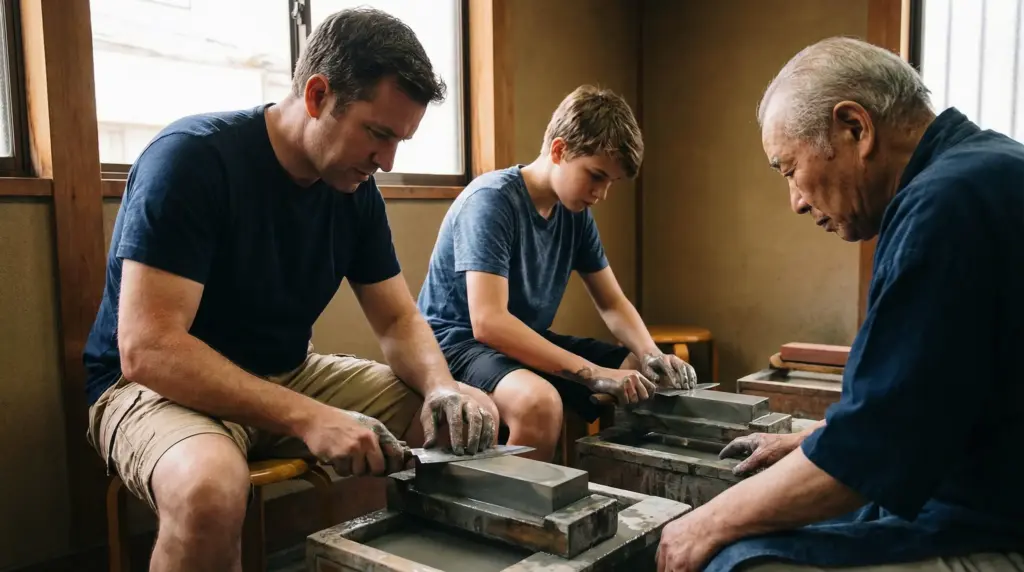
That’s the kind of experience that makes Kyoto worth the detour. It’s not just sightseeing, but real moments that connect us.
Three days feels right: enough time to see temples and take the class without rushing, but short enough that the kids don’t get tired of temples.
Days 9-11: Osaka (Family Time Before Work)
We’ll take the bullet train from Kyoto to Osaka. We’re staying in an Airbnb in Minato ward, not far from Kyocera Dome. We’ll be here for six nights total: three with family, three while I’m working.
Why Osaka? The trade show is here, so we have to end up in Osaka anyway. We’ll arrive as a family and spend three days exploring together—Osaka Aquarium, Universal Studios, and local food experiences—before I switch to work mode.
Universal Studios is on our Osaka list because we’ll have some time before the trade show starts. Two theme parks in one trip might sound like a lot, but it works out well. My daughter gets Disney in Tokyo, and the whole family gets Universal in Osaka. Both fit into our route.
The Airbnb location is convenient for work. Easy access to Intex Osaka where the trade show is. My family can stay comfortable in the same place while I’m at the show.
Days 12-14: Trade Show (Work Mode)
I’ll be working while my family explores Osaka on their own or relaxes at the Airbnb. We’ll meet for dinner each night. Evenings are together, but our days are separate.
By this point, everyone will be adjusted to the time zone. The kids will have had 10 days of experiences, and my wife will have had time with them without me being pulled between work and family. I can focus on the trade show without feeling guilty.
Why This Structure (Family First, Work Second)
The trade show timing is fixed. I can’t change those dates. So I had two options:
Option 1: Work for 3 days, then add family time after.
Option 2: Bring family 10 days before the show, then work.
I chose Option 2 for specific reasons:
Jet lag is handled before work starts.
If I show up to the trade show jet-lagged, I’m not performing well. By bringing my family first and spending 10 days adjusting, I’m fully acclimated by the time work begins. No fog. No exhaustion. Just a normal function.
Family time isn’t rushed.
If we did family time after work, I’d be tired from three intense days at a trade show. I’d be trying to switch modes from work to family while depleted. This way, I’m present for family time when I’m at my best. Then I can focus on work knowing we’ve already had our time together.
It aligns with our usual June family trip timing.
June is when we usually travel as a family. School ends, and the kids need to decompress. We typically spend a couple of weeks somewhere together. This year, instead of a separate family trip, we’re combining it with my work trip to Japan. Same timing, just a different destination.

Title: The bigger bleisure case
This isn’t just a Japan story. It’s part of a larger shift in how work trips get extended.
Inside:
- Why bleisure keeps growing
- When extra days actually make sense
- How to extend a trip without breaking the work part
What I’m Worried About
I’m not pretending this is risk-free. There are real concerns.
Cost could get out of control.
Thirteen days in Japan for a family of four is expensive. Bullet trains between cities. Accommodations in three different places. Activities like Disney and Universal Studios. Food for four people every day.
I’ve budgeted for this, but budgets and reality don’t always match. If costs go beyond what I planned, it creates stress that could undermine the whole point of the trip.
Mitigation: Set spending limits before we go. Use Airbnbs to have kitchens for some meals. Pick activities carefully instead of saying yes to everything. Track costs as we go.
Logistics of moving between cities with kids.
We’re changing locations twice: Tokyo to Kyoto, then Kyoto to Osaka. Each move means packing, navigating train stations with luggage, getting everyone to the right platform, finding the new place, and unpacking.
With two kids, ages 9 and 14, that’s manageable but not always easy. If one of those transitions goes badly—someone gets sick, we miss a train, or luggage gets lost—it could throw off the whole trip.
Mitigation: Pack light. Book bullet train seats in advance. Build buffer time into travel days. Have backup plans if something goes wrong.
Kids getting tired by days 8-10.
Ten days is a long time, especially when you’re constantly on the move and sightseeing. There’s a risk the kids get burned out before I even start working. If that happens, the last three work days become miserable for everyone.
Mitigation: Build in rest days. Don’t overschedule. Let the kids have downtime at the Airbnb. One major activity per day, maximum. Everything else is a bonus.
How I’m Preparing the Kids
Preparation started months before the trip.
We’ve been looking at maps together and talking about what makes Japan different. I showed them photos from my previous work trips—the trains, the temples, and the neighborhoods we’ll visit.
My 9-year-old is excited about the food. My 14-year-old wants to see specific places: Shibuya, the Ninja Museum, and Universal Studios. They’re both interested in the 47 Ronin temple because we watched the movie together.
I created a book about Japan for kids to help with this preparation. It covers culture, customs, food, and places in a way that helps them connect. We’ve been reading through it together, so Japan feels familiar by the time we land.
I also put together a destination overview video showing what Tokyo looks like, how the trains work, what neighborhoods we’ll explore. Giving them visual context helps them picture the trip instead of just hearing about it.
“Watch with the kids before Japan”
A quick visual warm-up for temples, trains, food, and the kind of Japan kids can actually picture before landing.
The kids are helping choose activities in each city. My wife and I picked the cities and the overall structure, but the kids get to help decide what we do in Tokyo, which temples we visit in Kyoto, and which day we go to Universal Studios.
That sense of ownership matters. If they’re just being dragged to places I picked, it won’t work. But if they’ve chosen some of the experiences, they’ll be more invested.
The Bullet Train Strategy
We’re taking the bullet train between Tokyo, Kyoto, and Osaka. Not flying. The train.
Why? Because riding the train is part of the experience.
Tokyo to Kyoto is about 2.5 hours on the Shinkansen. Kyoto to Osaka is under an hour. These aren’t grueling travel days. They’re comfortable, scenic rides that my kids will actually remember.
Flying would be faster gate-to-gate, but once you factor in getting to the airport early, security, baggage claim, and getting from the airport to the city center, the train is competitive in terms of on-time performance. And it’s significantly less stressful with kids.
The train drops you right in the center of the city. You walk off and you’re already where you need to be. No taxis, no transfers—just arrival.
Plus, the kids get to experience the Shinkansen. That’s memorable in itself.
Why Airbnb in Tokyo and Osaka, Hotel in Kyoto
We’re staying in Airbnbs for the longer stops (Tokyo and Osaka) and a hotel for the shorter stop (Kyoto).
Tokyo and Osaka: Airbnb for space.
Five days in Tokyo and six days in Osaka—three with family, three for work—mean we need real space. Two bedrooms, a kitchen, and a living area. Not a cramped hotel room where we’re all on top of each other.
Airbnb also saves money. We can cook some breakfast instead of eating out every meal. The kids can spread out and relax instead of being confined to hotel room routines.
Kyoto: Hotel for simplicity.
Kyoto is only two nights. That’s short enough that a hotel makes more sense. We’re not there long enough to need a kitchen or a full living space. A good downtown hotel with breakfast included keeps things simple.
There’s less setup and fewer logistics. We arrive, check in, explore Kyoto, check out, and move on to Osaka.
What I’ll Know by July
By the time you read this, I’ll have either finished this trip or be about to start it.
I’ll know if 10 family days were the right length or too long. I’ll know if moving between three cities with kids was manageable or chaotic. I’ll know if the Airbnb strategy worked or if we should’ve just stayed in hotels the whole time.
I’ll know if my kids handled the bullet trains well or if they got restless. I’ll know if Kyoto lived up to expectations or if we should have skipped it and stayed in Tokyo longer.
I’ll know if the plan worked—10 days with family first, then three days of work—or if I should have done it differently.
And I’ll write about it honestly: what worked, what didn’t, and what I’d change next time.
That’s the point of this site. It’s not about aspirational travel content, but about real attempts to make work trips less hollow by sharing them with family.
If you have a work trip coming up and you’ve thought about bringing your family, this is what the planning process looks like.
It’s not perfect, and it’s not guaranteed to work, but it’s worth trying.
The alternative is another solo trip, another hotel room, and another city experienced alone.
I’d rather try this and learn what works.
Related posts:
→ Why I’m Finally Bringing My Family on a Work Trip (And What I’m Planning So It Doesn’t Fail)
→ The Dad Math of Travel: When Upgrades, Points, and Extra Nights Are Worth It
I write about these topics regularly.
I share practical systems for dads who travel occasionally and want to stay sharp at work, connected at home, and avoid burnout in between.
Key takeaways
- Anchor the trip to the work date. The trade show at Intex Osaka in June was fixed. Everything else got built around it, not the other way round.
- Family time goes before the work, not after. Ten days up front means I’m acclimated by day one of the show. No fog, no exhaustion, and I’m present for my family when I’m at my best, not wrung out after three intense days.
- It lines up with our usual June trip anyway. Same timing we always travel, just a different destination.
- Route it Tokyo to Kyoto to Osaka. Tokyo (Asakusa Airbnb, five minutes from Senso-ji), Kyoto (downtown hotel, short stay), then Osaka (Minato ward, near Kyocera Dome) so I’m already in the right city when work starts.
- Shinkansen between cities, not planes. Less stress with kids and it drops you in the centre of town.
- Airbnbs with kitchens to keep food costs down, hotels only for the short stops.
- Plan for kid burnout. Max one major activity per day, scheduled rest days, light packing, trains booked in advance.
FAQ
Should family days come before or after a business trip?
Before. If I did family time after three intense days at a trade show, I’d be tired and not much fun. Ten days up front also means I’m fully over the jet lag by the time work starts, so I show up sharp instead of in a fog.
Is it better to take the Shinkansen or fly between Japanese cities with kids?
I’m taking the bullet train. It’s less stressful with children and it arrives central in the city instead of dumping you at an airport on the outskirts. We’re going Tokyo to Kyoto to Osaka.
How do you keep kids from burning out on a 13-day trip?
Pace it. I’m capping it at one major activity per day, building in rest days, and packing light so moving between cities isn’t a circus. The danger zone is days 8 to 10, so the back half stays deliberately easy.
📍 Part of: Bleisure & the Traveling Dad.