

Short answer: If a U.S. airline cancels your flight (for any reason) and you decline the rebooking, the Department of Transportation now requires an automatic cash refund to your original payment method — you don’t have to beg for it. But a refund is not “compensation,” and U.S. law does not force the airline to pay you for the lost day, the missed meeting, or your hotel. In the EU it’s different: under EU261, a cancellation within the airline’s control can owe you €250, €400, or €600 in cash on top of a refund or rebooking. Your fastest move on a work trip is almost always to get rebooked, not refunded — and the way to win that is to start working the rebooking the second the cancellation hits, on the app and the phone at the same time, while the desk line is still forming.
I once watched a 6 a.m. cancellation turn a gate area into a zombie movie — 180 adults shuffling toward one desk agent like she was handing out the last lifeboats. I was three deep in line and already rebooked on the app before the guy at the front finished saying “this is unacceptable.” He got the 9 p.m. flight. I got the 11 a.m. He was right. It was unacceptable. He also didn’t read the app.
Heads up: some links below are affiliate links — I may earn a small commission at no cost to you. I only point you toward stuff I’d actually use.
Refund vs. Rebook vs. Compensation: Know Which One You Actually Want
Here’s the mental model that fixes most of the panic. When a flight dies, three different things are on the table, and they are not the same thing.
- A refund means you get your money back and you’re on your own. Great if your trip is now pointless. Terrible if you still need to be in Chicago tomorrow.
- A rebooking means the airline puts you on another flight. This is what you want on a work trip 90% of the time, because your goal is to arrive, not to win a money-back argument.
- Compensation means cash on top, for the inconvenience. In the U.S. this barely exists. In the EU it can be real money.
Confusing these three is how people waste 40 minutes at a desk demanding a “refund” when what they needed was a seat on the 11 a.m. So decide first: do I still need to go? If yes, you’re playing the rebooking game, and the refund rules are just your fallback.
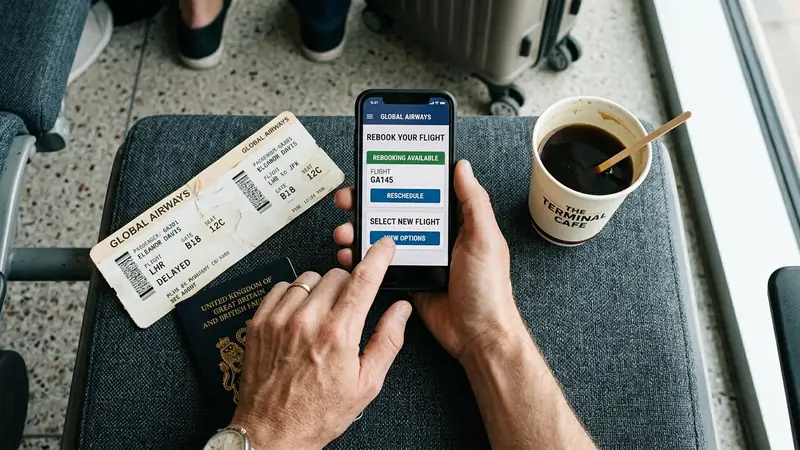
The Dad’s Rebooking Playbook (What I Actually Do, In Order)
This is the part nobody writes down. When the cancellation notification buzzes, I run the same sequence every time. The whole point is to be working three channels before the herd has finished groaning.
- Open the airline app first, not your eyes-to-the-desk. Most major carriers auto-rebook you and show the new flight in the app within seconds. If you like it, accept it. If you don’t, the app usually lets you self-rebook onto other same-day flights for free. This alone beats the line most of the time.
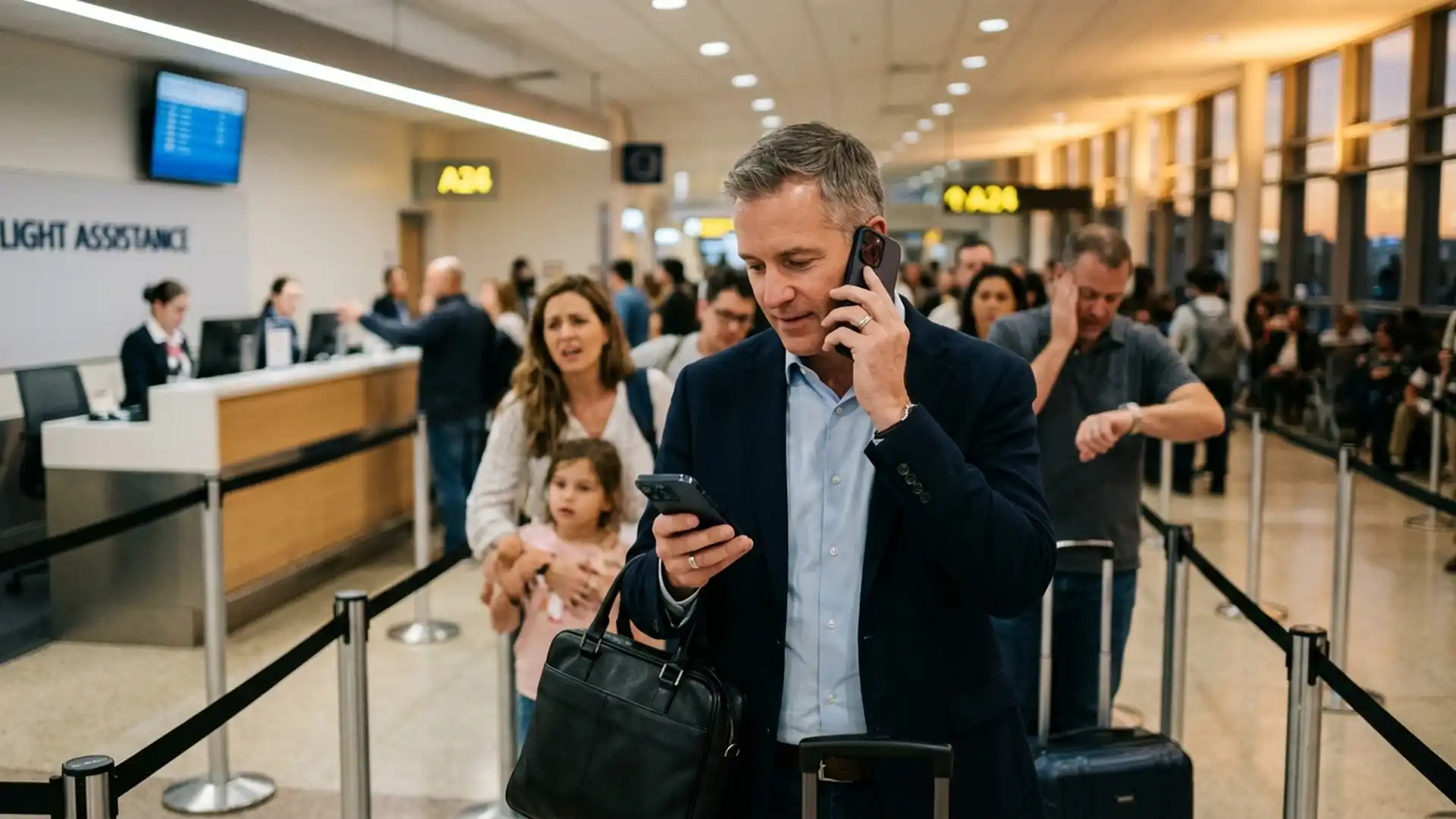
- Get in the physical line anyway — and call simultaneously. Stand in line with your phone to your ear calling the airline’s number (or better, the elite/reservations line). Whichever connects first wins. I have been rebooked by a phone agent while standing 15 people deep in a line that hadn’t moved.
- Ask for the specific flight, not for “help.” Before you reach anyone, you should already know the flights you want. I pull up the airline’s own schedule and say: “I need LGA to ORD today. Put me on the 11:05, and if that’s full, the 1:40, or rebook me through a connection on your metal.” Agents move faster when you hand them the answer.
- Use “within your control” language if it applies. If the cancellation is crew, maintenance, or the airline’s mess — not weather — say so. Under the DOT’s customer-service commitments, all ten major U.S. carriers have committed to free same-airline rebooking on cancellations within their control, and most to meals and hotels. That’s your lever for getting a hotel voucher.
- Partner-airline rebooking is your secret weapon. If your airline has no good seats, ask to be re-accommodated on a partner carrier. Only about half the majors formally commit to it on the DOT dashboard, so they often won’t volunteer it — but they can usually do it. “Can you endorse my ticket to a partner?” is a sentence that has saved my entire trip more than once.
- If nothing today works, decide refund-or-fight at the desk. Now — and only now — is the refund conversation worth having. If the rebooking is genuinely useless, you decline it and trigger the automatic refund (more on that below).
- Screenshot everything. The cancellation notice, the reason given, the new boarding pass, the receipts. This is your evidence for an EU261 claim, a travel-insurance claim, or a credit-card trip-delay claim. Future-you will be grateful.
The unglamorous truth: the playbook is mostly about parallelism. App, phone, and line all at once. The person who picks one channel and stares at it is the person sleeping in the terminal. If you want the wider pre-trip version of this thinking, it lives in my 24-hour pre-flight checklist.
DOT vs. EU261: Who Owes You What (The Comparison Table)
This is the table to bookmark. It’s the difference between “money back” and “money back plus a check.” Both columns are current as of 2026, but rights rules get revised — confirm DOT rules at transportation.gov/airconsumer and EU261 at the EU’s official Your Europe page before you rely on a number.
| Scenario | U.S. DOT rules | EU261 (EU departures, or EU-carrier arrivals) |
|---|---|---|
| Airline cancels, you decline rebooking | Automatic cash refund to original payment method — no request needed (7 business days for card, 20 calendar days otherwise) | Full refund or rerouting — your choice |
| Cash compensation for the hassle | None required by federal law. Refund only; no inconvenience payment | €250 / €400 / €600 by distance, if the cancellation was within the airline’s control and notice was short |
| Compensation amounts | n/a | €250 (under 1,500 km) · €400 (1,500–3,500 km, and intra-EU over 1,500 km) · €600 (over 3,500 km) |
| Weather / “extraordinary circumstances” | Refund still owed if you decline rebooking; no compensation either way | Refund/rerouting owed, but no cash compensation — airline can deny on extraordinary-circumstances grounds |
| Rebooking | Not a hard federal mandate, but all 10 dashboard carriers commit to free same-airline rebooking on controllable cancellations; about half also commit to rebooking you on another airline | Airline must offer rerouting at the earliest opportunity, including on other carriers if needed |
| Hotel / meals during a long delay | Per airline commitments (DOT dashboard); most commit to hotels for an overnight, with Frontier the lone holdout | “Right to care” — meals, refreshments, and hotel if an overnight is required |
Two things people get wrong here. First, the U.S. refund rule is genuinely automatic now — you no longer have to fight for your own money back when they cancel. Second, U.S. law still does not give you EU-style compensation. If you want a check for your ruined day on a domestic flight, the realistic source isn’t the airline — it’s your travel insurance — a policy like SafetyWing — or your credit card.
One 2026 wrinkle worth knowing: the DOT has paused enforcement of part of the refund rule until June 30, 2026 — specifically for situations where the airline operates your flight under a different flight number than originally assigned, with no significant change to your itinerary. The core “they cancel, you decline, you get your money” right is intact. By the time you read this that pause may already have lapsed, so check the official source for where it stands.
A Quick Word on EU261 in 2026
You’ll see headlines about an “EU261 reform” — in mid-June 2026 the EU Parliament and Council reached a provisional deal. The good news for passengers: the dreaded plan to raise the delay threshold and shrink payouts got beaten back. The 3-hour threshold stays and the €250–€600 scale holds. Those new rules aren’t slated to take effect until 2027 anyway, so for any trip you take in 2026, the classic EU261 numbers in the table above are what govern. Still — confirm before you file a claim.
Rights Are Not Insurance: Don’t Confuse the Two
This trips up a lot of dads, so let me draw the line in crayon.
Passenger rights (DOT refund, EU261 compensation) come from the government and you claim them from the airline. They cost you nothing and you already have them. Travel insurance and credit-card trip protection are products you buy (or that come bundled with a card) that pay you for out-of-pocket losses — the hotel you booked, the meals during a 12-hour delay, the prepaid tour you missed.
They stack. A cancelled EU flight can owe you an EU261 check and let you claim the unexpected hotel from your card’s trip-delay benefit. They cover different holes. If you only remember one sentence: rights get you your fare and (in the EU) a penalty; insurance gets you your expenses. For the bigger picture on why a standalone policy is worth it, here’s my full take on why travel insurance is a dad’s secret weapon.
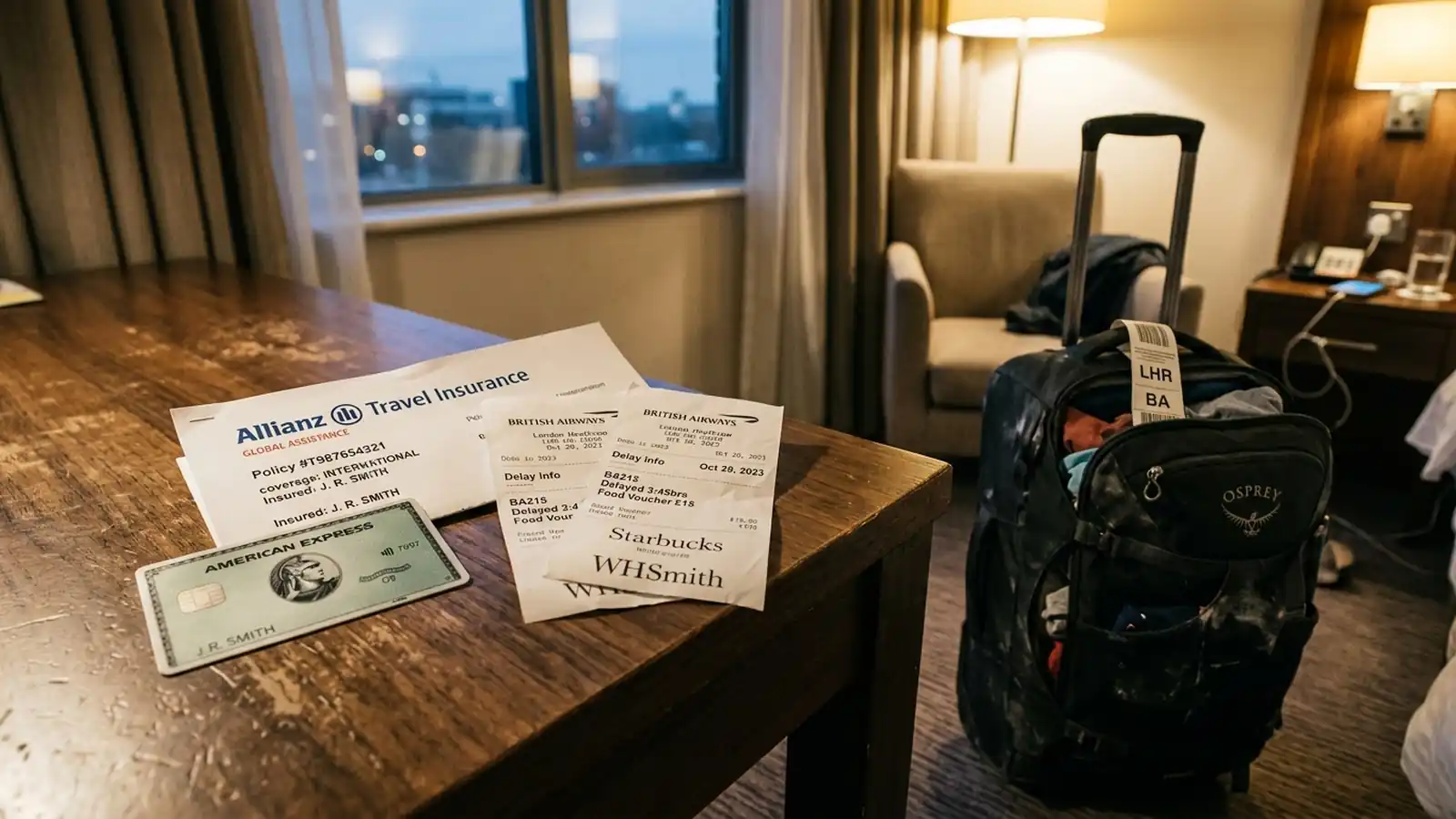
The Credit Card Angle (The One That Quietly Pays Out)
Here’s the part that’s saved me actual money. If you booked the flight with a travel card that carries trip-delay protection, that card often reimburses your unexpected expenses when a delay runs long — typically once you cross an overnight or a set number of hours. The catch is that not every “travel” card actually has this benefit, so read the fine print before you assume you’re covered.
The standard recommendation for the average traveler is still the Chase Sapphire Preferred, and it got a refresh in 2026 while keeping its $95 annual fee (unchanged for roughly 15 years). As of 2026 it carries trip-delay reimbursement of up to $500 per traveler when your covered trip is delayed more than 12 hours or requires an overnight, plus trip-cancellation/interruption coverage up to $10,000 per person (capped at $20,000 per trip) for prepaid, non-refundable expenses — provided you paid for the trip with the card. Mid-2026 it was also running a sign-up bonus of 100,000 points after $5,000 of spend in three months, which several outlets flagged as among the richest it’s ever offered. Bonuses and benefit terms change constantly, so verify the current offer and the benefits guide on the card’s official page before applying.
One important warning, because the wrong advice here costs real money: the standard Capital One Venture Rewards card does not include trip-delay protection. If you want that benefit from the Capital One side, it’s the premium Capital One Venture X ($395 annual fee) that carries it — up to $500 per traveler after a delay of more than six hours or an overnight, plus trip cancellation/interruption coverage. Don’t book your flight on a regular Venture expecting delay reimbursement that isn’t there.
The deeper breakdown lives in my first travel card guide for occasional travelers — the trip-protection math is the whole reason a once-a-year flyer carries one of these. And if the cancellation is the start of a worse day — bag goes one way, you go another — my 72 hours of lost luggage in Munich is the cautionary tale.
Who Should Do What: The Decision Block
When the board flips to CANCELLED, pick your lane fast:
- You still need to arrive (work trip): Run the rebooking playbook above. App + phone + line, all at once. Refund is your fallback, not your goal.
- The trip is now pointless: Decline the rebooking and let the automatic DOT refund trigger. Screenshot the cancellation. Don’t accept a voucher if you’d rather have cash — once you take the rebooking or voucher, the automatic-refund clock can stop.
- You’re flying out of (or into, on an EU carrier from) Europe and it was the airline’s fault: Get rebooked first, then file the EU261 claim afterward for your €250–€600. The rebooking and the compensation are separate; don’t let the desk tell you accepting a new flight waives the cash.
- You’re stuck overnight on a controllable cancellation: Ask for the hotel and meal vouchers by name, citing the airline’s customer-service commitment. If they won’t (looking at you, Frontier), keep receipts and claim through your card’s trip-delay benefit or your insurer.
- You booked with a trip-protection card or a policy: Save every receipt the moment the delay crosses the coverage threshold. The claim is boring to file and surprisingly worth it.
Don’t Want to Fight for the Compensation Yourself?
If filing an EU261 claim sounds like a second job, a service like AirHelp will chase the airline for you and only take a cut if they actually win the compensation — worth it when the airline is stonewalling and you’re back home with a shoebox of receipts.
FAQ
Am I owed a refund if my flight is cancelled in 2026?
Yes, if it’s a U.S. airline. As of 2026, the DOT requires an automatic cash refund to your original payment method whenever the airline cancels (or significantly changes) your flight and you decline the rebooking or alternative offered — you don’t have to request it. A refund is your fare back, not extra compensation. Confirm the current rule at transportation.gov/airconsumer, since enforcement details have shifted in 2026.
What is EU261 compensation?
EU261 is the European rule that, for flights departing the EU (or arriving in the EU on an EU carrier), can owe you cash compensation — €250, €400, or €600 by flight distance — when the airline cancels or seriously delays a flight for reasons within its control. It’s on top of any refund or rerouting. It does not apply if the cause was an “extraordinary circumstance” like severe weather. These figures are current as of 2026; verify on the EU’s official passenger-rights page before claiming.
Does the airline have to rebook me?
In the EU, yes — EU261 requires the airline to offer rerouting at the earliest opportunity, including on other carriers if necessary. In the U.S., rebooking isn’t a hard federal mandate, but all ten major carriers on the DOT’s Airline Customer Service Dashboard have committed to free same-airline rebooking for cancellations within their control (about half also commit to rebooking you on a partner airline). In practice you’ll almost always get rebooked — work the app and phone to get the good rebooking, not the leftover one.
What should I do when my flight is cancelled?
Open the airline app first (it often auto-rebooks you), get in the desk line while simultaneously calling the airline, and come armed with the specific replacement flights you want. If it was the airline’s fault, ask for partner-airline rebooking and, for an overnight, hotel and meal vouchers. Screenshot everything for later insurance, card, or EU261 claims. Only fall back to the refund if no rebooking actually gets you where you need to be.
Is travel insurance the same as my passenger rights?
No. Passenger rights (the DOT refund, EU261 compensation) come from the government, cost you nothing, and are claimed from the airline. Travel insurance and credit-card trip protection are products that reimburse you for out-of-pocket expenses like an unexpected hotel or meals during a long delay. They stack — a cancelled EU flight can owe you EU261 cash and let you claim the surprise hotel from your card. Use both.
One Response