

Short answer: Run the spend through four questions: Does it protect my energy? Protect a shared memory? Reduce friction? Will I regret skipping it? If two or more are yes, pay the cash or burn the points. That’s the dad math. The cheapest option usually isn’t best, and the priciest rarely earns its keep. I’ve made both mistakes.
Travel Math Isn’t Spreadsheet Math
The cheapest choice usually isn’t the best, and the most expensive one often doesn’t add much value.
I’ve made both mistakes. I’ve saved money on flights and regretted it for 40 hours. I’ve paid extra for upgrades that didn’t help. I’ve picked hotels just for the price and ended up wasting time.
If you only travel a few times a year, every choice feels more important. You don’t get to practice often or try out different strategies. Each trip is a big decision with not much experience to draw from.
Standard travel advice isn’t much help. Points bloggers juggle several loyalty programs and focus on getting the best value. Corporate travelers stick to strict expense rules. Vacation planners try to fit in as much as possible without worrying about how they’ll feel.
But that advice doesn’t really fit for people who travel for work just a few times a year.
Travel decisions extend beyond the pursuit of maximizing points or minimizing expenses; the purpose is to maintain personal well-being, foster meaningful experiences, and support optimal performance at work, while also exercising responsible financial judgment.
That’s what I call Dad Math. It’s not about gaming the system or squeezing every dollar. It’s about making practical choices that matter when you don’t travel for work very often.
The Three Things I Actually Optimize For
Most travel tips focus on saving money or earning points. That’s not bad advice, but it leaves out a lot.
When I’m deciding whether to use points, pay for an upgrade, or stay an extra night, I think about three things first:
1. Energy
Will this decision help me arrive functionally? Will I land sharp or depleted? Can I perform at work without burning out?
2. Time
Will this reduce friction? Will I waste time navigating logistics? Is the cheaper option actually more expensive in hours lost?
3. Shared Experience
If my family is with me, will this create memories or just save money? Will I regret not doing it?
Money comes last on my list.
That’s why I call it Dad Math, not travel hacker math. The approach changes when you’re not trying to beat the system, just make business trips work when you don’t travel often.
When I Upgrade (And Don’t Apologize)
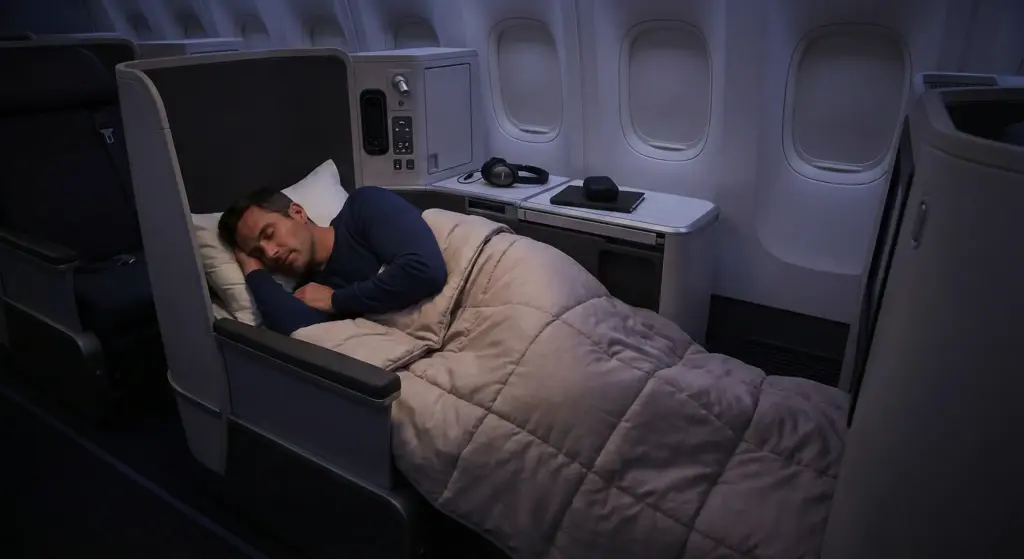
A couple of years ago, I flew to Taiwan for meetings. Long-haul overnight flight with a stop in California.
I had United points accumulated from previous trips. I also had $450 in cash I could spend. The question was: should I?
Here’s what I knew: I was landing at 6am. Hotel check-in wasn’t until 3pm. Nine hours with nowhere to go, jet-lagged, in a city I’d never been to. And I had important meetings starting the next morning.
If I flew economy, I’d arrive wrecked. Stiff. Exhausted. Unable to think clearly. Those nine hours would be brutal – too tired to explore, too uncomfortable to rest, just grinding through the day in a fog.
I decided to upgrade, using United points and $450. I flew business class on both flights: first to California, then on to Taiwan.
The flight itself was exactly what I needed. Lie-flat seat. Actual sleep. Room to move. I arrived tired but functional.
During those nine hours before check-in, I walked around, got coffee, and explored the area near the hotel. I adjusted to the local time. By 3pm, I was already used to the new rhythm and wasn’t struggling with jet lag.
The next day, I arrived at my meetings feeling alert and focused. I didn’t need to impress anyone—just to be ready and able to work.
Was spending $450 and points worth it? Definitely. The real alternative wasn’t saving money—it was showing up exhausted, doing poorly at work, and needing extra days to recover.
I upgrade when:
Long-haul overnight flight. If I’m crossing 10+ time zones and landing in the morning, sleeping on the plane is the difference between showing up functional or wrecked.
Important meetings within 24 hours. If I need to perform the day after landing, the upgrade is an investment in that performance.
No other option to rest. Like Taiwan – landing at 6am with a 9-hour wait. The upgrade covered that gap.
Here’s how I see it: What does it really cost to arrive worn out? If I’m tired, do badly in meetings, and need two days to recover, that ends up costing more than the upgrade.
Getting enough sleep is an investment, not just a luxury.
When I Don’t Upgrade (And Regret It)
On my last trip to Ho Chi Minh, I didn’t upgrade.
Not by choice. The flight was full. No upgrades available. No better routing options that fit the schedule. I was locked into the economy.
Total travel time: almost 40 hours door-to-door. Two layovers. Multiple time zones. The kind of journey that breaks you down incrementally.
The second layover was in Japan. Five hours at the airport.
Those five hours really wore me down. It wasn’t dramatic, just a slow loss of patience and focus. I was too tired to think, too uncomfortable to rest, and couldn’t get anything done.
Just five hours of sitting in uncomfortable chairs, watching the departure board, existing in that liminal space between flights.
The only thing that saved me was my Amex Platinum card. I have it through my business, and it gives me lounge access even without a business-class ticket.
I spent those five hours in the lounge instead of at the gate. There were comfortable chairs, decent food, and a quiet place to rest. It wasn’t perfect—I was still tired—but it was much better than the alternative.
Having lounge access turned a terrible situation into something just unpleasant. Without it, I’m not sure how I would have made it through that layover.
By the time I finally landed in Ho Chi Minh, I was wrecked. It took two full days to feel human again. Two days where I was physically present but mentally depleted.
That trip taught me something important: when the journey is that long and that complicated, the upgrade isn’t optional. It’s necessary.
I should have chosen a different route, maybe paid more for a direct or shorter flight, and planned better. I ended up paying for that mistake with exhaustion and lost productivity.
When I Choose the Extra Night Instead

On my first trip to Panama, I arrived a day early.
It wasn’t for rest—it was to explore. I was going to Panama for work, but I wanted to see the Panama Canal before three days of meetings took over my schedule.
I started at the Miraflores Locks in the morning. Watched massive ships pass through. Stood there for an hour just observing the engineering, the logistics, the scale of it all. The canal is the reason Panama exists the way it does. I wanted to see it.
When I was ready to leave, I hired a taxi driver—not through an app, just someone waiting outside the locks. I asked if he could show me around for a few hours.
Best $50 I’ve ever spent on a cab.
He drove me to the Bridge of the Americas first. On the way, he explained its significance – how it connects North and South America, how it was built before the newer Centennial Bridge, and why it matters to Panama’s identity. We stopped. I walked on it. The view stretched across the canal entrance. Container ships lined up in the distance. He waited while I took it in.
Then the harbor. He showed me where the container ships queue, waiting for their turn through the canal. Some of them wait for days. He explained the economics – how Panama makes money from every ship that passes through, why the canal expansion was necessary, and what it means for global trade. Not tourist information. Real context from someone who lives there.
Finally, he dropped me at the old center – Casco Viejo. Colonial buildings, narrow cobblestone streets, and history everywhere. He gave me specific recommendations. Where to walk. Where to eat. What to pay attention to.
I spent the afternoon wandering. On my way back to the hotel, I stopped at the fish market. It was crowded with locals eating at small open-air stalls and vendors selling fish straight from the boats. All the food was from that day’s catch, and you could see the boats unloading nearby.
I ate at one of the stalls. Ceviche made from fish that had been swimming a few hours earlier. Simple plastic chairs, no frills, just fresh food and the energy of a working market.
That day taught me more about Panama than any guidebook ever could. I learned not just facts, but real context—why things matter, how the city works, and what the canal means to the people who live there.
The next three days were intense work. Back-to-back meetings. Customer conversations. Deal negotiations. Then a flight home.
If I hadn’t added that extra day, the trip would have just been about getting in, working, and leaving. It would have been efficient, but forgettable. That extra night made it memorable.
That’s the trade-off: upgrades help you perform better, while extra nights help you make memories.
I chose the extra night when:
The city deserves it. If I’m flying halfway around the world to a place I’ve never been, one extra day to actually see it is worth the cost.
Family is with me. When my wife and kids are there, the extra night isn’t about sightseeing. It’s about time together that isn’t rushed.
Schedule allows. If adding a night doesn’t conflict with what’s waiting at home, it’s usually the right call.
No one remembers if you flew business or economy, but they do remember the extra day you spent together.
Hotel Points: Location Over Everything

Nuremberg, Germany. Trade show. I had hotel points to spend.
Two options: a nicer 4-star hotel farther from the center, or a 3-star hotel right next to the old city.
I chose the 3-star. Central location. Walking distance to everything.
My boss flew in the same day. We walked around the old city together. Talked work, but outside the office. Since we both love history, we visited the Nuremberg Trials Museum and the castle.
That walk changed the trip. We learned more personal things about each other. I appreciated and respected him more after that conversation. It was bonding time that wouldn’t have happened if we’d been stuck in a nicer hotel across town.
The hotel room was smaller and didn’t have as many amenities, but being in the right location gave me an experience that mattered much more than a bigger room ever could.
Location usually wins because:
Time matters more than square footage. If the hotel is walkable to meetings, restaurants, and other attractions, you save hours every day.
Friction compounds. A hotel that requires a taxi or train ride to get anywhere adds decision fatigue to every move. A walkable hotel removes that friction.
Spontaneity becomes possible. Like that walk with my boss. If we’d been 30 minutes away, it wouldn’t have happened.
Choosing the right hotel makes everything easier, and that’s more valuable than having a fancy lobby.
The Hidden Costs Nobody Calculates
When you’re deciding whether to spend extra money or points, most people calculate the direct cost. $450 for an upgrade. $200 more for a better hotel. An extra night at $300.
What they don’t calculate:
Decision Fatigue
Every choice you make while traveling drains mental energy. Where to eat. Which route to take? How to get from the hotel to meetings. Those decisions compound.
A hotel in a walkable location eliminates dozens of micro-decisions per day. That mental energy is redirected to work and family rather than logistics.
Recovery Time
A cheaper flight with two layovers might save you $300, but if you arrive exhausted and need three days to recover instead of one, you’re not really saving. That’s a hidden cost in lost time.
Coming home tired affects your work, your family, and even your next trip. Sometimes, the pricier option that keeps you rested actually saves you more in the long run.
Performance Degradation
Show up to meetings jet lagged and foggy, and you’re not performing at your level. You miss details. You make worse decisions. You’re less persuasive.
What’s the real cost of not performing your best? It’s probably higher than the price of the upgrade you didn’t buy.
Emotional Depletion
Travel takes an emotional toll. The isolation. The stress. The constant low-level friction of being in unfamiliar places.
Sometimes, spending a bit more helps ease that stress. An extra night can make the trip feel less rushed. An upgrade helps you arrive rested. A better location keeps you from feeling stuck.
These aren’t luxuries. They’re investments in showing up as yourself, not a depleted version.
The Programs I’m Actually Loyal To (And Why)
I don’t worry about getting the most out of every point. I travel a few times a year, so keeping things simple is better than trying to maximize everything.
United Airlines
Hub convenience. I’m near a United hub, so most of my routes go through them. I’m not optimizing across five airlines. I fly United consistently and accumulate points without thinking about it.
Hilton Honors
Reliable coverage in the cities I visit. Not the flashiest program, but Hilton is usually there. I know what I’m getting. The points accumulate. I use them when it makes sense.
Amex Platinum
I have this through my business. The lounge access has saved me multiple times – like that five-hour layover in Japan. The points transfer to airlines and hotels when needed.
That’s all I use: one airline, one hotel chain, and one credit card. It keeps things simple.
I don’t keep track of five programs, move points around, or try to get the best deal every time. That’s a hobby, and I don’t have time for it.
If you travel all the time, optimizing might make sense. But if you only travel a few times a year, sticking with a few programs that fit your needs is enough.
The Dad Math Formula
To guide my travel-related decisions regarding points, expenditures, or additional arrangements, I apply the following four-question framework:
This structured approach enables consistent and effective evaluation of potential travel options.
1. Does this protect my energy?
Will I arrive more functional? Will I perform better at work? Will I come home less drained?
2. Does this protect shared memory?
If family is involved, will this create a moment that matters? Will we remember it?
3. Does this reduce friction?
Will this save time, stress, or decision fatigue? Is the cheaper option actually more expensive in hours lost?
4. Will I regret not doing it?
This is the gut check. If the answer is yes, that tells you something.
If two or more of these are true, I consider spending the money or points. If none are true, I skip it.
This system isn’t perfect, but it’s easy to use and helps me focus on what really matters instead of chasing the wrong goals.
How This Actually Works (Taiwan Example)
Let me show you the framework in action with a real decision.
Taiwan flight. I had United points accumulated. The upgrade would cost those points plus $450 cash. Worth it or not?
Question 1: Does this protect my energy?
Yes. Landing at 6am with a 9-hour wait until hotel check-in. If I arrive wrecked in economy, those 9 hours will be brutal. If I sleep on the flight, I can actually function during that gap. Important meetings start the next day – I need to show up sharp.
Question 2: Does this protect shared memory?
No. Solo work trip. Family isn’t involved.
Question 3: Does this reduce friction?
Yes. Huge friction reduction. If I land exhausted, that entire first day is wasted. I’ll be foggy, unproductive, just trying to survive until check-in. The upgrade eliminates that friction completely – I arrive functional and can use those 9 hours productively.
Question 4: Will I regret not doing it?
Absolutely. If I show up to important meetings jet-lagged and perform poorly because I saved $450, I’ll regret that decision immediately.
Result: 3 out of 4 questions are yes.
Given that three out of four criteria from the Dad Math framework are met, allocating both the points and $450 is justified. This decision illustrates how the broader system provides clear, consistent guidance for making travel choices that align with personal and professional priorities.
This framework doesn’t make every decision easy, but it does make most choices clearer. It also helps you avoid saving money at the cost of your energy, performance, or memories.
Why Simple Beats Optimal
I could try to get the best deals by tracking five airline programs, hotel promotions, and transfer bonuses. I could spend hours figuring out the best way to use my points for every trip.
But that’s a hobby, and I just don’t have time for it.
If you only travel a few times a year, keeping things simple is better than trying to optimize everything. It’s better to stick with programs that fit your travel needs than to chase the perfect deal.
I use United, Hilton, and Amex Platinum. That’s it. Points add up on their own, and I use them when it makes sense. I don’t waste time tracking every detail or trying to game the system.
The Dad Math formula works because it’s simple and easy to use. Just ask four questions, and if two or more are true, it’s worth spending. That’s the whole system.
It’s not perfect, but it’s good enough—and that’s exactly what you need for occasional business travel.
Travel math isn’t about getting the most out of every dollar or point. It’s about spending on what really matters.
Upgrades help you perform better, extra nights help you make memories, the right location makes things easier, and loyalty keeps decisions simple.
Ultimately, Dad Math represents a pragmatic approach to travel decision-making that prioritizes well-being, relationships, and effectiveness over purely financial considerations. By focusing on what genuinely enhances the travel experience, this framework encourages intentional choices that are both meaningful and sustainable.
Related posts:
→ Jet Lag Is Easy — Performing Like a Human Is the Hard Part
→ Why I’m Finally Bringing My Family on a Work Trip
→ The 2-3 Trips a Year Dad: How to Travel for Work Without Losing Your Edge
I write about this regularly.
Practical systems for dads who travel occasionally and want to stay sharp at work, connected at home, and not burned out in between.
Key takeaways
- The rule is two yeses. Ask: protects my energy, protects a shared memory, reduces friction, will I regret not doing it. Two or more yes answers means spend the money or points.
- Optimize for energy, time, and shared experience — not the lowest fare or the biggest points haul. Arriving functional beats arriving cheap.
- The upgrade test is 10+ time zones landing in the morning. That’s when sleeping on the plane is the gap between showing up functional or wrecked. The Taiwan upgrade (points plus $450) earned it; the 40-hour Ho Chi Minh economy slog cost me two full days of productivity.
- An extra night can be the best money you spend. One added day in Panama bought Casco Viejo and the locks before the work grind. The 3-star central hotel in Nuremberg beat the nicer 4-star out of town because it put me where the bonding happened.
- Keep loyalty stupid-simple. United for the hub, Hilton Honors for coverage, Amex Platinum for lounges. Chasing perfect deals across programs is a hobby, not a strategy.
- If you only travel a few times a year, simple beats optimal. The hidden costs — decision fatigue, recovery time, jet-lagged performance — are real, and they don’t show up on the receipt.
FAQ
When is a flight upgrade actually worth the money?
When two of the four dad-math questions come back yes — and especially when you’re crossing 10 or more time zones and landing in the morning. That’s when sleeping on the plane is the difference between showing up functional or wrecked. My Taiwan upgrade (points plus $450) paid off because I landed able to work through a 9-hour gap before check-in.
Should an occasional business traveler chase points across multiple loyalty programs?
No. If you only travel a few times a year, simple beats optimal. I stick to United for the hub, Hilton Honors for coverage, and Amex Platinum for lounge access. Chasing perfect deals across programs is a hobby — it costs you decision fatigue you don’t need.
Is paying for an extra night or a pricier hotel worth it?
It depends on what it buys. An extra night in Panama bought real memories — the Miraflores Locks, Casco Viejo, the fish market — before the work started. But pricier isn’t automatically better: in Nuremberg I picked a 3-star central hotel over a nicer 4-star farther out, and being in the middle of things led to a spontaneous walk with my boss. Location beat luxury.
📍 Part of: Bleisure & the Traveling Dad.