
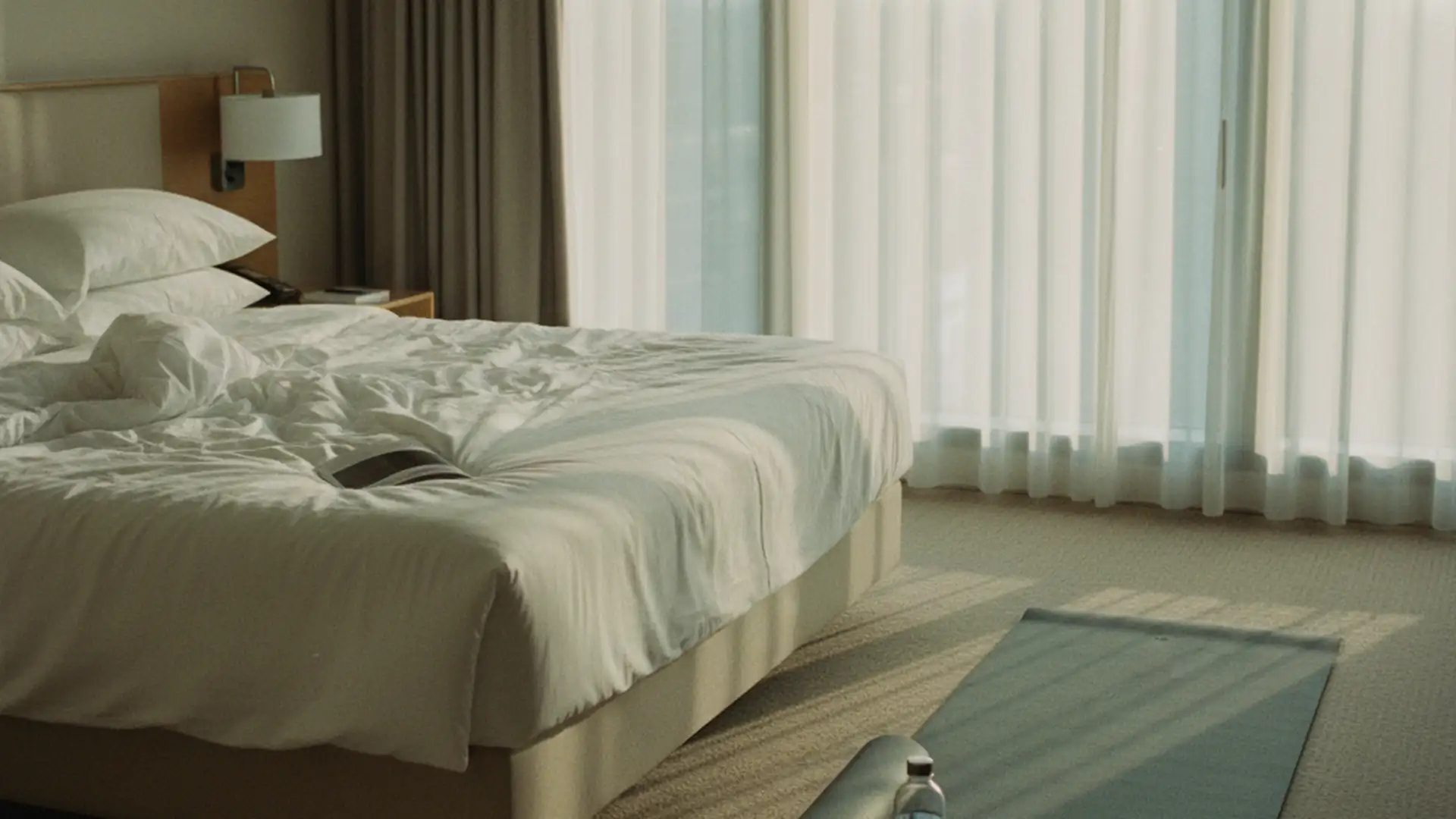
Short answer: My hotel room workout is 20 minutes, no equipment: 3 minutes warm-up, 8 minutes strength (push-ups, bodyweight squats, plank — 30 seconds work, 15 rest, three rounds), 5 minutes cardio (mountain climbers and jumping jacks, or slow burpees), and 4 minutes of stretching. The trick isn’t the moves. It’s removing the decision so you actually do it.
I’m not a fitness influencer. I’m a dad who travels for work. Here’s the 20-minute, no-equipment hotel room workout I’ve actually done on more than 100 trips — and the easier version I do on the mornings I’m half-broken.
Why a Hotel Workout Is the Hardest Workout
The hotel workout is harder than the home workout, and not for the reason you’d think.
It’s not the limited space. It’s not the lack of equipment. It’s not the carpet that’s a little weird underfoot.
It’s the decision-making. Every morning on the road, you wake up tired, possibly jet-lagged, definitely under-slept, and your brain proposes a hundred reasons why “today’s not the day to work out.” You have a 9 AM meeting. The flight was rough. The room is small. The towels are scratchy. You’ll do it tomorrow.
By the third day of “tomorrow,” the trip is over and you haven’t moved. By the fifth trip in a row of skipping the workout, you’re in worse shape than you were a year ago.
The fix isn’t a better routine. The fix is removing decisions. The system below is what I use to keep the decisions out of the morning, so the workout just happens.
The Three Rules That Make This Work
Before any specific exercises, three rules:
1. Same time, every trip. Within 20 minutes of waking. Brush teeth, drink a glass of water, change into the gear I packed last night, start. No checking email first. No “let me just see what time the meeting starts.”
2. The shorter version is always available. If I’m exhausted, I do 10 minutes instead of 20. If I’m crushed, I do 5. The workout I will not skip is the one with a guaranteed minimum that’s always too small to skip.
3. Pack the gear last, unpack it first. I put my workout shorts and shirt in the carry-on last, so they’re the first thing I see when I open the bag. The visual cue helps the next morning.
These three rules are the actual workout. The exercises matter less.
The 20-Minute Routine
The routine itself, in priority order. If I run out of time, I do the first three blocks and stop. If I have extra energy, I add the fourth.
Block 1: Warm-up (3 minutes).
- 30 seconds — slow jumping jacks
- 30 seconds — leg swings (15 each leg)
- 30 seconds — arm circles, both directions
- 30 seconds — bodyweight squats, slow
- 30 seconds — hip openers (deep squat, slowly opening hips)
- 30 seconds — gentle spine twists, standing
The warm-up is the secret weapon. It tells my body that the workout is starting, eases the joints, and prevents the small injuries that can sideline a trip.
Block 2: Strength (8 minutes).
Three exercises, three rounds, 30-45 seconds each:
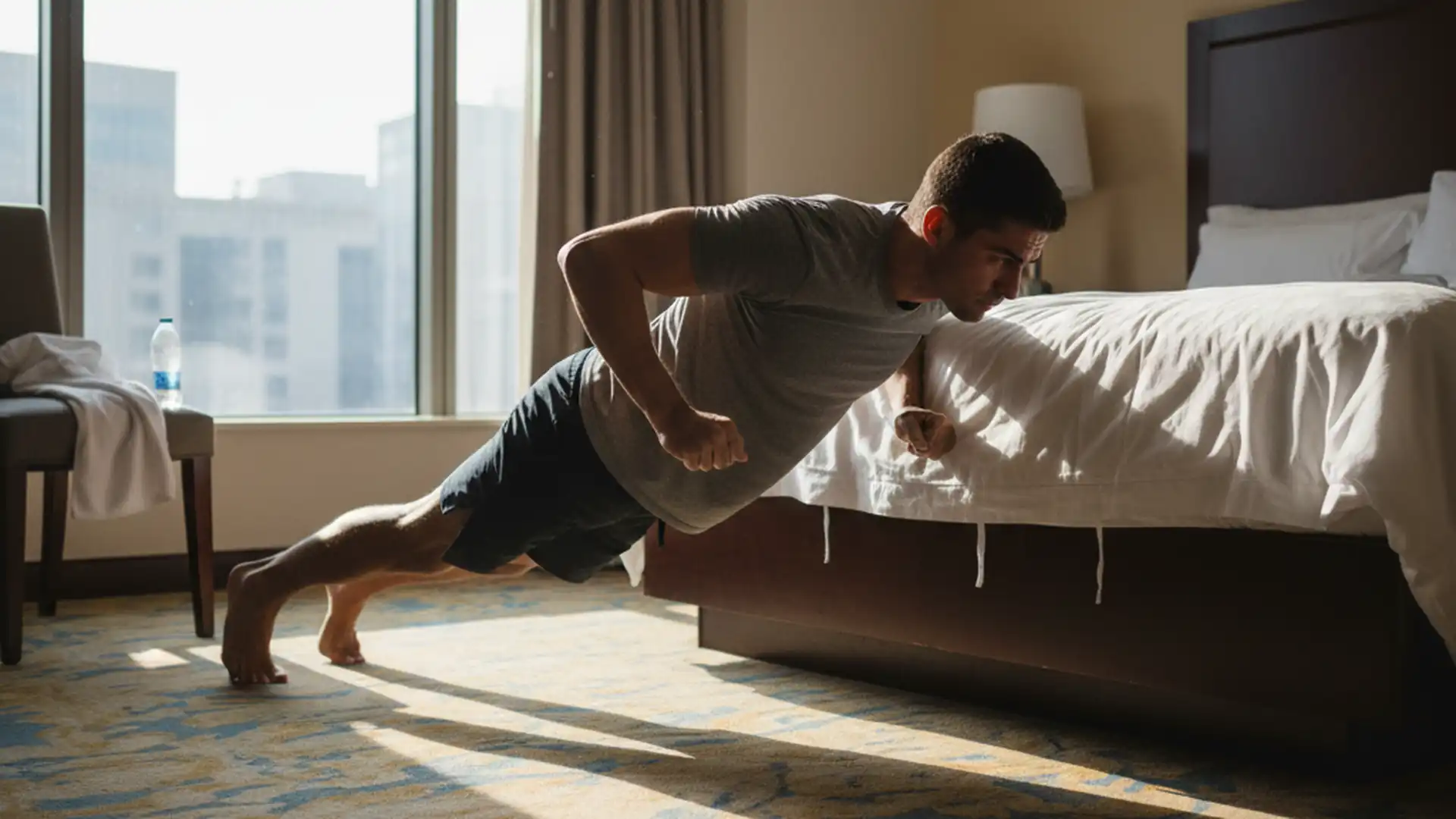
- Push-ups (modified to knees if needed)
- Bodyweight squats (or split squats if there’s space and energy)
- Plank (or side planks alternating)
30 seconds work, 15 seconds rest, three rounds. That’s 8 minutes including the rest.
The point of these three: they hit the largest muscle groups, they require zero equipment, they fit in a 6-by-3-foot space, and they can be modified easily. Push-ups can be on knees, against a wall, or full. Squats can be slow or jumping. Plank can be 15 seconds or 60.
Block 3: Cardio (5 minutes).
One of these, depending on my energy:
- Mountain climbers + jumping jacks intervals. 30 seconds each, alternating, for 5 minutes. Effective.
- Burpees, slow. 5 minutes of slow, controlled burpees. Brutal.
- Stairs. If the hotel has accessible stairs, walking up and down for 5 minutes. Best option when available.
Five minutes of cardio in a hotel room makes a real difference even when it feels like nothing while you’re doing it.
Block 4: Cool-down and stretch (4 minutes).
- 30 seconds — child’s pose
- 30 seconds — pigeon stretch (each side)
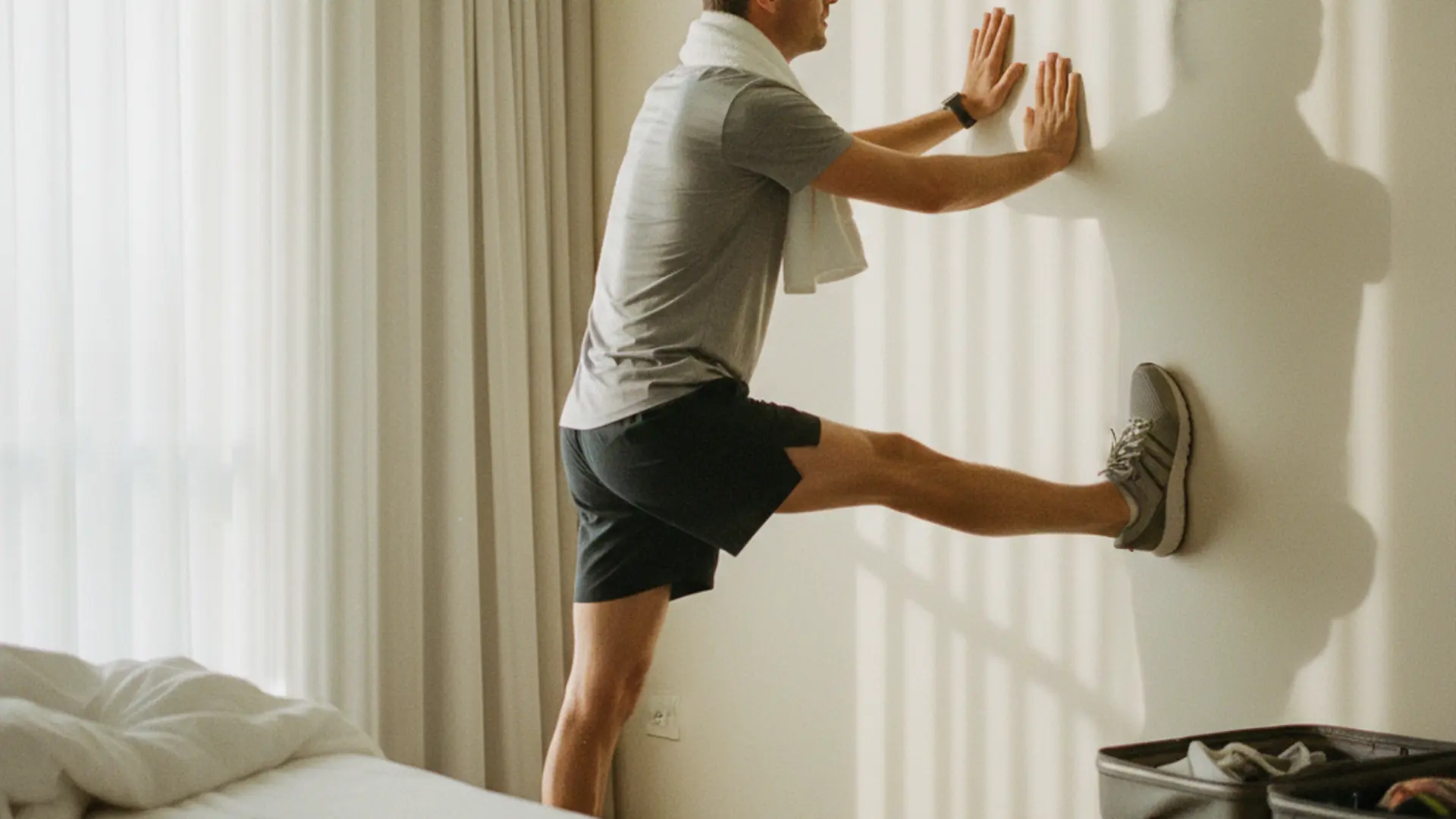
- 30 seconds — hamstring stretch (each leg)
- 30 seconds — chest stretch in doorway
- 30 seconds — neck rolls
- 30 seconds — deep breathing, eyes closed, standing or seated
The cool-down is what I most often skip when I’m rushed. It’s also what I most regret skipping by the end of the day. Five minutes spent here saves the lower back from the long flight a day later.
The 10-Minute Version (For Bad Mornings)
Some mornings 20 minutes is not happening. The 10-minute version:
- 2 minutes — quick warm-up (jumping jacks, arm circles, squats)
- 4 minutes — strength: push-ups, squats, plank — 30 seconds each, two rounds
- 2 minutes — mountain climbers
- 2 minutes — stretch and breathe
Ten minutes. Heart rate up. Body warm. I’ve left the room moving better than I entered it. That’s the win.
The 5-Minute Version (For Crushed Mornings)
The mornings when I really shouldn’t but I will:
- 1 minute — bodyweight squats, slow
- 1 minute — push-ups (any form)
- 1 minute — plank
- 1 minute — jumping jacks
- 1 minute — stretch and deep breathing
Five minutes. It’s almost nothing. It also keeps the chain unbroken — the chain that says “I work out on every trip, even on the bad days.” The 5-minute version is mostly a discipline tool. The actual fitness gain is small. The fitness gain over a hundred trips is large.
The Equipment I Don’t Bring (And Why)
Resistance bands, jump ropes, mini-yoga-mats — I’ve tried all of them. I don’t bring any of them anymore.
The reasons:
- The bands take up bag space and I forget them in hotel rooms
- The jump rope works in some rooms and not others — too many ceilings are too low
- The mini yoga mat is uncomfortable and slips on hotel carpet
- The honest workout doesn’t need them
What I do bring: one pair of running shoes (already worn, no extra space), one workout shirt, one pair of shorts. That’s it. The shirt and shorts go into the bag last, near the top.
When the Hotel Has a Gym (And You Should Use It)
Some hotel gyms are excellent. Most are mediocre. A few are actively bad — three machines facing a wall, no air conditioning, smelling of carpet glue.
The rule I use: if the gym has a treadmill, use it. The treadmill alone justifies any gym. A 25-minute treadmill walk-jog at moderate pace is significantly better than the bodyweight workout, and the difference in fitness over a year is real.
If the gym has only weight machines I don’t recognize and no treadmill, I do the bodyweight workout in my room. The hassle of figuring out an unfamiliar machine in 25 minutes isn’t worth it.
Outside Options
Some cities reward leaving the hotel for the morning workout:
- Tokyo. The morning walk through any neighborhood is its own meditation. I’ve covered this in the broader Tokyo guide. Add a small park run if you want more.
- Singapore. The river path along the Singapore River, or the Botanic Gardens early morning, is genuinely beautiful and runnable.
- European cities. Most have river paths, parks, or pedestrian streets that work well early. The Main in Frankfurt, the Seine in Paris, the canals in Amsterdam.
- US cities. Highly variable. Some are great (Chicago lakefront, San Francisco’s Embarcadero). Some are not (anywhere along an interstate).
If the hotel is near something runnable, I run. If not, the room workout is the default.
The Recovery Mindset
One thing that took me years to learn: the workout on the road isn’t about progress. It’s about not losing ground.
I’m not going to break personal records on a Tuesday morning in a Munich hotel room. I’m going to maintain. I’m going to keep my body in the version of itself that’s familiar to me, despite the disrupted sleep, the heavy meals, the long flights.
That mindset shift removed a lot of pressure. The workout doesn’t have to be hard. It has to be present. Twenty minutes of breathing hard, sweating slightly, stretching at the end — that’s the deliverable. The rest takes care of itself when I’m home.
This is the same reason I lean into eating reasonably on the road rather than trying to “diet” while traveling. Maintenance, not progress. Don’t lose what you’ve already built.
The Mental Side
The workout matters for fitness, but it matters more for what comes after.
By the time I’ve finished the 20 minutes — sweat, shower, breakfast — I’ve already made one good decision before the day’s first meeting. I’m awake. My body has moved. The jet lag is dimmer. My head is clearer.
The day after a workout starts at a higher baseline than the day after a skipped workout. Even if the workout was 5 minutes. Even if it was a bad workout. The fact of having done it is more important than the quality.
This is the dad-on-the-road version of the broader sleeping on planes without pills piece — small disciplines that compound. The workout is the daily one. The plane sleep is the per-flight one. Together they’re the difference between arriving like a person and arriving like a survivor.
What I Did Wrong for Years
Mistakes I made early in my business travel career:
- Over-ambitious routines. I’d plan a 60-minute workout, fail to do it, feel bad, skip the next day. The 20-minute version is more realistic and actually gets done.
- Waiting for “good” hotels. I’d skip workouts in hotels with small rooms or no gyms. The room is fine. The carpet is fine. Just go.
- Workout shame. I’d avoid the gym because I felt out of shape next to the in-shape regulars. Nobody cares. Show up.
- Skipping when I was tired. Tired is the default state of business travel. If I only worked out when I felt fresh, I’d never work out.
- Treating it as optional. The workout is part of the trip. Same as the meetings, same as the dinner. Non-negotiable doesn’t have to mean intense.
Putting It All Together
The summary, for the dads who don’t want to read the whole thing:
- Pack workout gear at the top of the bag
- Wake up, put it on, start within 20 minutes — no email first
- 20 minutes if you can, 10 if you can’t, 5 if you really can’t
- Same three exercises every time: push-ups, squats, plank, plus some cardio
- Stretch at the end
- Shower, eat, go to work
That’s the whole thing. Six bullet points. They’ve kept me functional through more than 100 trips. They will not turn anyone into an athlete. They will keep you from falling apart on the road, which is a much more useful goal.
The Bigger Frame
The hotel workout is one piece of the broader work of staying functional through frequent business travel. Sleep matters more. Diet matters about the same. Rest days matter. None of it works without the others.
But the workout is the easiest of these to control completely. Sleep depends on flight schedules and time zones. Food depends on what’s available. The workout depends on whether I get out of bed twenty minutes earlier than I have to.
That’s a controllable thing. So I control it. The rest of the trip benefits.
Combined with packing systems out of the 24-hour pre-flight checklist and the calmer arrival those produce, the workout becomes part of a longer routine that protects the trip from the cumulative damage of constant travel.
You don’t have to be in great shape to do this. You just have to do it. Twenty minutes. Most days. That’s the whole game.

Title: How I sleep on planes without pills
The workout helps you arrive in shape. The flight is the other half of the equation. Here’s how to sleep through it without chemistry.
Inside:
- The bedtime discipline that beats sleep aids
- Why I stopped using meditation apps on flights
- The two pieces of gear I never fly without
Key takeaways
- Twenty minutes, four blocks: 3 min warm-up, 8 min strength, 5 min cardio, 4 min cool-down. No bands, no jump rope, no mat — I don’t pack any of that anymore.
- Strength is three moves, three rounds: push-ups (drop to knees if needed), bodyweight squats (or split squats), plank (or side planks). Thirty seconds work, fifteen rest.
- Cardio, pick one: mountain climbers and jumping jacks alternating for 5 minutes, slow controlled burpees for 5 minutes, or stairs if the hotel has them.
- Remove the decision: same time every trip, within 20 minutes of waking. Deciding when and what is what kills the workout, not the room or the gear.
- Have a shorter version ready: a 10-minute and a 5-minute option, so a bad morning still gets something done.
- Aim for maintenance, not progress. On the road you’re holding the line, not setting records. The only gear required is shoes, a shirt and shorts you already packed.
FAQ
Do I need any equipment for a hotel room workout?
No. I used to haul bands, a jump rope and a yoga mat — I don’t bring any of them anymore. The whole routine runs on bodyweight. All you need is running shoes, a workout shirt and shorts, which are already in your bag.
What if I don’t have a full 20 minutes?
Keep a shorter version ready. There’s a 10-minute cut (2 min warm-up, 4 min strength over two rounds, 2 min mountain climbers, 2 min stretch) and a 5-minute version: one minute each of slow squats, push-ups, plank, jumping jacks, then stretch and breathe.
Should I just use the hotel gym instead?
If there’s a treadmill, use it. Otherwise do the room workout. The point isn’t finding the perfect gym — I wasted years waiting for that. The room workout removes the excuse, because it works in any room.