

Short answer: You’re not trying to lose weight on the road. You’re trying not to gain it. The rule that holds the whole thing together: one indulgence per day, no more. Eggs and protein before carbs at breakfast, don’t skip lunch, skip the bread basket at customer dinners, leave the mini-bar shut, and drink your water. That’s it.
I gained 11 pounds in my first year of frequent business travel. The hotel breakfast buffet, the heavy customer dinners, the airport snacks all conspired. Here’s the boring system I use now to come home roughly the same shape I left.
The Year I Got Heavier on the Road
2017. I had just transitioned from a domestic role into one with regular international travel. Eight or nine trips a year, mostly week-long. By the end of the year I’d gained 11 pounds and didn’t fit into two of my suits.
It wasn’t one bad meal that did it. It was the cumulative effect of small choices, repeated:
- Two croissants and a yogurt at every hotel breakfast (instead of just one croissant)
- An extra glass of wine at every customer dinner (instead of stopping after one)
- A snack at the airport while waiting for the flight (chips, a pastry, a cookie)
- Dessert when the customer ordered dessert
- “Why not” with the bread basket
- Skipping breakfast on the day I felt heavy from the night before, then overeating at lunch
None of these alone is a problem. Together, three or four times a week, they add up. By June I’d gained four pounds. By December, eleven.
The wake-up wasn’t the scale. It was a customer dinner where the customer’s wife — a doctor who I’d met twice before — said warmly, “you look tired, are you traveling more?” She wasn’t being rude. She was being kind. But the comment registered.
The system below is what I built between January and June of 2018 to not gain another 11 pounds in 2018, and not in any year since. It’s not glamorous. It works.
The Single Most Important Rule
Maintenance, not progress.
I’m not trying to lose weight on the road. I’m not doing macros, calorie counts, or fasting protocols. I’m trying to come home roughly the same shape I left.
This shift in framing changed everything. Instead of “the trip is a chance to keep my diet” or “the trip is a write-off, I’ll restart Monday,” I started thinking: “the trip is a maintenance phase. Don’t lose ground. Don’t try to gain ground.”
That mindset removes the all-or-nothing trap. The Tuesday dinner isn’t a “diet day” or a “cheat day.” It’s just a Tuesday dinner that I’m going to eat reasonably.
Hotel Breakfast: The First Battle
The hotel breakfast buffet is where most road weight is gained. It’s free, it’s varied, it’s there every morning, and the portions feel small even when they aren’t.
My rules for the buffet:
- Eggs and protein first, carbs second. A plate with eggs, some fruit, and a small piece of bread is fundamentally different from a plate with two pastries, juice, and a yogurt. I default to eggs.
- One pastry maximum, only if it’s good. Not “two of these little ones.” One pastry, and only if the bakery section actually looks fresh. Most hotel pastries are not worth eating.
- Fresh fruit, plenty. Fruit is essentially infinite at hotel buffets. Use it.
- Coffee, not juice. Hotel orange juice is mostly sugar water. I drink coffee, water, and one small glass of fresh juice if there is any.
- One plate, not two. Walk through the buffet once. Take what you want. Sit down. Don’t go back for “just a little more.”
The breakfast plate I aim for: 2-3 scrambled eggs (or an omelet), a couple of slices of fruit, one small piece of toast or one pastry. That’s it. Maybe 500 calories instead of 1200.
Lunch: The Forgotten Meal
Lunch on a business trip is usually one of three things: a quick meal between meetings, a long meal with a customer, or skipped entirely.
For the quick meal: I look for soups, salads, sandwiches with lean protein, simple bowls. The temptation to grab a burger and fries is real, especially when I’m tired. Resisting it once a day is the difference between maintenance and weight gain.
For the customer lunch: I follow the customer’s lead. If they order an appetizer, I order one (small). If they have wine, I might have one glass. If they order dessert, I split or skip.
For the skipped lunch: I don’t skip. The skipped lunch becomes the overindulgent dinner. Better to eat a small lunch — a salad, a soup, half a sandwich — than to “save room” for dinner. The savings never materialize.
The Customer Dinner: Where Most Damage Happens
The business dinner is unavoidable on most trips. It’s also where the cumulative caloric load can be enormous: appetizers, bread, multiple courses, wine, often dessert and digestifs.
The system I use:
1. Skip the bread basket. Bread before food is the easiest 400 calories to cut. The bread is rarely good enough to be worth it. I let the basket sit.
2. Order a starter that’s vegetable-forward. Salads, soups, vegetable preparations. Save the appetite for the main course.
3. Order the main course you want most, eat reasonable portions. Whatever it is. Don’t feel guilty about a steak if that’s what you actually want. Just don’t eat all of it if it’s enormous.
4. One glass of wine, sometimes two, never three. The third glass is where the calories pile up and where I make worse food decisions. The two-glass rule has held up for years.
5. Skip dessert when possible. If everyone is ordering dessert and the customer has insisted, I share or take a few bites. The full plate of tiramisu after a three-course meal is not necessary.
This approach lets me participate fully in the dinner — meaning, in the relationship-building part — without absorbing the full caloric content of every course. The customer doesn’t notice. The relationship is fine. The waistline is fine.
The drinking part of customer dinners is its own conversation, especially in East Asia. Business dinner drinking etiquette covers that one specifically — but the underlying principle is the same: pace, not abstain.
Snacks and the Airport
Airports are the most expensive places to eat poorly. The food is mediocre, the prices are doubled, and the temptation to grab “just something” while waiting is constant.
What I do:
- Eat before going to the airport. Real meal at the hotel or near the office. Don’t depend on the airport for food.
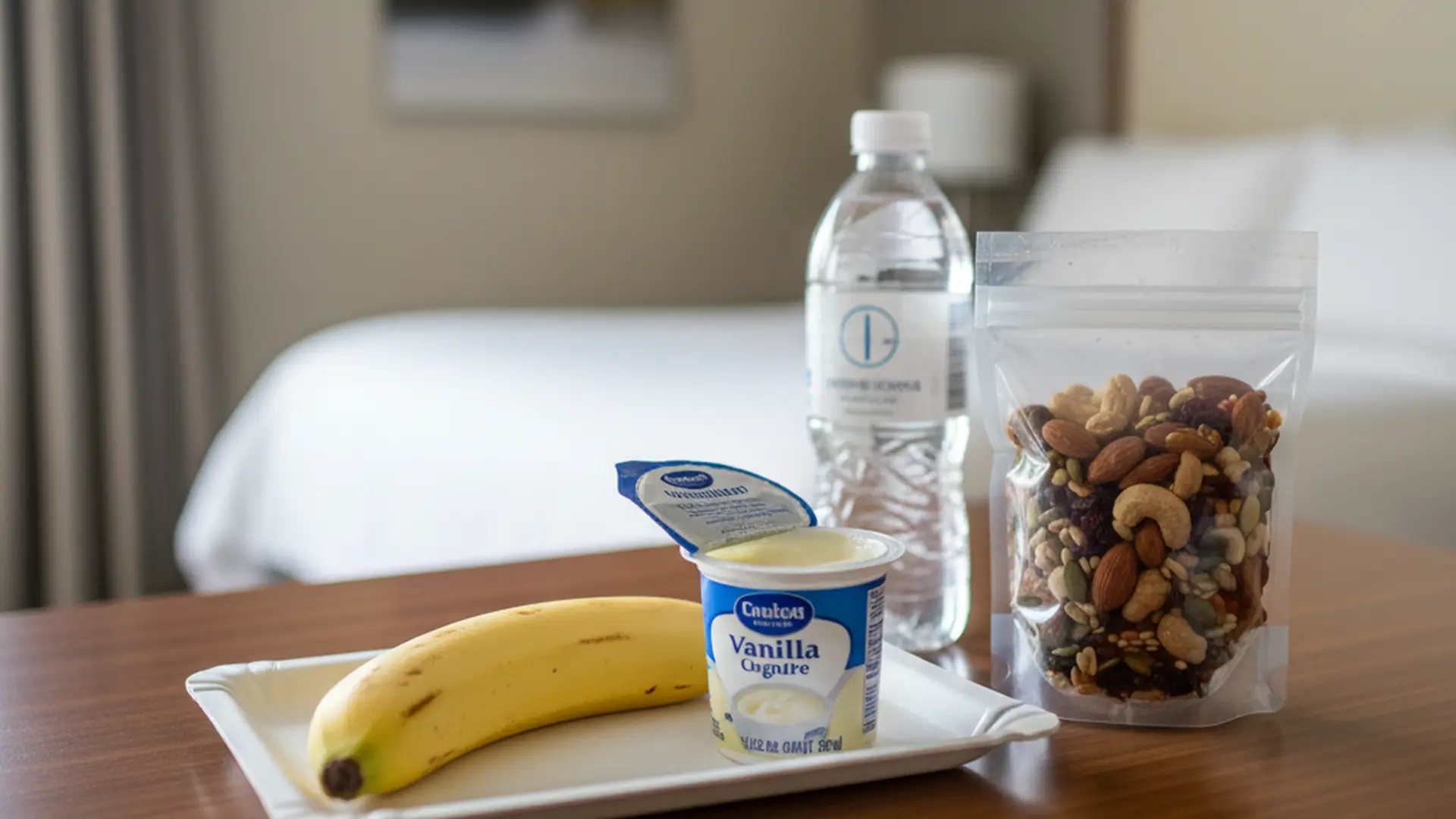
- Pack snacks. A protein bar, a small bag of nuts, a piece of fruit. They take no space and prevent the desperate purchase of a $14 mediocre sandwich.
- Water bottle, refill at the airport. The cabin air dehydrates you. Don’t pay $5 for a bottle of water you’ll drink in 20 minutes.
- One coffee. One. Not three Starbucks visits while waiting four hours.
The airport rule of thumb: spend less than $20 on food and drink each direction. If I’m spending more, I’m probably overeating.
Hotel Mini-Bar: Just Don’t
The hotel mini-bar is a tax on tired people. The Pringles are $9. The Toblerone is $11. The diet coke is $7.
I don’t open it. The mini-bar is sealed in my mental “do not engage” category. I bring my own water. I bring my own snacks. The mini-bar charges accumulate fast and the food is never worth what’s charged.
If I genuinely need something at 11 PM, I go to a 24-hour grocery store or convenience store. Most cities have them within a 10-minute walk of the hotel.
Hydration Is Half the Battle
The single biggest non-food behavior change I made: drinking more water.
Travel dehydrates you constantly. The cabin air, the time zone changes, the heavy meals, the wine — all of these conspire. The dehydration shows up as hunger more often than as thirst, leading to overeating that wouldn’t have happened if you’d just had a glass of water.
My rule: a full bottle of water in the morning, two more during the day, one with each meal, and one before bed. Maybe 3 liters total. I notice the difference within a day.
This also helps with sleep on planes — see the 20-minute hotel room workout for the broader morning routine that the hydration plays into.
The Local Food Trap
One specific trap: thinking “I have to try the local cuisine on every meal.”
I love food. I want to try local specialties. But “trying the local cuisine” can become a license to overindulge — three tacos a meal in Mexico City, two pastries a day in Paris, full hot pot with all the meats in Beijing.
The compromise I use: one local-cuisine indulgence a day, in moderation. Not three. The other meals are simpler and more controlled. The trip still gives me a real experience of the food without becoming a cumulative caloric disaster.
This also lets the indulgences register more. The Tokyo ramen is more memorable when it’s the one really memorable food experience of the day, not the sixth distinct cuisine I’ve tried.
Light Dinner When I’m Free
On nights when I’m not at a customer dinner — maybe one or two nights per week-long trip — I eat light.
The default I use:
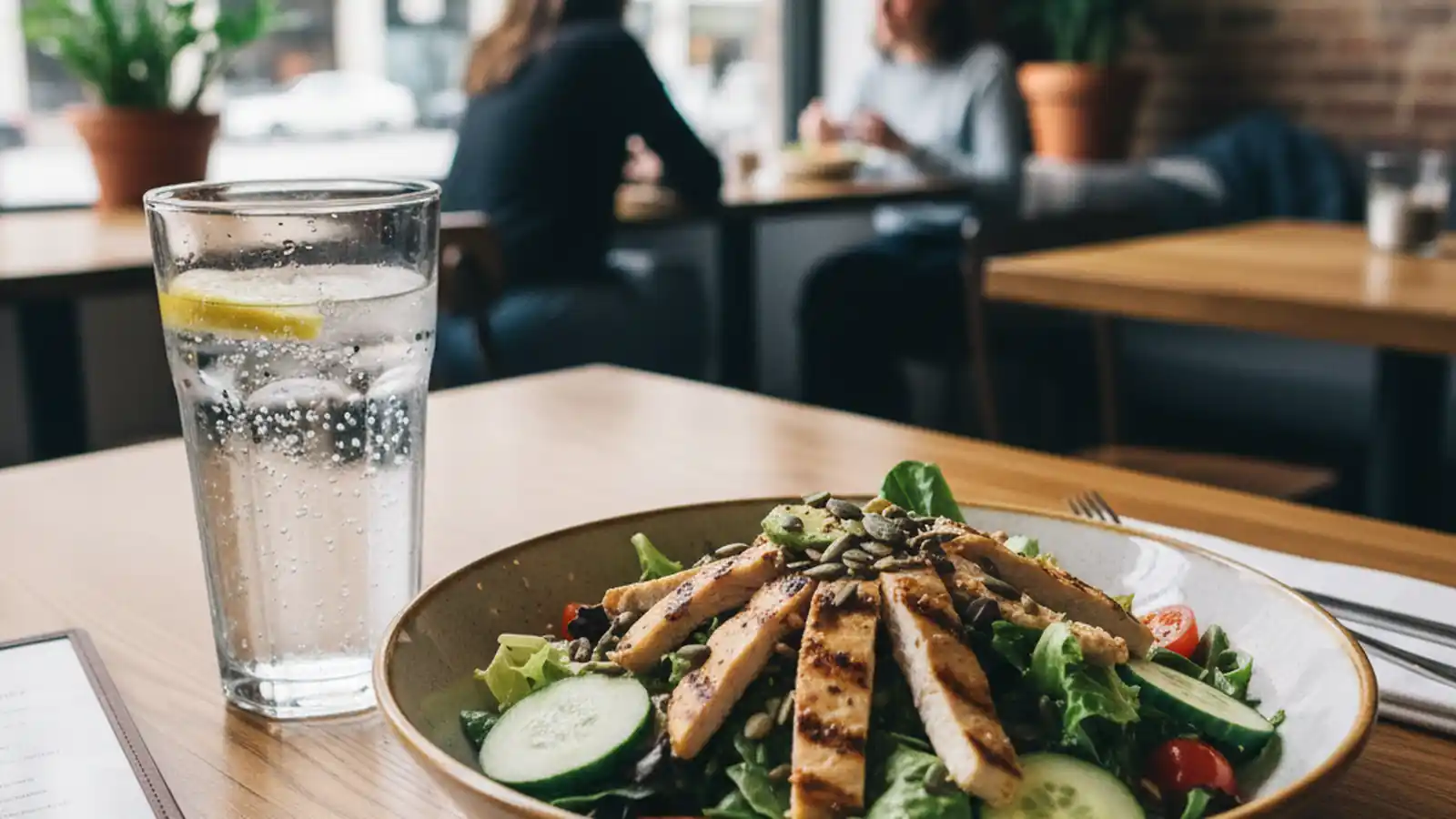
- A salad with grilled protein
- A simple soup
- A small plate of sushi
- A bowl of vegetables and rice
Nothing dramatic. The point is to give my body a break from the heavier meals on either side of the free night.
This is also where I avoid the temptation to “go big” because the night is “mine.” The treat-night version of business travel — three drinks at the hotel bar, room service burger, ice cream — adds up fast. Quiet nights are also rest nights.
When I Have Real Dietary Restrictions
Different from preferences — covered separately in dietary restrictions abroad — but worth a brief mention here. Allergies, religious restrictions, real medical needs are not in the “maintenance” frame. They need their own conversation, in advance, with the host or organizer. This article is about preferences and patterns, not non-negotiable medical needs.
Tracking, Or Not
I do not count calories on the road.
I tried, briefly, in 2018. It didn’t last. The cognitive load of logging every restaurant meal, every airport snack, every airline serving was too much on top of the already-high cognitive load of the trip itself.
What I do instead: I weigh myself the morning before I leave and the morning after I get back. If I’m up by more than 2 pounds, I tighten the controls on the next trip. If I’m flat or up by less than 2, the system is working.
That’s all the tracking. Not glamorous. Effective.

The Recovery Day
The first day home matters. The temptation, after a week of dinners and airport food, is either to “treat yourself” with one more big meal or to overcorrect with a fast or a hard workout.
I do neither. Day one home is just normal. A normal breakfast. A normal lunch. A real, family-style dinner. A solid workout the next morning. By day three home, the trip is metabolically gone.
The “punish yourself for the week” approach doesn’t work for me. The trip’s caloric load isn’t undone by a Monday salad. It’s undone by going back to a normal, slightly-attentive eating pattern at home and letting the weeks compound.
What Actually Stays Off
The 11 pounds I gained in 2017 didn’t all come back off the next year. I lost about 7 pounds in the first half of 2018, with the help of the system above plus regular exercise at home.
The remaining 4 pounds turned out to be permanent. Not because I’m not trying — but because I genuinely had been a few pounds underweight in my early 30s and the road life nudged me into a more reasonable range. So I made peace with that and kept the system focused on stopping further gain.
That’s six years now. I haven’t gained more. The system isn’t optimal. It’s just durable.
The Bigger Idea
Healthy eating on the road isn’t really about food. It’s about not letting the small daily compromises accumulate into big quarterly damage.
The business traveler version of “eating healthy” looks unimpressive in any individual meal. A small breakfast. A simple lunch. A reasonable dinner with one glass of wine. No snacks at the airport. No mini-bar raids. No skipped meals followed by overcompensation.
None of this is dieting. None of this requires logging anything. None of this prevents you from enjoying the local food, the customer dinners, the trip itself.
It just keeps the trip from quietly ruining your year. Which, when you do this enough times, is the whole game.
Combined with the 20-minute hotel room workout, the food side of the well-being puzzle covers most of what you need. The rest is sleep, hydration, and not letting the trip be an excuse to drift away from the version of yourself you want to be at home.
That last part is the harder problem, and it lives in the conversation I have with my wife from 6,000 miles away. It’s a different kind of well-being. Worth its own piece.

Title: Calling home from a different time zone
Food is one trip leg. The harder one is the marriage 6,000 miles away — here’s how I keep that one healthy too.
Inside:
- The check-in rhythm that works across time zones
- Why the daily call is the wrong default
- How to be present at home even from a hotel
Key takeaways
- Goal is maintenance, not progress. I stopped trying to lose weight on trips and just stopped gaining it. That mindset shift did most of the work.
- One indulgence a day. Pick it. The single most important rule. One pastry, one local dish, or one extra glass of wine. Not all three.
- Breakfast: protein first, carbs second, one plate. Two or three eggs, some fruit, one piece of toast or one pastry. Coffee, not juice. Around 500 calories instead of 1200.
- Don’t skip lunch to “save room.” Skipping it just means you arrive at the customer dinner starving and stupid. Soup, salad, lean protein.
- Customer dinner is where the damage happens. Skip the bread basket, vegetable-forward starter, one glass of wine (two tops, never three), skip dessert when you can.
- Shut the mini-bar and drink the water. Pringles for $9 is a scam, and roughly 3 liters of water a day kills half the phantom hunger.
FAQ
Do I have to count calories to eat well while traveling for work?
No. I don’t count calories on the road. Logging every restaurant meal was too much cognitive load and I gave up on it. The system is rules, not math: protein first, one plate, one indulgence a day, skip the bread. Follow the rules and the numbers mostly take care of themselves.
What’s the worst place to blow your diet on a business trip?
The customer dinner. That’s where most of the damage happens. Bread basket, three glasses of wine, dessert because everyone else ordered it. Skip the bread, go vegetable-forward on the starter, cap the wine at one or two, and pass on dessert when you can.
How do I know if my travel eating is actually working?
Weigh yourself the morning you leave and again when you get back. If you’re up more than two pounds, tighten the controls on the next trip. Then have a recovery day at home, eat normally, and don’t punish yourself for it. The point is stopping small daily compromises from becoming big quarterly damage.