

Short answer: Treat dietary restrictions as logistics, not table talk. Tell the dinner organizer days ahead, brief local colleagues and restaurant staff before food is cooked, and shut up about it once you sit down. Real allergies get a translated card handed quietly to the server. Plain dislikes? Eat a polite minimum and keep them to yourself.
I once told a host in Riyadh I “don’t really eat lamb” — twenty minutes before he served a whole-roasted lamb feast he’d planned in my honor. The lesson cost me both my appetite and my dignity. Here’s how to handle dietary restrictions abroad without making the meal about you.
The Riyadh Lamb Disaster
The host was a long-time customer in Saudi Arabia. The dinner was at his family compound, on a Tuesday evening, in the formal majlis with about ten guests. I had been told to expect “a traditional dinner” — a phrase I now read more carefully.
About twenty minutes after my arrival, the host’s nephew leaned over while we were talking and asked casually, “do you like lamb?” I gave the honest, casual American answer: “I don’t really eat lamb that often, to be honest. I’m more of a chicken or fish guy.”
I watched the nephew’s face. He smiled politely, said “ah, of course,” and excused himself. I assumed nothing of it.
Twenty minutes later, two staff members carried in a whole roasted lamb on a large platter, set in a bed of rice and dates. It was, my host explained warmly, “the kabsa — our family specialty, in your honor.”
I want you to feel the depth of the mistake I’d made. The lamb had been started hours earlier. The dinner had been planned for me, around the lamb, as an act of hospitality. And twenty minutes before serving, I’d told the host’s nephew, in passing, that I “didn’t really eat lamb.”
The host noticed nothing — he was gracious, he served me first, he watched approvingly as I ate. The nephew never said a word about my comment. But I have replayed that small dinner conversation in my head many times since. The mistake wasn’t disliking lamb. The mistake was treating dietary preferences as casual conversation in a setting where they could quietly disrupt the entire meal someone had spent the day preparing.
Since then, I’ve thought harder about how to handle dietary restrictions and preferences across cultures. The system below is what I now use.
The Core Rule: Restrictions Are Logistics, Not Conversation
The single most important shift, for me, was learning to treat dietary needs as logistics — handled in advance, with the right people, quietly — rather than as table conversation.
If I have a real restriction, I tell:
- The person organizing the dinner, ideally days in advance
- The local colleague who will be at the dinner
- The restaurant or host’s staff, before food is being prepared
I don’t tell:
- The host casually, at the table, after the food is on the way
- The customer, as a personal anecdote during the meeting
- The waiter dramatically, in front of the table
The difference between these two approaches is the difference between making the dinner work and making the dinner about me.
Real Allergies: Be Direct, Be Early, Be Specific
If you have a real food allergy — shellfish, peanuts, tree nuts, gluten in the celiac sense — that’s different from a preference. It needs to be communicated clearly, ideally in writing, before the meal.
The system:
- Email the host or organizer in advance: “I have a serious shellfish allergy. Please pass this on to the restaurant.”
- Bring a written card in the local language. There are templates online; print one before you fly. “I have a serious allergy to shellfish. This includes shrimp, crab, lobster, oysters, and squid. Please prepare my food in a way that has not touched these ingredients.”
- Hand the card to the server discreetly when seated. They’ll show it to the kitchen.
- If the host asks why you’re handing over a card, explain briefly: “It’s a serious allergy, and the card translates more accurately than I could.” That’s all.
This approach works because it removes ambiguity, it shows you’ve thought about the issue, and it doesn’t put the host in the position of being responsible for translating your medical needs.

Vegetarian and Vegan: Country by Country
Vegetarianism and veganism land very differently across cultures.
India. Vegetarianism is widespread and respected. “I’m vegetarian” is a clear, commonly understood category. No explanation needed. Many restaurants are entirely vegetarian.
Italy and France. Vegetarianism is reasonably accommodated, especially in larger cities. Veganism is harder — fewer restaurants will have a clear vegan menu. Mention preferences in advance.
Germany, the UK, Scandinavia. Vegetarianism and veganism are well-established, with options on most menus. Easy to navigate.
Japan. Vegetarianism is harder than it looks. Many Japanese dishes contain dashi (fish stock) or small amounts of fish even when they look plant-based. Buddhist shojin ryori restaurants are explicitly vegetarian and excellent. For business dinners, mention dietary needs in advance — Japan will accommodate, but they need notice.
Korea. Korean cuisine relies heavily on meat and seafood. Vegetarian options exist but require explanation. Mention in advance.
China. Buddhist vegetarian cuisine exists but isn’t standard. Many “vegetable” dishes contain pork or fish. Mention in advance, in writing if possible.
Brazil and Argentina. Meat-centric cultures. Vegetarianism is increasingly accommodated in major cities but requires advance notice for business dinners.
Middle East. Vegetarian options are abundant in mezze and side dishes, but main courses often involve meat. Hosts can usually accommodate with notice.
Religious Restrictions: Halal, Kosher, and Specific Practices
Religious dietary restrictions are well-understood in most parts of the world and don’t require explanation in the way a personal preference does.
Halal: easy in Muslim-majority countries. Outside those countries, mention in advance and the host can usually book a halal-certified restaurant. Avoiding pork and alcohol can be handled quietly.
Kosher: harder logistically outside major Jewish communities. Mention in advance; the host may need to plan around it. In some countries, the simplest fallback is choosing a vegetarian or seafood-only meal.
The Hindu practices around vegetarianism, no beef, or no onion/garlic vary by region and individual. Don’t assume; ask.
Buddhist practices vary widely. Some Buddhist colleagues are strict vegetarian, others eat fish, others eat all meat. Don’t assume.
The general principle: religious restrictions handled in advance, communicated to the organizer, never explained at length at the table. Brief is better.
“I Don’t Like It” Is a Different Conversation
Disliking something — like my lamb misstep — isn’t a restriction. It’s a preference, and it deserves much less air than a real restriction.
What I do now if I genuinely don’t enjoy a particular food:
- Eat a polite minimum if it’s served
- Don’t volunteer my preference to the host
- If asked, give a non-controversial answer like “I’m happy to try whatever you’d recommend” or “I tend to eat lighter at dinner”
- Never describe a food as “weird,” “strange,” or “I would never eat that”
The reason: dinner isn’t about my preferences. The host has prepared something. Eating it gracefully is the work. If I genuinely cannot bring myself to eat something — really can’t, not just don’t enjoy — I’ll quietly not finish it. Most hosts won’t push.
The Translated Restriction Card
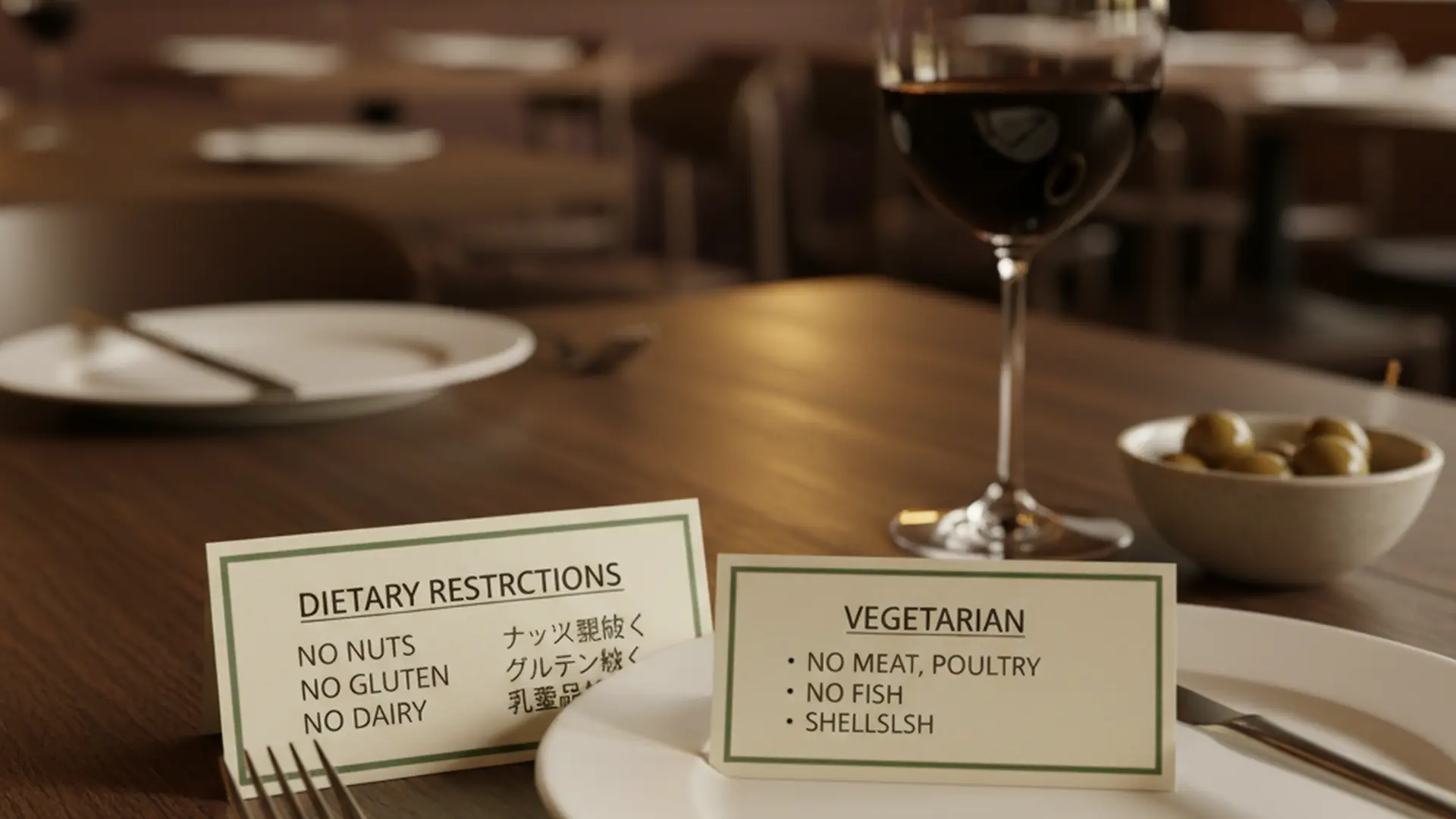
For any serious restriction in a country where you don’t speak the language, a printed card is the single best tool you can carry.
What I include on mine:
- A clear English statement: “I have a serious allergy to [ingredient]”
- The same statement translated into the local language
- A list of common ingredient names in both languages — including hidden forms (fish sauce, anchovy paste, tree nut oils)
- A note: “Please prepare my food separately and confirm with me if there is any uncertainty”
I keep one in Japanese, one in Korean, one in Chinese, and laminated. They live in my card case. They’ve never once been refused or treated as strange. Servers are universally grateful for the clarity.
When the Host Has Cooked for You Personally
The Riyadh lamb scenario — where the host is personally hosting you in their home, with food they’ve personally prepared or commissioned — is a special category. The rules are different.
What I do now:
- If I have a real allergy, I communicate it well in advance. Days, not hours.
- If I have a preference but no real restriction, I shut up about it. The lamb gets eaten.
- I express genuine appreciation for the effort. Whether the food is to my taste or not, the gesture deserves real thanks.
- I eat what’s served. If it really doesn’t sit well, I eat a polite portion and stop. I don’t explain.
Hosting in someone’s home, especially in cultures where this is a serious gesture (Middle East, parts of Asia, Latin America), is a high-trust act. Rejecting the food they’ve prepared registers as rejecting the gesture itself. That’s a much bigger problem than discomfort about a particular dish.
The Conversational Tactics
A few specific phrases I’ve found useful when dietary topics come up:
- “I’m not picky and I’m here to try the local cuisine. There’s just one thing I have to avoid for medical reasons — [ingredient].” Brief, specific, frames it as medical not preferential.
- “I tend to eat lighter at dinner.” A useful catchall that signals modest portions without being about a specific food.
- “I’d love your recommendation. Please order whatever you’d order for yourself.” Defers to the host, signals openness, prevents the “you decide / no, you decide” loop.
- “This was wonderful, thank you for the hospitality.” Said sincerely at the end of any meal. Closes the dinner well.
What I avoid:
- Long explanations of dietary philosophies
- Casual mentions of “what I usually do at home”
- Detailed preferences disguised as restrictions
- Anything that puts the host in the role of solving my problem
When You’re Hosting Someone With Restrictions
The other side: when you’re hosting an international colleague with their own dietary requirements.
The good practice:
- Ask in advance. “Are there any dietary preferences or restrictions I should know about for the dinner?” Email, not at the table.
- Plan accordingly. Choose a restaurant that can handle whatever they need. Confirm with the restaurant before the dinner that they’re prepared.
- Don’t make it visible. Don’t introduce your guest’s restrictions to the rest of the table or to the server in front of them. Handle it quietly.
- Brief the staff. Speak with the server before the meal so they know what to bring and what to avoid. The guest never has to advocate for themselves at the table.
The goal: your guest enjoys the dinner without the restriction being the topic. That’s hospitality.
The Mistake I Still Sometimes Make
I’ll be honest. I still occasionally drop into casual conversation that I “don’t eat much red meat” or “prefer lighter food.” It slips out. Then I catch myself and steer back to “but please order whatever you’d recommend.”
The instinct is hard to lose entirely. American food culture treats individual preferences as worthy of detailed expression. Most of the world doesn’t. The shift takes years.
What I aim for now is a meal where the host doesn’t know I have any preferences at all — until they need to. Then I’m specific, quiet, and grateful. That’s the version of “managing dietary needs abroad” that works.
The Underlying Idea
The dinner is about the relationship. The food is the medium. My personal preferences, however valid, are a distraction from the relationship the dinner is trying to build.
This sits inside the broader frame I use for international business meals — the idea that pacing through business dinner drinking etiquette, navigating ordering when you can’t read the menu, and handling dietary needs are all parts of the same skill: being a good guest.
The lamb in Riyadh wasn’t to my taste. I ate it. The host was happy. The deal we’d been working on closed three months later. None of that would have been true if I’d refused the lamb at the table.
And on the rest of the trip, when I was eating eating reasonably on the road in less ceremonial settings, I had complete control. The hospitality dinner is the exception. Other meals I can shape to my needs. The hospitality dinner I’m there to receive.
That’s the whole frame. Restrictions are logistics. Preferences are private. The dinner is the relationship. And the lamb gets eaten — even if you “don’t really eat lamb.”

Title: The drinking game I lost in Seoul
Dietary needs are one half of the dinner. Knowing how to pace through soju, sake, and baijiu is the other.
Inside:
- How I stopped going home wrecked from Korean dinners
- The polite refusal that works in Tokyo, Seoul, and Beijing
- Pacing tactics that protect your morning
Key takeaways
- Restrictions are logistics, not conversation. Handle them in advance with the organizer, not casually at the table after the food arrives.
- Tell the right people. Dinner organizer (days ahead), local colleagues, and restaurant or host staff before prep. Not the host mid-meal, not customers as anecdotes, not the waiter dramatically in front of the group.
- Real allergies get a system. Email the organizer in advance, carry a printed card in the local language with ingredient translations, and hand it discreetly to the server with minimal fuss.
- Know the country. Vegetarianism is widely respected in India and well-established in Germany, the UK, and Scandinavia. Japan hides fish stock everywhere; Korea, China, Brazil, and Argentina are meat-centric and need advance notice.
- “I don’t like it” is not a restriction. Eat a polite minimum, never volunteer preferences, and don’t call food “weird” or “strange.”
- When the host cooked for you personally, you eat it. The meal is about the relationship; the food is the medium. The lamb gets eaten even if you don’t really eat lamb.
FAQ
How do I tell a host abroad about a food allergy without making a scene?
Don’t announce it at the table. Email the dinner organizer in advance with the specific allergy, then carry a printed card in the local language listing ingredients to avoid. When you sit down, hand the card discreetly to the server with minimal explanation. Religious restrictions like halal and kosher are well-understood and just need advance notice to the organizer.
What if I just don’t like a dish that’s served to me?
That’s a preference, not a restriction, so keep it private. Eat a polite minimum, never volunteer your dislikes to the host, and don’t describe the food as “weird” or “strange” if asked. A line like “I tend to eat lighter at dinner” handles it without putting the host in a problem-solving role.
What do I do if the host has cooked something specially in my honor?
You eat it. A hospitality meal is the exception where you receive rather than control. The post’s own cautionary tale is a whole roasted lamb served as a family specialty right after the author mentioned he didn’t really eat lamb. The dinner is about the relationship; the food is the medium.