

Short answer: Skip the daily call. It turns into an obligation that drains you both. Build a rhythm instead: a quick morning text exchange, one real 30-45 minute call mid-trip, an end-of-trip logistics call, and photos throughout with no reply required. Less, done well, beats more, done badly. The marriage isn’t kept alive by talking every day.
I tried the “one call a day” rule for years. It nearly broke us. After a long argument across nine time zones, my wife and I built a different rhythm that actually works for the marriage and the trip. Here’s how.
The Argument Across Nine Time Zones
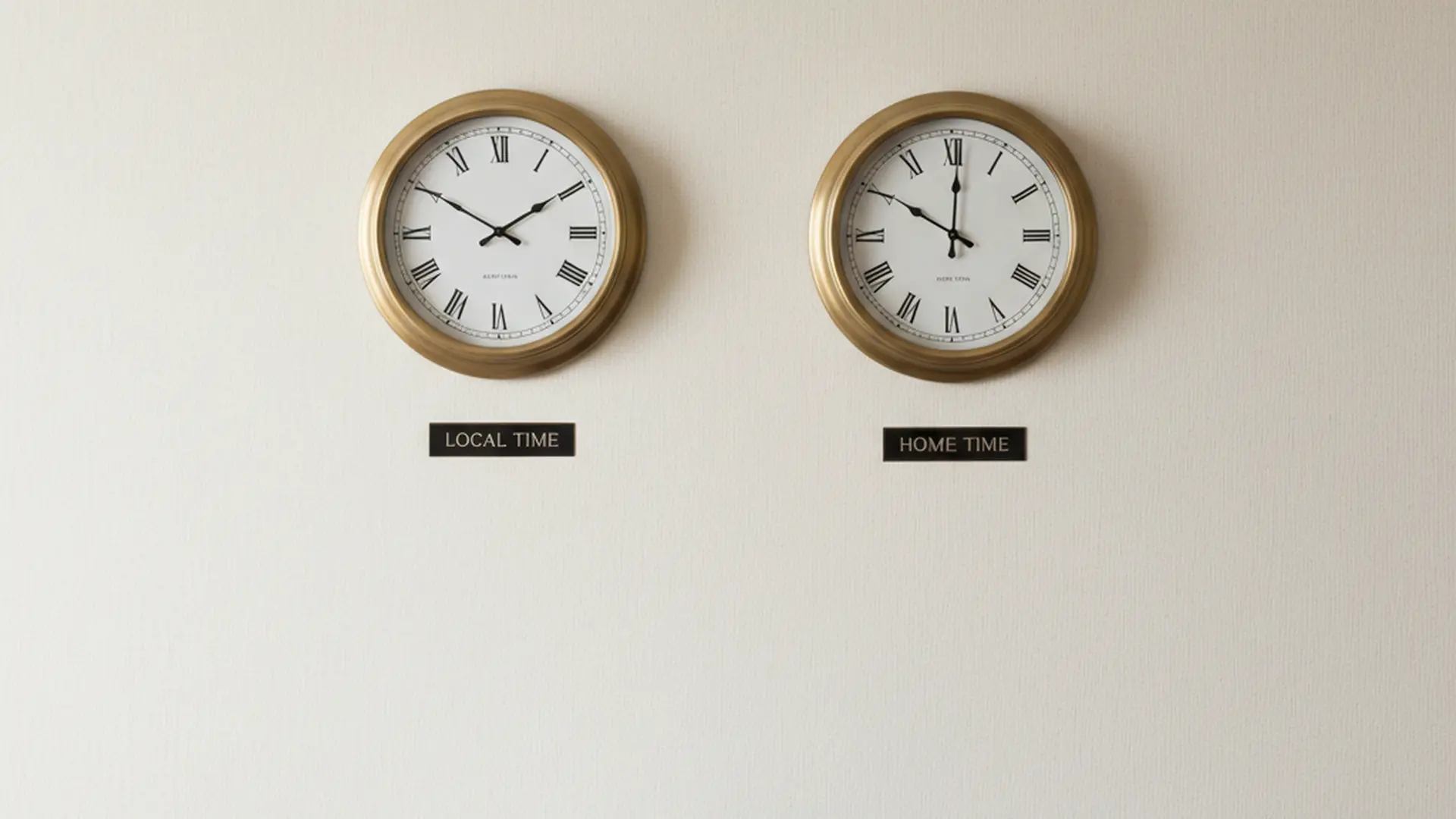
I was in Bangkok. She was in Florida. The time difference was 11 hours, which meant my morning was her late evening, and my evening was her morning.
I called her, as I’d been calling her every day for years, around 9 PM Bangkok time — 9 AM her time. I’d been doing this for years. The trip was day four of seven. The conversation started normal. Then she said something that landed harder than usual:
“Why do you sound like you’re doing me a favor?”
I bristled. I told her I was tired. She said she was also tired. The conversation got pointed. We didn’t really argue, but the feeling was clear: the daily call had become an obligation we both performed, neither enjoyed, and which was making the trip worse for both of us.
By the end of the call we’d both said things we didn’t quite mean. I went to my customer dinner irritated. She went to school pickup with a heavy mood. The next day’s call started with “I’m sorry about last night,” and the day after with “are we okay?” The whole pattern wasted three days of our lives.
That’s when we sat down (over Zoom, three days later) and rebuilt how we communicate during my trips. The system below is the result. It’s not romantic. It’s specific. It’s been the difference between trips that strain the marriage and trips that don’t.
The Daily Call Is the Wrong Default
The intuition behind a daily call sounds right: stay connected, don’t drift, hear each other’s voices. The problem is what the daily call becomes in practice.
What it actually becomes:
- An obligation that has to be scheduled around two different time zones
- A conversation that’s often happening when one or both people are tired
- A status report — “what did you do today” — rather than a real conversation
- A source of conflict when one of you misses or postpones it
- A thing you do because not doing it would feel worse, not because doing it feels good
None of those are the actual goal. The actual goal is feeling connected. The daily call doesn’t always deliver that. Sometimes it delivers the opposite — small daily failures that accumulate.
The shift my wife and I made was to stop treating “talking every day” as the gold standard, and start treating “feeling connected and present in each other’s lives” as the goal. Different goal, different system.
The Rhythm We Use Now
Here’s the actual structure, which we negotiated over a few iterations:
Morning text exchange. Every morning of the trip, we exchange a few short messages. Not a status report. Just “good morning, sleeping well, hoping the kids are okay.” Usually three or four texts each, takes ten minutes total. This is the daily heartbeat. It’s enough.
One real call mid-trip. On a longer trip (4+ nights), we have one substantive call, usually around the midpoint. 30-45 minutes. Scheduled when both of us are reasonably alert. This is where the actual conversation happens — what’s going on, how I’m feeling, how she’s feeling, the kids, the small annoyances and joys.
An end-of-trip call. A short one the day before I fly home. Mostly logistics: when I land, what I need from her, what’s happening at home that I should know about.
Photos and small updates throughout. Photos of where I am, small observations, things that made me think of her or the kids. These aren’t requests for a response. They’re presence in her day.
That’s the whole system. Two real calls per week-long trip. A constant low-volume text exchange. Photos when something interesting happens. The total time is similar to what a daily 30-minute call would be — but distributed differently.

The Time Zone Math
The thing nobody tells you about long-distance calls during business travel is that the time zones almost never line up well.
The reality:
- My morning is often her late evening, when she’s exhausted from kids and ready for bed
- My evening is often her early morning, when she’s getting kids to school
- The midday windows on both sides are the only times we’re both reasonably alert, and those are usually full of meetings or her work
The implication: there is no naturally good time to call. Every call is a compromise. Forcing a daily call into that compromise is forcing two tired people to perform a conversation neither of them is in shape for.
The fewer-calls system reduces the number of compromises. The morning texts cover the connection. The one or two real calls happen in windows we can actually plan around.
What I Don’t Try to Do Anymore
The behaviors I’ve cut:
Trying to “be present” for her morning routine. When the kids are getting ready for school, that’s chaos. My presence on a video call doesn’t help. It often distracts. I send a “good morning, hope school drop-off goes smooth” text instead.
Calling during my customer dinner break. I used to step out of dinners to “check in for two minutes.” This was bad for the dinner and bad for the call — both got truncated and unfocused. Now I let her know there’s a dinner happening and we’ll talk after.
Long video calls right before bed. The video call where I’m in a hotel room and she’s in our kitchen, both tired, was a recipe for snippy. I don’t do these anymore.
Apologizing for being away. Repeated apologies became their own friction. We agreed: I’m traveling for work, she knows that, the apologies aren’t necessary. Better to just be present in the time we do have than to apologize for the time we don’t.
The Family Brief Before the Trip
The other half of the system happens before I leave. The family brief in the 24-hour pre-flight checklist is a 5-minute conversation the night before the trip where my wife and I review:
- What’s the trip — country, dates, hotel, key meetings
- What’s happening at home — kids’ schedules, school events, deliveries, anyone visiting
- What we both need from each other — small reminders, anticipated friction
- How and when we’ll talk during the trip — the rhythm above
This 5-minute brief is the foundation that makes the rest of the trip’s communication low-friction. Without it, I’m asking via text “what’s happening Friday” and getting “we talked about this” responses that are technically true but socially expensive.
What I Actually Talk About on the Calls
The content of the calls matters as much as the frequency. The trap is for the call to become a list of facts: what I did, what she did, what the kids did. That’s not connection. That’s a status report.
What I try to talk about instead:
- How I’m feeling, not just what’s happening
- One or two specific moments that meant something to me — a meeting that went well, a conversation that surprised me, something I noticed about the city
- How she’s feeling — what’s been on her mind, what’s hard this week, what she’s looking forward to
- The kids’ specific moments, not just summaries — what one of them said that was funny, what they’re struggling with
- What I’m looking forward to about coming home
This sounds obvious. It isn’t, when you’re tired. The default for a tired-on-tired call is “what did you do today / oh that’s nice / how was the meeting / it was fine.” That call is technically a call. It’s not actually a conversation.
The 30-minute call mid-trip is where the conversation happens. The morning texts and the photos are the connective tissue between conversations. Different functions. Both needed.
The Hard Days
Some days the system breaks down. Someone has a hard day at home — sick kid, work crisis, a hard week. I have a hard day on the road — failed meeting, food poisoning, lost luggage.
On those days, the rhythm flexes. We call when we need to. The 30-minute call becomes a 90-minute call. The morning text becomes “are you okay?” with a quick check-in.
The point of the system isn’t to be rigid. It’s to be a default that prevents the daily-call obligation from grinding us both down. When something genuinely needs more, more happens. When the trip is normal, the lighter rhythm works.
The Photos Question
Photos are the small accelerator that makes everything else easier.
What I send:
- The view from my hotel room window in the morning
- An interesting meal at a local restaurant
- The street I’m walking on if it’s beautiful or weird
- A small moment — a colleague’s expression, a building I noticed
- Things I see that made me think of her or the kids
What I don’t send:
- Selfies in business attire trying to look impressive
- Photos of customer events — work moments belong in calls, not in pictures
- Photos of expensive things I bought or restaurants I’m at — performative
Photos are presence in her day without requiring a conversation. They keep the connection alive between the calls. They also give the kids a sense of what dad is doing, which matters more than I expected.
The Letter (Yes, the Letter)
One specific habit my wife introduced and we’ve kept: a short handwritten letter on hotel stationery, mailed mid-trip from wherever I am.
It’s short — three or four paragraphs — and contains nothing urgent. It’s a small artifact that arrives at our house a week after I’m home. It’s the kind of thing that doesn’t replace any of the other communication. It just adds something specific that’s only possible because I’m somewhere else.
Our daughter sometimes finds the letters in the mail and asks who they’re from. The first time my wife told her “from dad, traveling,” she got the look of someone whose internal model of family was being expanded slightly. Letters from dad. From Tokyo. To mom.
The letter is an indulgence. It also takes about 15 minutes per trip. The return on those 15 minutes has been outsized.

When the Marriage Is Already Strained
The system above works when the marriage is generally healthy. When it isn’t, the system isn’t enough.
I won’t pretend I have an easy answer for the harder version. What I’ve learned, including from talking to colleagues whose marriages have struggled with frequent travel:
- Travel doesn’t cause marriage problems, but it amplifies them. A small fault line at home becomes a bigger gap on the road.
- The conversations that need to happen need to happen at home, not on a 30-minute call from a hotel
- Frequent travelers benefit from short trips home being protected — not used for catching up on work, not used for “errands you saved up.” Real, present time.
- If the trips are constantly making things harder, that’s information about the job, not just about the relationship
I’ve seen colleagues take fewer trips, change roles, or restructure their travel because the math wasn’t working. None of these were career-ending decisions. All of them protected something more important than the next trip.
The Bigger Idea
The marriage is not actually maintained by talking every day. It’s maintained by being a present, attentive person in each other’s lives — at home and on the road.
The system above isn’t romantic. It’s logistical. The romance happens in the small, real moments that the system makes space for: the long mid-trip call where we actually talk, the photos that say “I’m thinking of you,” the letter that arrives a week late, the calm dinner home together when I’m back.
The daily call almost made all of those harder. Less, done well, beats more, done badly.
This is the same lesson I’ve learned about eating reasonably on the road and about sleeping on planes without pills: the small daily disciplines, applied consistently, are the actual health of the trip. Heroic efforts are unnecessary. Defaults that work, repeated, are the whole system.
My wife and I have been doing this for about five years now. The marriage is good. The trips happen. Neither of them is the source of grinding small frictions anymore. The argument across nine time zones was a turning point I’m grateful for, even though it didn’t feel like one at the time.
Don’t default to the daily call. Build a real rhythm. Send the photos. Write the letter. Show up when you’re home. The marriage that survives a working life of business travel is built on those small specific habits, not on talking on the phone for thirty minutes every night when both of you are tired.

Title: The 20-minute hotel room workout
Marriage health and physical health share an underlying habit: small daily disciplines that travel with you.
Inside:
- The no-equipment routine that fits any hotel room
- The 5-minute version for the bad mornings
- Why the workout matters more for your head than your body
Key takeaways
- The daily call is the wrong default. It becomes obligatory instead of connective, and that’s what wears the marriage down.
- Trade the daily call for a rhythm. Morning text exchange (3-4 texts each way, about ten minutes total), one real call mid-trip on trips of four-plus nights, and an end-of-trip call the day before you fly home.
- Stop the things that quietly make it worse. No calling during your customer dinner break, no long video calls right before bed when you’re both wrecked, and quit apologizing for being away.
- Do a five-minute family brief the night before you leave. Trip details, what’s happening at home, what you each need, and the communication rhythm. It’s not romantic. It’s specific.
- Talk about feelings, not status reports. How you’re feeling, plus one or two specific moments that meant something. That beats reciting your itinerary.
- Photos and a handwritten letter do the heavy lifting. Small updates that don’t demand a reply, and a short letter on hotel stationery mailed mid-trip.
FAQ
Do I really need to call home every single day when I’m traveling?
No. The daily call is the wrong default. It turns into an obligation that exhausts both of you. A morning text exchange plus one real call mid-trip does more for the marriage than forcing a conversation every night.
How do I handle calling home across a big time-zone gap?
Schedule the one real call for when you’re both alert, not when one of you is half-asleep. With an 11-hour gap, 9 PM in Bangkok lands at 9 AM in Florida, so pick the window that works for both ends instead of squeezing it in before bed.
What should we actually talk about on the call?
Skip the status report. Lead with how you’re feeling, not just what’s happening, and share one or two specific moments that meant something. The end-of-trip call is the place for logistics; the mid-trip call is for connection.
📍 Part of: Bleisure & the Traveling Dad.