
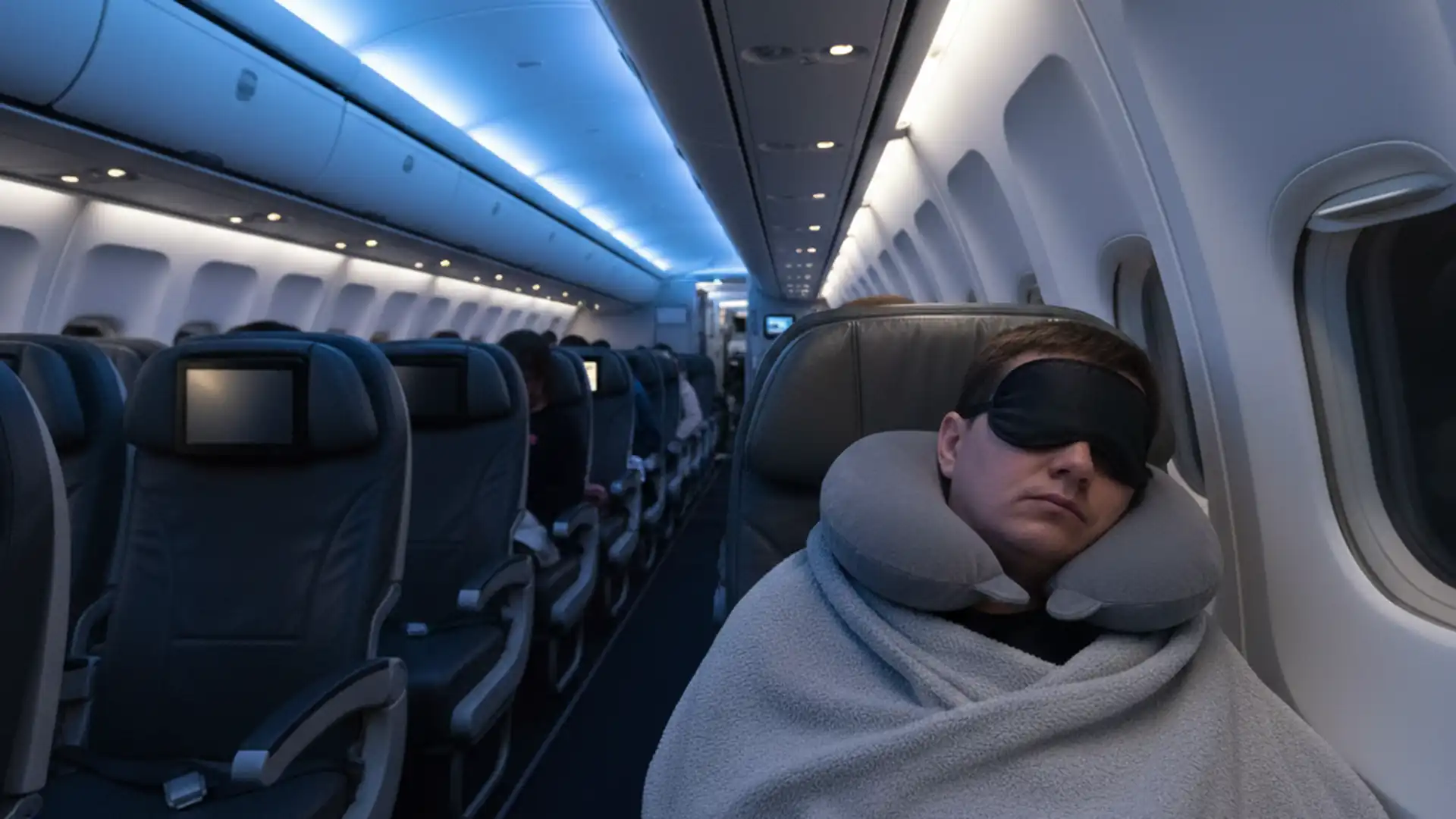
Short answer: No pills. I treat the flight as bedtime on the destination’s clock, skip the in-flight wine, hydrate hard, and eat light. Two bits of gear do the heavy lifting: a proper contoured eye mask and cheap foam earplugs. It’s a checklist of small disciplines, not magic. Works about two-thirds of the time, and I’ve stopped pretending it works every time.
I used to take half an Ambien every long flight and tell myself it was fine. Then one trip it stopped working, and the next trip it gave me a 14-hour fog instead of sleep. Here’s the boring, drug-free system I use now — with the honest admission that it doesn’t always work either.
The Year the Pills Stopped Working
I’d been taking half an Ambien on every overnight flight for about three years. It worked fine — I’d take it after dinner, watch 20 minutes of a movie, and be asleep before the cabin lights went down.
Then one Bangkok-to-Frankfurt flight, the half-pill did nothing. I lay there for nine hours, eyes closed, brain running, occasionally drifting and then jerking awake. I landed exhausted and underslept and spent the first two days of the trip in a slow shuffle.
I tried a full Ambien on the next flight. That worked, sort of — I slept for about six hours. But I woke up in a fog that didn’t lift for the rest of the day. The medication had hit harder, lasted longer, and made my arrival worse.
I read more about the drugs. I talked to my doctor. I learned what I should have already known: sleep aids don’t really produce sleep — they produce sedation, which has overlap with sleep but isn’t the same thing. The recovery, the dreaming, the cognitive resetting — those don’t happen the same way.
I quit. The first three flights without anything were rough. By the fifth flight, I had a system that mostly worked. By the tenth, the system was muscle memory.
What follows isn’t a guarantee. It doesn’t always work. I’ve had flights where I slept four hours, flights where I slept ninety minutes, flights where I didn’t sleep at all. But the system has lifted my average dramatically and removed the side effects of medication entirely.
The System Is Mostly Discipline, Not Tools
Before any gear, four behavioral rules:
1. The flight is bedtime, even if it’s 4 PM at home. If the destination time zone says it’s nighttime when I’m in the air, I treat the flight as sleep, not as in-flight entertainment. No movies. No work email. No “let me just respond to this one thing.”
2. No alcohol on the plane. This is the single biggest behavior change. Wine on a plane feels relaxing for 20 minutes and then wrecks the sleep cycle for the rest of the flight. I don’t drink in flight, period.
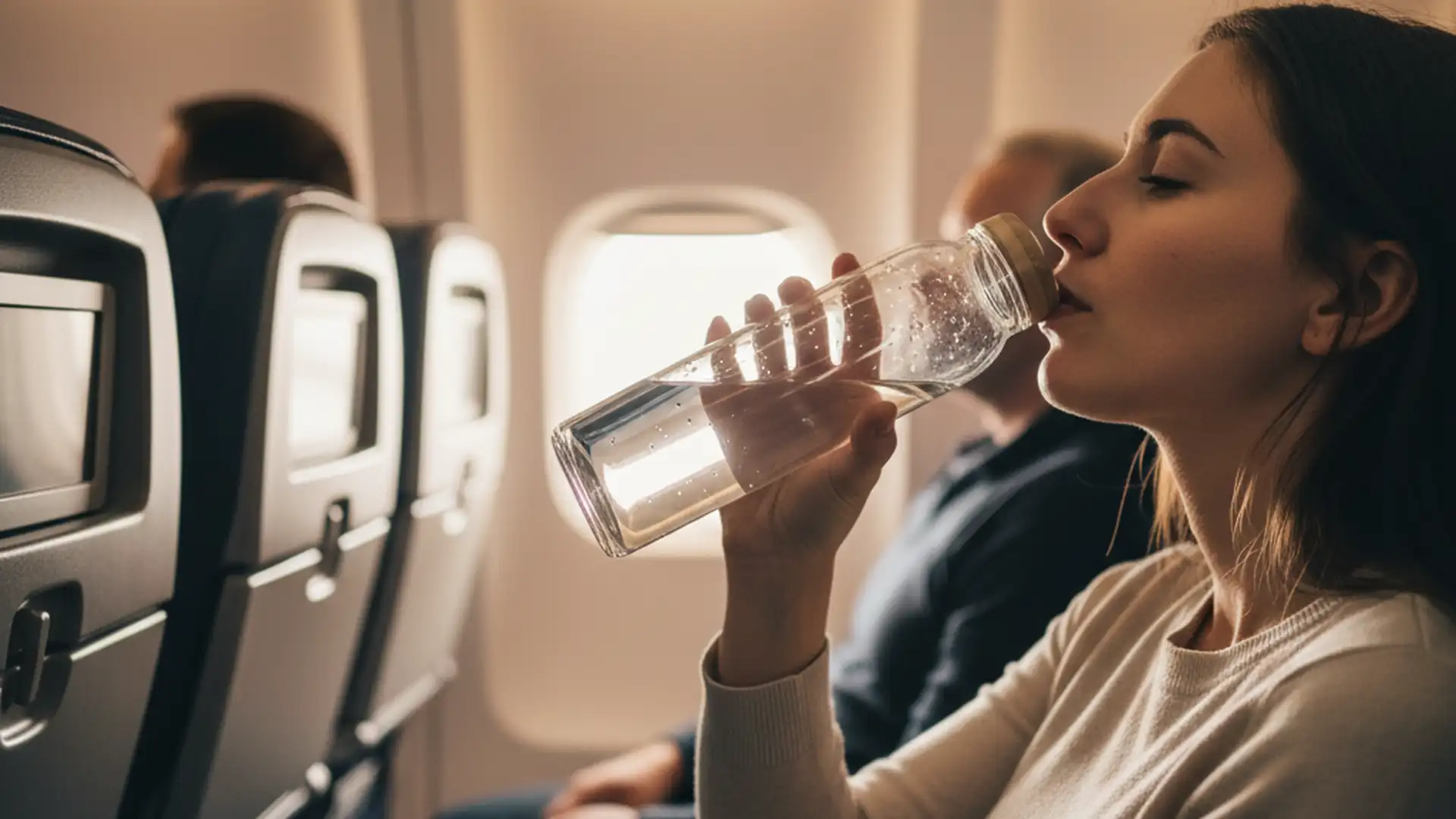
3. Hydrate aggressively, before and during. Two glasses of water before boarding. A bottle of water on board, refilled. Yes, this means more bathroom trips. Worth it.
4. Eat lightly. Don’t eat the heavy in-flight meal if it lines up with my destination’s nighttime. I’ve started bringing a small meal of my own — a protein bar, a banana, some nuts — and skipping the airline meal entirely on overnight flights.
These four rules do most of the work. The gear adds maybe 20% on top.
The Two Pieces of Gear I Never Fly Without
I’ve tried many things. The two that have stayed in my carry-on for years:
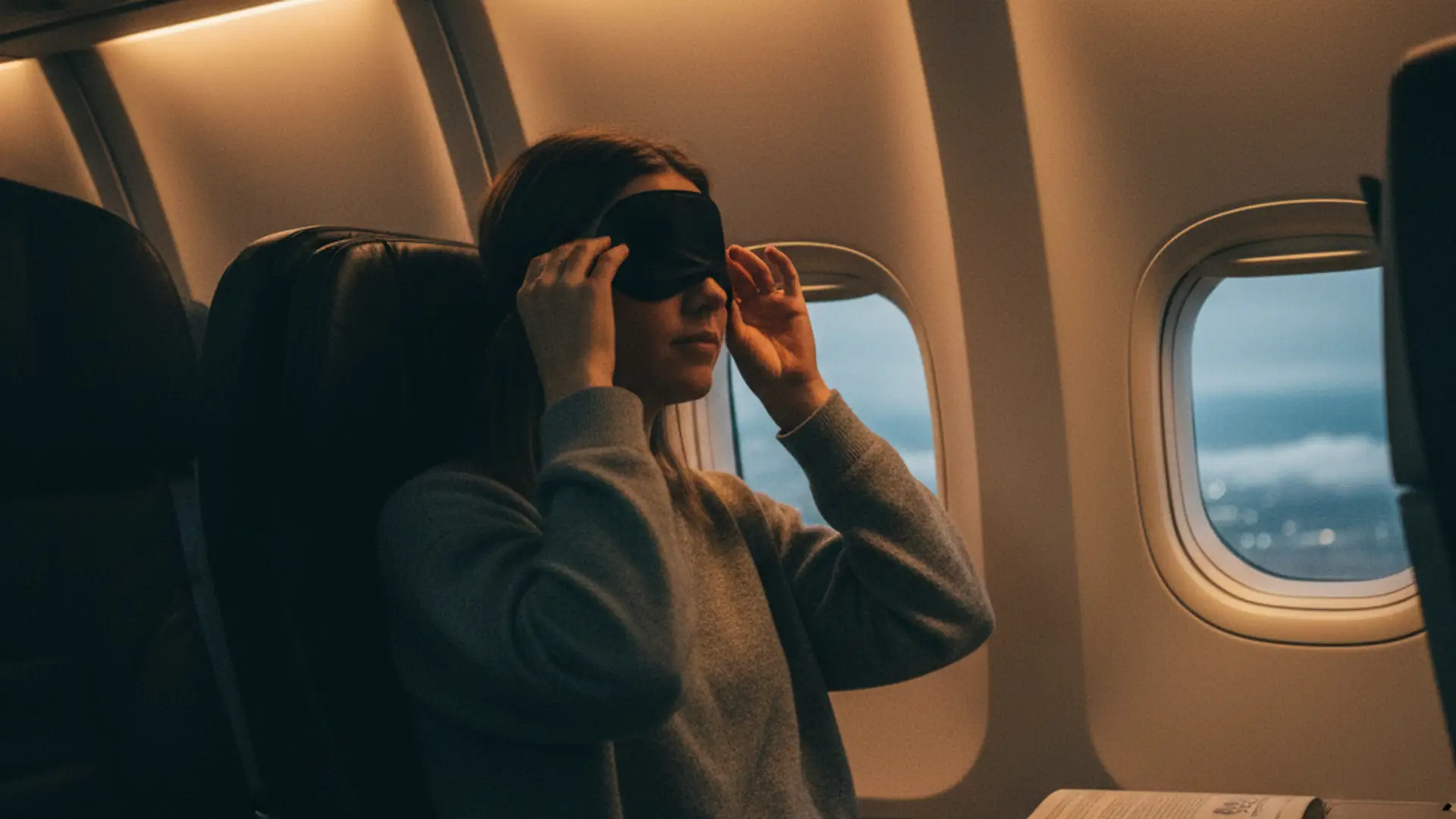
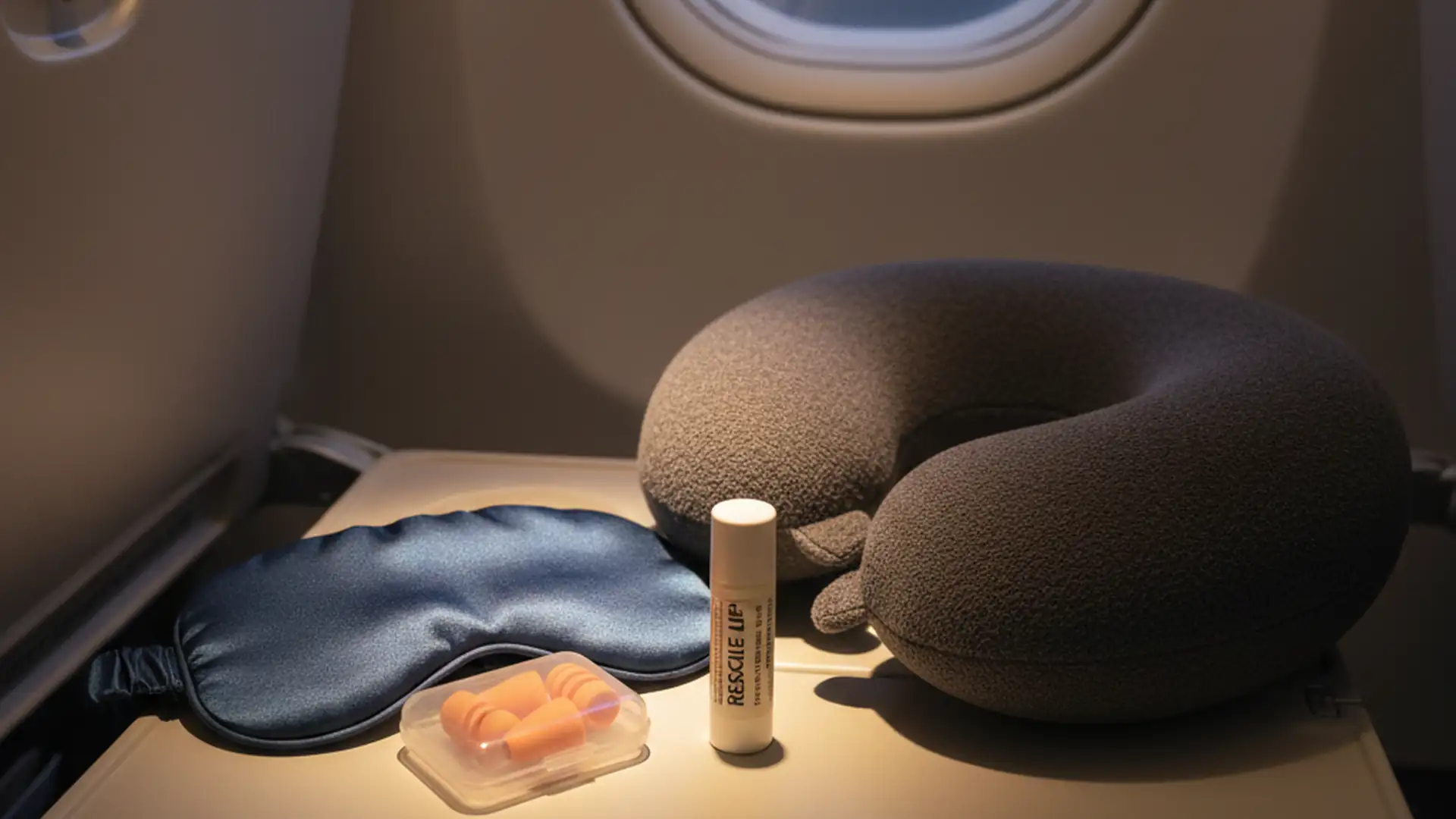
1. A high-quality eye mask. Not the cheap freebies they hand out on long-haul flights. Those are fine but they slip, they’re thin, they let light in around the nose.
The mask I use is contoured — molded with space for the eyes so the fabric doesn’t press on the eyelids — and has an adjustable strap that doesn’t ride up. It cost me about $25. I’ve had it for four years.
The eye mask is the single most important piece of sleep gear on a plane. Cabin lights, neighbor screen brightness, the brief flashes when bathroom doors open — all are sleep-disrupting in ways you don’t notice until they’re blocked.
2. Foam earplugs. Not noise-cancelling headphones — those are great for movies and the cabin hum, but they’re uncomfortable to sleep in for me, and the active noise cancellation creates its own subtle pressure feeling that I find annoying after a few hours.
Foam earplugs, the orange ones from a hardware store, are cheap, comfortable, and effective. They reduce the cabin noise enough to sleep without creating any other sensation.
Total cost of the gear that matters: about $30. The rest is discipline.
The Pre-Flight Routine
The flight starts before the flight. What I do in the hours before boarding:
- Eat a real meal at the airport, two hours before boarding
- Drink water (a bottle, not a sip)
- Walk for 20-30 minutes through the terminal — get steps in before being trapped in a seat for 10 hours
- Brush teeth before boarding
- Change into the clothes I’ll be sleeping in (loose, layered, comfortable shoes)
The brushing teeth thing sounds small. It changes the experience. Boarding a plane with the small evening rituals already done means I’m signaling to my body that the next stage is sleep, not a continued day.
If I’m in the lounge before a long-haul flight — and the broader question of whether to use them is in airport lounge access calculus — I’ll use the shower. A shower 90 minutes before boarding is a cheat code. The flight feels different starting clean.
Once Onboard
The first 30 minutes on the plane:
- Stow the carry-on, settle in
- Take out the eye mask, earplugs, water bottle, lip balm — put them on the tray table or in the seat pocket
- Decline the welcome drink (no alcohol, no soda)
- Recline the seat to a comfortable angle once we’re in the air
- Put on a quiet podcast or instrumental music — never a movie
Then I keep moving toward sleep. I do not “stay awake to eat dinner” if the destination’s clock says it’s bedtime. The skipped meal is a small price.
The eye mask goes on. The earplugs go in. The blanket goes over me. I close my eyes and wait. Sometimes sleep comes in 15 minutes. Sometimes it takes 90. Sometimes it doesn’t come at all. But I make space for it consistently, and that’s most of the battle.
What I Don’t Do
The list of things that didn’t work for me:
Meditation apps. I tried Headspace and Calm. The act of putting in earbuds and listening to a guided sleep meditation worked the first few times and then started to feel performative. I’d be aware that I was “trying to sleep” rather than just sleeping. Now I just close my eyes.
Melatonin. I took it for a while. Three milligrams, an hour before “bedtime.” Honestly, I couldn’t tell if it was helping. After three months I stopped and noticed no difference. May work for you. Didn’t for me.
Compression socks. A safety item more than a sleep item. I do wear them on long-haul flights to reduce DVT risk. They don’t help me sleep.
The full lay-flat seat in business class. When work pays for it, the lay-flat seat is great. But it doesn’t replace the system. I sleep about the same amount in business class as I do in economy, with this system. The lay-flat seat helps mostly with the first hour and the morning recovery — it doesn’t extend my sleep total much.
Audiobooks. I tried sleeping to soft audiobooks. I’d either get interested in the story (bad for sleep) or not interested enough to ignore the cabin (also bad). Now I either listen to instrumental music for the first 20 minutes or nothing at all.
The Honest Admission
The system fails about a third of the time.
Some flights I just don’t sleep well. The seat is uncomfortable, the neighbor snores, there’s a baby crying for two hours, the cabin is too hot or too cold, my brain refuses to settle. I’ve had flights where I tried everything and got 90 minutes of fitful sleep across 12 hours.
What I’ve learned to accept: those flights happen. The system isn’t a magic trick. It’s a way to maximize the chance of decent sleep, not a guarantee.
The recovery on the bad nights is the same thing I’d be doing anyway: get sunlight on arrival day, eat meals on local time, do the morning 20-minute hotel room workout, no naps over 30 minutes. The system after the bad flight matters as much as the system on the flight.
Time Zone Strategy
The other half of plane sleep is choosing when to sleep based on the destination, not the origin.
The principle: sleep on the plane during what will be nighttime at the destination. Stay awake during what will be daytime at the destination. This is how you arrive partially adjusted instead of fully wrecked.
Practical rules I follow:
- Westbound flights from the US to Asia. Try to sleep on the plane during the long middle of the flight. Stay awake for the last few hours so I’m tired when I arrive in the late afternoon and can sleep through to a normal local morning.
- Eastbound flights from the US to Europe. Sleep as much as possible from boarding. Eastward flights to Europe usually arrive in the morning local time, and you need to be functional. The flight is shorter (6-9 hours), the sleep window is smaller.
- Eastbound flights from Asia to the US. Stay awake for the first half if your arrival is in the morning of the same day; sleep the second half. Counterintuitive but it works.
- Domestic US transcons. 5-6 hours, often during the day. I don’t try to sleep — I work, watch something, eat, land at a normal hour.
The time zone strategy adjusts which sleep tactics to apply when, but the gear and discipline stay constant.
Recovery on Arrival
The arrival day is critical. What you do in the first 12 hours after landing matters more than what you did on the flight.
- Sunlight, immediately. Walk outside as soon as practical. Sunlight resets the body clock faster than anything else.
- Eat on local time. If you arrive at 3 PM local, don’t eat dinner at 6 PM (your body’s lunch). Wait until 7 or 8 local time, then eat the local-time dinner.
- No long naps. If you must sleep, 20-30 minutes maximum. Set an alarm. The 2-hour nap will wreck your night.
- Bedtime at local time. Even if your body wants 9 PM, hold out for 10:30 or 11. The first night is hard. The second night is normal.
This is also where the other components of trip discipline pay off — eating the right amount, sticking to a routine, getting that morning workout in. None of these is heroic. All of them compound.
When the Flight Is Just Bad
Some flights are just bad. Equipment swaps with worse seats, weather delays that compress sleep windows, full flights where you’re stuck in a middle seat next to people who didn’t shower.
What I do on those flights:
- Accept that this one is going to be rough
- Don’t beat the system by drinking — alcohol on a bad flight is just amplification
- Get whatever rest I can — 30 minutes here, an hour there
- Use the recovery system harder on arrival — extra walk, extra hydration, earlier bedtime
Some flights are losses. The trip can absorb them if I don’t compound the loss with bad arrival behavior.
The Bigger Idea
Sleeping on planes used to feel like an art I couldn’t quite master. Now it feels like a small set of habits I either execute or don’t.
The system isn’t elegant. It’s a checklist of small disciplines: no alcohol, eye mask, earplugs, water, light food, eyes closed when the destination clock says it’s bedtime. Six items, executed consistently, that produce two-thirds of the maximum possible sleep on most flights.
The transition off pills was harder than I expected and easier than I expected. Harder because the first few flights were genuinely bad. Easier because the long-term reduction in fog, in muddled mornings, in days where I felt 60% of myself, was worth more than I’d realized.
If you’re on the chemistry route, I’m not telling you to stop. Talk to a doctor. But if it’s stopped working — or you’ve never tried the boring system — give the system three flights. By the third one, the muscle memory will be there. By the tenth, you’ll know how to use it on the days when nothing else works either.
And once you’re arriving rested, the rest of the well-being puzzle — the workout, the diet, the simple act of eating reasonably on the road — becomes easier to maintain. Sleep is the foundation. Everything else builds on it.
The pills did some work. The system does the same work, more reliably, without the cost. That’s the trade I’d take every time now.

Title: Eating reasonably on the road
Sleep is one piece of arriving like a person. Food is the other — here’s how I keep the buffet from winning.
Inside:
- What I eat on a typical work-trip day
- The hotel breakfast traps to avoid
- How I order at a business dinner without being ‘that guy’
Key takeaways
- The flight is bedtime — even if it’s 4 PM at home. No movies, no work email. Sleep on the destination’s clock, not your own.
- Skip the wine. It feels relaxing for 20 minutes, then wrecks the rest of the flight. Decline the welcome drink too.
- Hydrate and eat light. Two glasses before boarding, refill the bottle onboard. Skip the heavy airline meal — protein bar, banana, nuts.
- Two pieces of gear, about $30 total. A contoured eye mask with room for your eyelids (not the freebie) and orange foam earplugs. I skip noise-cancelling headphones — they hurt after a few hours.
- Run the pre-flight routine. Real meal, terminal walk, brush teeth, change into loose sleep clothes before boarding.
- Arrival day is where it’s won. Get sunlight, eat on local time, cap naps at 20-30 minutes, go to bed local time. That’s the part most people skip.
FAQ
Does melatonin actually help you sleep on a plane?
Not in my experience. I used it for three months and couldn’t tell any difference. Meditation apps wore off too — they started feeling performative after the novelty faded.
Is business class worth it just to sleep better?
Honestly, I sleep about the same amount in a lay-flat business seat as I do in economy. The discipline matters more than the seat. The gear and the routine are doing the work, not the price tag.
What if I just can’t fall asleep on the flight?
Sometimes you won’t. The system fails about a third of the time — I’ve had flights with 90 minutes of fitful sleep across 12 hours. Bad seat, snoring neighbor, crying baby, or a brain that won’t cooperate. When that happens, lean hard on arrival-day recovery: sunlight, local meal times, and a short nap at most.