

Short answer: You can’t “see” Mexico City in a day, so stop trying. After a dozen trips, my Sunday playbook is simple: chilaquiles breakfast, a cab to Coyoacán for a plaza walk, a long lunch, a stroll through Chapultepec, then tacos al pastor and bed by 10. Skip the Teotihuacán pyramids, skip alcohol night one, and drink two liters of water minimum.
Mexico City is too big to “see” in a free day. After a dozen trips, here’s the focused playbook for the one Sunday you’ll have between meetings — and the altitude lesson nobody warned me about until my second trip.
The Altitude I Underestimated
The first time I went to Mexico City for work, I flew in from Florida on a Sunday afternoon, dropped my bags at a hotel in Polanco, and went out for a quick walk to “stretch the legs.”
The walk was 25 minutes. By the end of it, I was breathing harder than I should have been on flat ground, my head was pounding mildly, and I felt vaguely off-balance.
I assumed it was the airline food, the long flight, or the early start. I didn’t realize that Mexico City sits at about 2,240 meters — over 7,300 feet — above sea level. That’s higher than Aspen. The altitude does real things to anyone arriving from sea level.
I’d had two beers with dinner that first night. By morning I had a hangover that didn’t match the amount I’d drunk. Then I had my first meeting at 9 AM and felt foggy enough that I had to apologize for being slow.
The lesson came on trip number two, when a colleague who’d been doing Mexico City for ten years told me casually: “Drink twice the water and skip the alcohol on day one. The altitude doesn’t care that you flew first class.”
It’s the first thing I tell anyone going to Mexico City for the first time: respect the altitude. Drink water. Skip the first-night drinks. Don’t try to run the morning of arrival. The city forgives many things, but it does not forgive ignoring what 7,300 feet does to your body.
Where to Stay (And It Matters Here)
Mexico City is huge — roughly the size of New York or London by population, with a much larger physical footprint. The neighborhood you stay in materially affects the trip.
The three neighborhoods I rotate between:
Polanco. Upscale, business-friendly, walkable to many corporate offices. Lots of high-end hotels (Four Seasons, St Regis, etc.). Excellent restaurants. Less of the “real” Mexico City character but very functional for a business trip.
Roma Norte / Condesa. Trendy, leafy, full of cafes and small restaurants. The neighborhood I default to for trips where I have time to enjoy the city. Walkable, beautiful, more relaxed than Polanco.
Centro Histórico. The old center. Stay here if you want to walk to the Zócalo, the Cathedral, the historic core. More tourists, more energy, more chaotic. Better for a single weekend visit than for a week of business.
For a working trip with one free day, my recommendation is Roma Norte. It’s the neighborhood where you’ll most enjoy your one day off, and the access to business areas is workable.
The One Free Day: Sunday Is Your Friend
If you have a single free day on a Mexico City trip, hope it’s a Sunday. The city has a different rhythm on Sunday — slower, family-oriented, with specific things you can only really do well on that day.
The Sunday playbook:
- Coyoacán in the morning. Take a cab or Uber to the historic Coyoacán plaza. Walk around. Have a coffee at a small cafe. Visit the Frida Kahlo Museum (Casa Azul) if you want — book tickets in advance.
- Lunch at a long, family-style restaurant. Mexico City Sundays are made for unhurried lunches that stretch from 2 PM to 4 PM. Try a place like Contramar (seafood) or El Cardenal (traditional).
- Afternoon walk in Chapultepec Park. Mexico City’s central green space. The Anthropology Museum is there if the weather is bad; the lake area is great if it’s nice.
- Evening light food in Roma Norte. Don’t try to do another “big” meal. A few tacos al pastor at a small taqueria, a juice, an early bedtime.
That’s a full day. Don’t try to add Teotihuacán (the pyramids) on top. They’re spectacular, but they’re a half-day round trip with traffic. Save them for your second trip.
The Food Map
If I had to pick five food experiences from Mexico City that I think every business traveler should have once, in priority order:
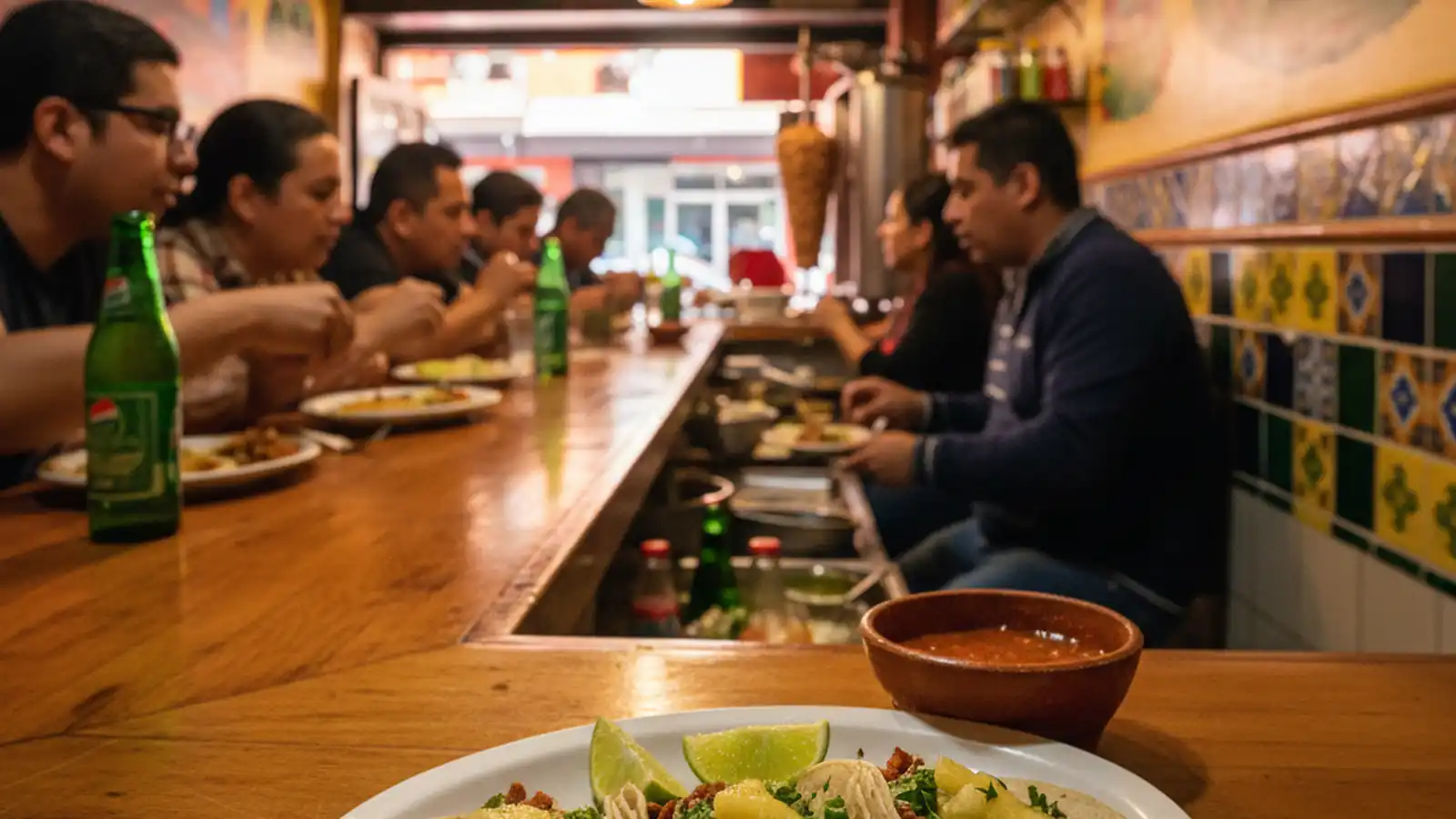
1. Tacos al pastor. The marinated pork-on-a-trompo taco that defines street food in this city. Specific places I love: El Tizoncito in Condesa (a classic), or any neighborhood taqueria with a long line of locals at lunch. $1-2 per taco. The most efficient food you’ll eat all year.
2. A real mole. Mole is one of the great cuisines of the world. Mexico City has many places that do it well. Pujol’s mole tasting (if you have the budget and reservation luck) is famous, but a more accessible version at a place like Azul Histórico or Ostería Las Garrafas can be just as memorable.
3. Sunday breakfast (a true Mexican breakfast). Chilaquiles with eggs, fresh fruit, real coffee, a glass of fresh juice. The breakfast at Azul or Café de Tacuba on a Sunday morning is a cultural institution.
4. Birria. A meat stew that’s recently become trendy in the US but has been done in Mexico forever. A small birrería in Polanco or Condesa will give you the real version, often as tacos with consommé on the side.
5. A long, leisurely lunch with a colleague or customer. Mexico City lunch culture is one of the best in the world. Two-hour lunches over wine and slow conversation are normal. Lean into it. Don’t try to be efficient.
What I avoid: the international hotels’ “Mexican” restaurants. They’re fine. They’re not the city. Get out of the hotel for at least one meal a day.
Getting Around
The honest assessment of Mexico City transit:
- Uber / DiDi. The default. Cheap, reliable, in-app payment, no language barrier. I use Uber 90% of the time.
- Taxis. Use only sitio taxis (from official stands, often outside hotels) or hotel-called taxis. Don’t hail random street taxis.
- The Metro. Cheap and efficient on paper. Crowded, often unpleasant, not great for tourists with bags. Locals use it skillfully; visitors are better off with Uber.
- Walking. Excellent in Roma Norte, Condesa, Polanco, Centro. Less great elsewhere. Be aware of altitude — pace yourself.
Plan for traffic. Mexico City traffic is real. A 5 km trip can take 45 minutes during rush hour. Allow buffer.
Safety: Practical, Not Paranoid
Mexico City has a reputation that is partly outdated and partly accurate. The reality I’ve experienced over a dozen trips:
- The neighborhoods I’ve recommended (Polanco, Roma, Condesa, Centro) are generally safe during the day and reasonably safe in the evening
- Use Uber rather than street taxis
- Don’t flash valuables, don’t wave a phone around, don’t carry large amounts of cash
- Stay aware on the metro and in crowded markets
- Avoid certain areas (some parts of Iztapalapa, Tepito, etc.) as a tourist — your hotel can advise
- Late nights in walking-around mode are the times to be most careful
I’ve never had a serious safety issue in Mexico City. I’ve also never relaxed completely the way I would in Tokyo or Singapore. Reasonable awareness is the right setting.
The Working Day in Mexico City
Mexico City business culture has its own rhythm:
- Meetings often start later than US standards. 10 AM is common. 9 AM is early.
- Lunch is the main social meal — long, often two hours, with wine
- Dinner is later than US standards — often 8:30 or 9 PM
- Personal connection matters more than transactional efficiency. Asking about families, weekends, kids is part of every meeting.
- Punctuality has flex — being five or ten minutes late is normal, but make sure you’re not the only one who’s late
If you’re new to Mexican business culture, the most important shift is slowing down the deal pace. The customer in Mexico City often wants three or four meetings before committing — not because they’re stalling, but because they need to know who you are. Investing time in the relationship pays off in trust that lasts. The transactional, “let’s close this today” American posture lands poorly. This isn’t unique to Mexico — see the broader patterns of calling home from a different time zone approach to long-distance work and the kinds of relationships you build over many trips.
What I Wish I’d Known Earlier
The lessons that took me too long to learn:
- The altitude is real. Already covered. Worth saying twice.
- Hydration matters more than usual. The dry air at altitude dehydrates you fast. Two liters of water a day, minimum.
- The first afternoon nap is fine, the second is a mistake. A 30-minute nap on arrival day helps. A 2-hour nap will wreck your sleep that night.
- Eat where the locals eat at lunch. Tourist restaurants charge double for half the quality.
- Don’t try to “see Mexico City” in 24 hours. The city is too dense. Pick a neighborhood. Go deep.
- Watch the lunch wine. A long Mexican business lunch is real, and the wine is real, and you may have a 4 PM meeting after. Pace.
Day Trip Possibilities (For Trip 2 or 3)
Things I would not try on a one-free-day trip but that justify a return visit:
- Teotihuacán pyramids. 90 minutes each way plus a few hours on site. Half-day minimum.
- Xochimilco floating gardens. The colorful trajinera boats. A half-day with food and music.
- Puebla day trip. Two-hour drive each way, beautiful colonial city, mole poblano. A full day.
- Tepotzotlán or Cuernavaca. Smaller, slower towns within an hour or two of the city.
None of these belong in a one-free-day plan. They turn the day into a logistics exercise rather than a chance to slow down in the city itself.
The One-Day Structure I Use Now
To pull it together, here’s the actual structure for a Sunday free day:
- 7 AM. Wake naturally. Drink a large glass of water before anything else. Walk for 30 minutes in your neighborhood.
- 8:30. Breakfast at a real Mexican breakfast spot — chilaquiles, eggs, fresh fruit, coffee. Take your time.
- 10:30. Cab to Coyoacán. Walk the plaza, the side streets. If interested, visit Casa Azul (advance ticket).
- 1 PM. Lunch at a long, sit-down place. Don’t rush.
- 3:30. Walk in Chapultepec Park. Visit one museum if you have energy.
- 6 PM. Light dinner near your hotel. A few tacos. A juice. Bed by 10.
Five locations. Six hours of activity. Eight hours of rest. That’s the day. Not “ten Mexico City things.” Five real ones.
The Bigger Idea
Mexico City is one of the world’s great cities, but it’s also one of the easiest cities to misuse on a working trip. The temptation is always to “do more” — see another neighborhood, try another restaurant, drive out to the pyramids — and the temptation is almost always wrong.
The trips I remember from Mexico City aren’t the ones where I crammed in five neighborhoods. They’re the ones where I had a long lunch with someone interesting, walked through Coyoacán in the morning sun, ate three perfect al pastor tacos at a small place I’d never been to before, and got to bed at a reasonable hour.
This is the same lesson I take from the Singapore 48-hour playbook and from the Tokyo guide. Less, done well, beats more, done fast. The free day in Mexico City is a gift. Treat it that way.
And if you’re worrying about how to eating reasonably on the road with all the heavy meals on the calendar — Mexico City has tools. Fresh juices, small portions at the right places, lots of vegetables in the markets. The food is rich, but the city has options if you want them.
Go. Drink water. Eat the tacos. Skip the first-night drinks. Take the long lunch. Sleep early. The city will reward the calm visitor every time.

Title: Frankfurt — better than you think
Mexico City rewards a slow Sunday. Frankfurt rewards knowing what to skip and where to actually eat.
Inside:
- Why Frankfurt is unfairly judged
- Sachsenhausen taverns and apple wine
- The Saturday markets nobody tells you about
Key takeaways
- One free day is usually a Sunday. The city runs slower and more family-oriented, so lean into that rhythm instead of fighting it.
- Pick one area, not five. Coyoacán’s plaza for the morning, Chapultepec for the afternoon. Cramming multiple neighborhoods ruins the day.
- The altitude will get you. At over 7,300 feet you’ll get headaches and fog. Drink two liters of water a day minimum, double your usual intake, and skip alcohol on day one.
- Eat the right things. Tacos al pastor at $1-2 each, real mole, chilaquiles for breakfast. Don’t waste a meal on the hotel’s Mexican restaurant.
- Move by Uber or DiDi. Default to the apps, avoid street taxis, and skip the crowded metro.
- Don’t do the pyramids. Teotihuacán is a half-day round trip you don’t have. Save it for a trip with real time.
FAQ
Can I visit the Teotihuacán pyramids on a single free day in Mexico City?
No. The pyramids are a half-day round trip, and you don’t have that kind of time. If your free day is a Sunday between meetings, stay in the city, do Coyoacán and Chapultepec, and save Teotihuacán for a trip with real days off.
Why does the altitude matter so much in Mexico City?
The city sits over 7,300 feet above sea level, which brings headaches and fogginess if you ignore it. Drink at least two liters of water a day, double your normal intake, and skip alcohol your first night. A 30-minute nap is fine; a long one isn’t.
How should I get around the city on my day off?
Use Uber or DiDi as your default. Avoid street taxis, and skip the metro since it’s crowded. The apps are the simplest, lowest-hassle way to get from your hotel to Coyoacán, lunch, and Chapultepec without losing the day to logistics.
📍 Part of: Business Travel City Guides.