

Short answer: UK business etiquette runs on understatement, not rules. The British rarely say exactly what they mean, so “quite good” is faint praise, “interesting” usually signals disagreement, and “with the greatest respect” means you’re flatly wrong. Master three things and you’ll be fine: decode the polite-but-coded language, buy your round at the pub, and show up on time. Everything else is small talk about the weather. (Conventions as of 2026 — etiquette is custom, not law, so read the room over any guide and confirm anything formal with an official source.)
My first London meeting, a director told me my proposal was “very brave.” I beamed. I thought I’d impressed him. I had, in fact, just been told I was insane, and nobody corrected me for two weeks.
Why the British Confuse Everyone (Including Me)
I’ve done business in a dozen countries, and the UK is the only one where I needed a translator for a language I already speak. In Tokyo I expected to be lost. In London I expected to coast. The English is the same. The meaning is not.
Here’s the part nobody warns you about. British business communication is built on a polite refusal to say the actual sentence in your head. They will not tell you your idea is bad. They’ll tell you it’s “interesting,” watch you nod, and let you walk off a cliff with a smile. That’s not dishonesty. It’s a national reflex toward harmony, understatement, and never making it weird. Once you see it, you can’t unsee it.
This guide is the field manual I wish I’d had. We’ll decode what they say versus what they mean, walk through the pub-round mechanics that quietly decide whether your colleagues respect you, and cover the unspoken stuff: punctuality, queueing, seniority, and why self-deprecation is a power move. If you want the broader country-by-country picture, I keep a running international business etiquette guide, and this UK piece is the deep dive.
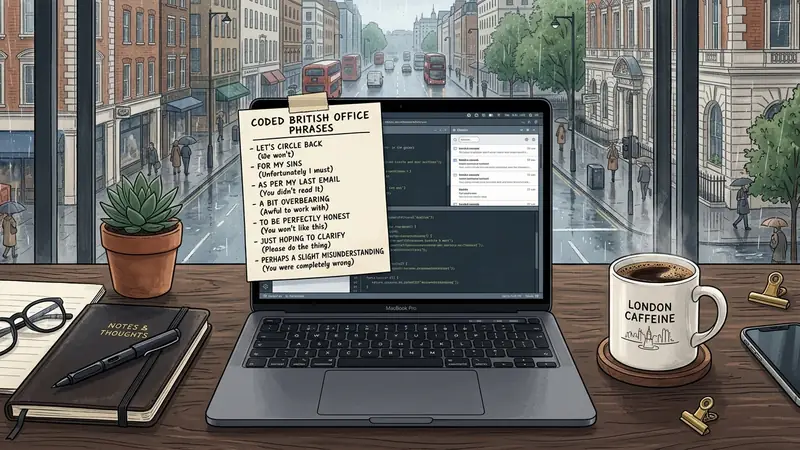
The Decode Table: What They Say vs. What They Actually Mean
This is the single most useful thing I can hand you. Versions of this table have floated around British offices and diplomatic circles for years, and the joke lands because it’s true. Print it. Tape it to your laptop. The left column is what comes out of their mouth. The middle is what a foreigner hears. The right is what’s actually happening.
| What the Brit says | What you hear | What they actually mean |
|---|---|---|
| “Quite good.” | Pretty good! | Mediocre. A bit disappointing, honestly. |
| “That’s interesting.” | They’re intrigued. | I disagree and I’m being polite about it. |
| “With the greatest respect…” | They respect me. | You are wrong, possibly an idiot. |
| “I’ll bear it in mind.” | They’ll consider it. | I’ve already forgotten it. It’s gone. |
| “I hear what you’re saying.” | They agree. | I disagree and don’t want to discuss it further. |
| “That’s a very brave proposal.” | They admire my courage. | You are insane and this will fail. |
| “I only have a few minor comments.” | Small tweaks needed. | Please rewrite the whole thing. |
| “Not bad.” | It’s okay, I guess. | This is genuinely good. High praise. |
| “I’m sure it’s my fault, but…” | They’re taking the blame. | It is entirely your fault. |
| “We’ll definitely have to do this again.” | New friendship! | I am never doing this again. |
| “No harm done.” | All forgiven. | You’ve done real harm. I’m just too polite to say so. |
| “Perhaps we could consider some other options.” | Brainstorm time. | I do not like your idea at all. |
The trap, as I learned the hard way, is “not bad.” It sounds like a shrug. It’s actually a standing ovation from someone who refuses to clap and make it awkward. If a British colleague calls your work “not bad,” go buy yourself a drink. You earned it. One caveat: this is shorthand humor, not a science. Tone and eyebrows carry half the meaning, and a warm “that’s interesting” is a different animal from a flat one. But as a starting decoder ring, it’s shockingly accurate.
Pub-Round Mechanics: The Real Test
Forget the boardroom. The actual evaluation happens at the pub, and the currency is the round. Drinks with colleagues after work are a normal, expected part of British business life, not some frat-boy aberration. Inviting counterparts for a pint after a meeting is completely standard. And the round system is where foreigners quietly fail.
Here’s how it works. In a group, you don’t buy your own drink. One person buys a round for everyone, then the next person buys the next round, and so on until everyone has taken a turn. The British will silently — and I mean silently, they will never mention it — keep a running ledger in their heads of who has and hasn’t bought one.
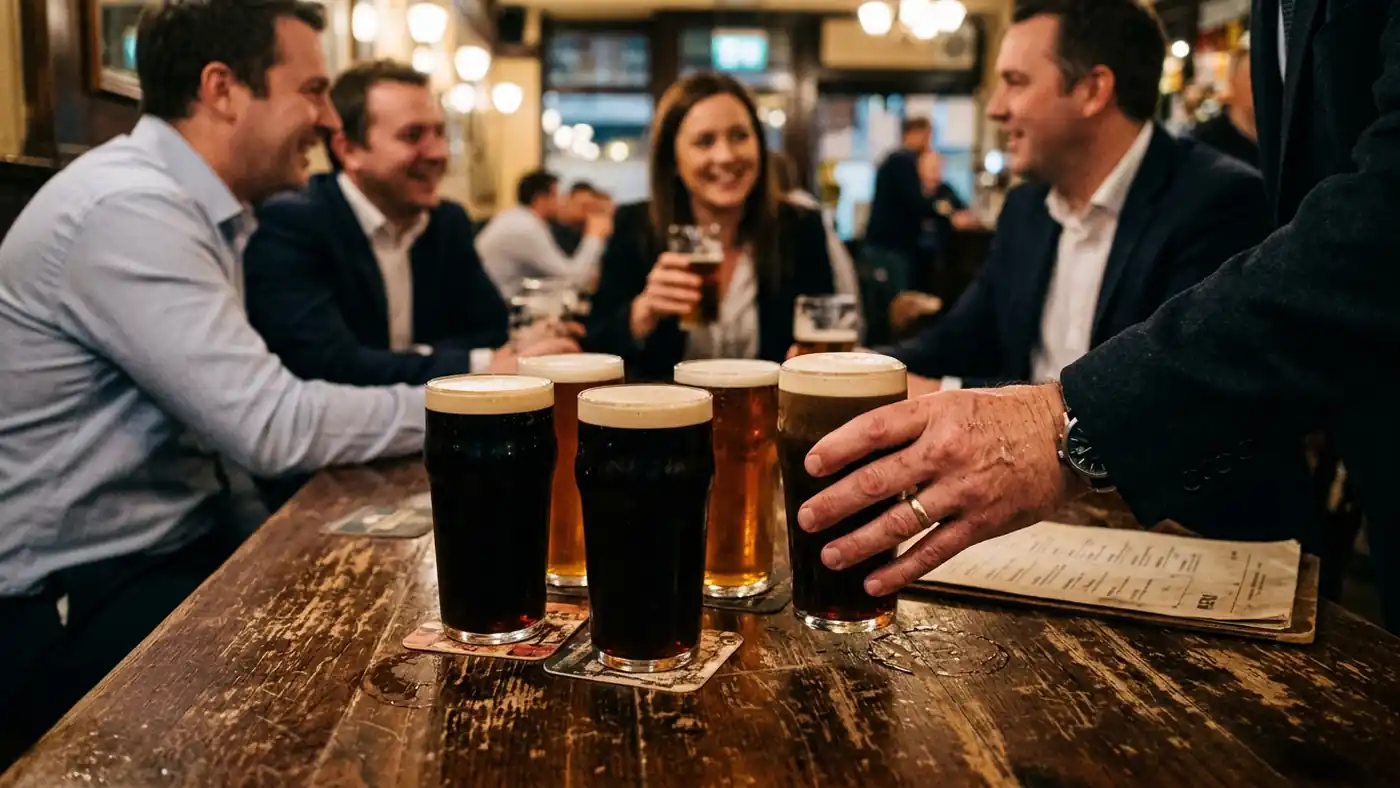
The rules that matter:
- Never leave before you’ve bought a round. This is the cardinal sin. Slip out after drinking three of other people’s pints and contributing nothing, and you’re marked, permanently, as a freeloader. Buy your round.
- Watch the glasses, not the clock. The cue to stand up and say “right, my round” is when everyone’s drinks are about a quarter full, so fresh ones land just as the old ones empty. Seamless. No gap. That timing is itself a small social skill they’ll clock.
- Keep it roughly even. Don’t order the most expensive thing on the menu when someone else is buying. The unspoken goal is that everyone spends about the same across the night. Splashing out on someone else’s tab is bad form.
- A round is goodwill in liquid form. Nobody’s legally obligating you, but doing it gracefully earns quiet respect. Skipping it earns you a few “light-hearted” jokes at your expense, which, per the decode table, are not actually light-hearted.
I once watched an American executive offer to “just split the bill at the end” to a table of British colleagues. The silence was the loudest thing in the room. He’d meant to be fair. He’d accidentally insulted a thousand years of tradition. Don’t be that guy. Just buy the round.
Punctuality, Queueing, and the Quiet Rules
A few things aren’t coded at all. They’re just hard lines.
Punctuality. For business meetings, arriving on time — or about five minutes early — is non-negotiable. Show up late, especially without a heads-up message, and you read as disrespectful and disorganized. In a British office, chronic lateness signals inefficiency, not importance. This is a different planet from the “stroll in fifteen minutes late” cultures I’ve worked in. In the UK, on time is the floor, not the target. (More than ten minutes early gets a bit awkward too — five is the sweet spot.)
Queueing. The British queue for everything, and jumping a queue is one of the very few things that will crack the famous calm and produce actual audible huffing. This applies at the coffee machine and the sandwich shop as much as anywhere. The rule is simple: find the back of the line and stand in it. When in doubt, assume there’s a queue and you’re at the end of it.
Small talk first. Even though they value time, British meetings almost always open with a few minutes of small talk — the weather, your journey in, whether you found the building okay. Don’t bulldoze it to “get down to business.” The chit-chat is the warm-up, and skipping it reads as cold.
Unspoken seniority. Hierarchy exists, but it’s worn lightly and rarely announced. The most senior person in the room may be the quietest, the least flashy, the one making the self-deprecating joke. Status gets signaled through understatement, not volume. Watch who defers to whom before you assume who’s in charge.
Humor and Self-Deprecation: The Secret Handshake
The fastest way to win a British room is to make fun of yourself. Self-deprecation is the national love language. Confidence delivered straight reads as arrogance; the same confidence wrapped in a joke at your own expense reads as charm and, somehow, competence. The person who says “well, I’ll probably mess this up, but…” and then nails it gets trusted far more than the one who oversells.
Irony is constant, and often delivered completely deadpan. If a British colleague says something absurd with a totally straight face, that’s a joke, and the right move is to play along, not earnestly correct them. American-style enthusiasm — “this is going to be HUGE, this is the BEST quarter EVER” — tends to land with a thud. Dial it down by about 40%. The British trust the understated and distrust the hyped. This thread runs through a lot of European business cultures, actually. I noticed a milder version of it working in Germany, where directness is prized but theatrics are not.

A Field Checklist Before Your First UK Meeting
Run this before you go in. It’s saved me from myself more than once.
- Re-read the decode table. Assume “interesting,” “brave,” and “with respect” mean the opposite of what they sound like.
- Arrive five minutes early. Not on the dot — early. Late without a text is a real strike.
- Let the small talk happen. Weather, your journey, the building. Two minutes. Don’t skip it.
- Dial your enthusiasm down ~40%. Understate your wins. “Not bad” energy beats “this is incredible” energy.
- Lead with a small self-deprecating joke. It disarms the room faster than any pitch.
- If drinks follow, commit to your round. Buy one, time it right, don’t leave before you do.
- Don’t jump the queue. Ever. Even the coffee one.
If you’re building the wider trip around this meeting, my London business travel guide covers the logistics — transport, neighborhoods, where to actually stay — and my international business etiquette cheat-sheet is the one-page version you can glance at in the taxi.
FAQ
Do I really have to buy a round at the pub?
You’re not legally obligated, but yes, you basically do. When drinking in a group, the expectation is that everyone takes a turn buying drinks for the whole group. Buying yours earns quiet goodwill; skipping it — especially leaving before your turn — marks you as a freeloader. Watch for everyone’s glass hitting about a quarter full, then stand up and say “my round.”
What does “that’s interesting” actually mean in a British meeting?
Usually that the person disagrees and is being too polite to say so directly. Same goes for “with the greatest respect” (you’re wrong), “a brave proposal” (this will fail), and “I’ll bear it in mind” (forgotten already). When you hear these, treat them as soft no’s and ask a clarifying follow-up rather than charging ahead. Tone matters, though, so read the face along with the phrase.
How early should I arrive for a UK business meeting?
Aim for on time or about five minutes early. Punctuality is taken seriously in British business culture, and arriving late without messaging ahead reads as disrespectful and disorganized. Showing up more than ten minutes early can be slightly awkward too — five minutes early is the sweet spot.
Is British self-deprecation real or just a stereotype?
It’s real and it’s strategic. A modest joke at your own expense signals confidence without arrogance, which the British trust far more than overt self-promotion. Pair it with understatement — describing a clear success as “not bad” — and you’ll fit the cultural register much faster than if you oversell.
Why does no one tell me directly that my idea is bad?
Because directness can feel like rudeness in British workplace culture, the preferred mode is understatement and coded language aimed at keeping things harmonious. The criticism is there — it’s just delivered through phrases like “have we considered other options?” or “a few minor comments.” Learn the decode table and you’ll hear the real message underneath the politeness.
Etiquette norms described here reflect general British business custom as of 2026 and are conventions, not rules — regions, industries, and individual people vary, so read the room and confirm anything formal (visas, contracts, legal requirements) with an official source.