

Short answer: If you fly internationally even once a year, buy Global Entry ($120 for 5 years, as of 2026). It includes TSA PreCheck for free, so you get the fast domestic security line and a fast U.S. customs line on the way home for only about $35–$43 more than PreCheck alone. If you only ever fly domestically, get TSA PreCheck by itself (roughly $76.75–$85 for 5 years, depending on the provider). CLEAR Plus ($209/year) is a different animal entirely — it’s a private speed-up-the-ID-check service, not a government program, and most people don’t need it. Terms and prices change, so confirm on the official source before you pay.
I paid for all three. Not because I’m thorough — because I’m dumb and impatient. I bought CLEAR at an airport kiosk while a very friendly person in a blue vest told me my life would change. It did not change. Then I bought PreCheck. Then, a year later, standing in a 40-minute customs line at Newark holding a cold McDonald’s bag I’d carried from Frankfurt, I bought Global Entry and realized I’d done the whole thing backwards.
Heads up: some links below are affiliate links — I may earn a small commission at no cost to you. I only point you toward stuff I’d actually use.
The Verdict, Before You Scroll
Here’s the thing nobody tells you at the kiosk: these three programs solve different problems. They’re not three flavors of the same thing. They’re barely even competing.
PreCheck gets you through the domestic security checkpoint without doing the shoe-belt-laptop striptease. Global Entry does all of that plus blows past the customs and immigration line when you re-enter the United States from abroad. CLEAR just walks you to the front of the line to show your ID — and then you go through security like everybody else.
So the question isn’t “which is best.” It’s “which problem do I actually have.” For most business-traveling dads who leave the country occasionally, the answer is Global Entry, and it’s not close.
The 3-Way Comparison (2026)
This is the table I wish someone had shoved in my face before I started handing out my credit card at airports. All figures are as of 2026 — programs adjust their pricing, so treat this as a starting point and verify on the official site.
| Global Entry | TSA PreCheck | CLEAR Plus | |
|---|---|---|---|
| Price | $120 / 5 years | ~$76.75–$85 / 5 years | $209 / year |
| What it speeds up | U.S. customs & immigration on re-entry plus domestic security | Domestic security screening | The ID-check line only |
| Includes PreCheck? | Yes (bundled, free) | It is PreCheck | No — add PreCheck for the fast lane |
| Domestic vs. international | Both | Domestic only | Domestic only (select airports) |
| Who runs it | U.S. Customs & Border Protection (government) | TSA (government) | CLEAR (private company) |
| Replaces screening? | No — speeds it up | No — speeds it up | No — you still get screened |
| Validity | 5 years | 5 years | Annual subscription |
Read that “Includes PreCheck?” row twice. That’s the whole ballgame. Global Entry bundles TSA PreCheck at no extra cost, which means you’re choosing between paying $120 once for both benefits over five years, or paying roughly $76.75–$85 for just one of them over the same five years. Thirty-five to forty-three bucks to also skip the customs line forever? Come on.
A note on TSA PreCheck pricing
You’ll see “$78” thrown around like it’s the official price. It isn’t — there’s no single flat number anymore. Since the program went multi-provider, you pick your enrollment company and the price varies: $76.75 through IDEMIA, $79.95 through CLEAR’s enrollment service, and $85 through Telos (as of 2026). Same benefit, slightly different sticker. TSA also runs occasional promotions — there was a “$20 off” deal for new enrollees aged 30 and under that ran for the month of May 2026 — so it’s worth a quick check on the official TSA site before you sign up.
A note on CLEAR Plus pricing
CLEAR Plus runs $209 per year as of 2026 (that price took effect in mid-2025), and CLEAR has confirmed another increase landing July 1, 2026 — it just hasn’t said how much. So by the time you read this, it may cost more. That’s the math problem with CLEAR: it’s the most expensive of the three and the only one you pay for every single year, forever.
Who Should Buy Which: The Decision Tree
Stop overthinking it. Run yourself down this list and stop at the first line that’s true.
- You fly internationally even once a year → Buy Global Entry. It includes PreCheck. You’re done. This covers most business-traveling dads I know.
- You only ever fly domestically and don’t see that changing → Buy TSA PreCheck. Cheaper, does the one job you need, lasts five years.
- You fly out of a CLEAR airport constantly, hate lines with the heat of a thousand suns, and money is no object → Consider adding CLEAR Plus on top of PreCheck. Note the word “add.” CLEAR is a supplement, not a substitute.
- You travel rarely and the fee stings → Get a travel card that reimburses the fee (more on this below), then buy Global Entry or PreCheck and let the card pay for it.
- You have kids who fly with you → Read the family section. Seriously, don’t skip it. It’s where people get ambushed.
That’s the entire decision. If you got to the bottom without stopping, you probably don’t fly enough to need any of this — and that’s a perfectly fine answer too.
The Family Gotcha That Got Me
I assumed my kids could ride through on my PreCheck. Memberships, it turns out, can’t be shared — every traveler needs their own enrollment tied to their own identity. That’s true for Global Entry too: each kid needs their own Global Entry membership and their own $120 application.
There is one mercy, and it’s a real one: children 12 and under can use the TSA PreCheck lane for free when they’re traveling with a parent who has PreCheck. No enrollment, no fee, no fuss. Once a kid turns 13, that grace period ends and they need their own membership to use the PreCheck line.
So the practical move for a family that flies internationally: enroll the adults (and any teens 13 and up) in Global Entry, lean on the free-for-12-and-under lane for the little ones while it lasts, and budget for the kids’ own memberships as they age into it. Confirm the current age rules on the official CBP and TSA sites before you plan around them — these details get tweaked.
The Cheat Code: Cards That Reimburse the Fee
Here’s the part that makes the occasional flyer’s decision easy. A whole pile of travel credit cards will reimburse your Global Entry or PreCheck application fee as a statement credit — typically once every four years, which lines up neatly with the membership term. You pay the $120, the card credits you $120 back, the program is effectively free.
The card I point first-timers to is the Chase Sapphire Preferred. Its annual fee has stubbornly held at $95 for about 15 years now, it carries a statement credit toward Global Entry, PreCheck, or NEXUS (currently up to $120 every four years), and in mid-2026 it was running an unusually large sign-up bonus — TPG called the 100,000-point offer one of the best the card has ever had. Bonuses and credits change constantly, so check the current terms on Chase’s official page before you apply rather than trusting a number you read in a blog post (even this one).
Prefer something simpler? The Capital One Venture family is the standard no-fuss alternative and also reimburses up to $120 of the application fee once every four years. The point is the mechanism, not the specific card: if you’re going to get a travel card anyway, getting one that pays for your trusted-traveler membership turns a “should I bother?” question into a “why wouldn’t I?” question.
I dig into how to choose your first one without getting fleeced in my guide to the best first travel credit card for occasional travelers. Read that before you apply for anything.
What These Programs Do NOT Do
Quick reality check, because the kiosk people won’t give you one. None of these three programs gets you a refund when your flight implodes. That’s a totally separate set of rights, and dads get these confused all the time.
If a U.S. airline cancels or significantly changes your flight and you decline the rebooking, the Department of Transportation now requires an automatic cash refund — not a voucher, actual money, back to your original payment method (a rule that took effect in October 2024 and remains in force in 2026). Flying out of or into Europe, the EU’s passenger-rights regulation can owe you cash compensation — broadly in the €250 to €600 range depending on distance — for cancellations and long delays within the airline’s control, on top of any refund. These are rights, not insurance payouts, and you don’t need a fancy membership to claim them. I broke down exactly how to work that system in my piece on what to do when your business-trip flight gets cancelled. Verify the current thresholds on the DOT and EU sites before you file — the conditions have fine print.
And obviously: none of this is your passport. A trusted-traveler membership is worthless if your passport is expired or about to be. Plenty of destinations want several months of validity left on the book before they’ll let you in, and the exact cushion varies by country. If you don’t know about the trap that strands travelers at the gate, read the passport six-month rule before your next international trip. Ask me how I learned about it.
A Couple of Cheap Things That Actually Help
Once you’ve got the fast lane sorted, the next bottleneck is fumbling at the kiosk and the bin. Two cheap, dumb fixes I keep using:
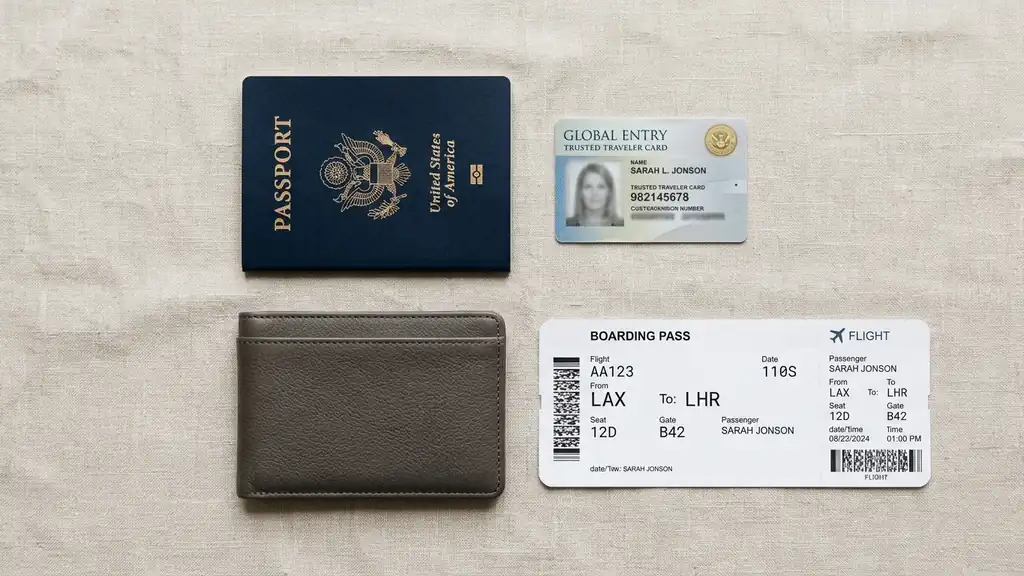
- A slim RFID-blocking travel wallet so your passport, Global Entry card, and a backup card live in one place instead of scattered across four pockets. The kiosk is faster when you’re not patting yourself down like you forgot your keys.
- A simple passport holder that keeps the document from getting bent into a banana in your bag. Border agents are not charmed by a passport that looks like it survived a washing machine.
Neither is life-changing. Both have saved me roughly nine seconds of flailing per trip, which over a career adds up to, I don’t know, a sandwich’s worth of time.

So Did I Waste Money on All Three?
Mostly, yes — but you don’t have to. CLEAR was the one I’d skip if I had it to do over; for my travel pattern it solves a problem I rarely have. Global Entry is the one I’d buy on day one, because it quietly does PreCheck’s job and spares me the customs line that ruins the last 45 minutes of every international trip. PreCheck I’d only buy standalone if I were certain I’d never leave the country.
Buy the one that matches the trips you actually take, let a credit card pick up the tab, and don’t let a friendly person in a vest sell you a subscription you’ll forget to cancel. That’s the whole post.
FAQ
Is Global Entry worth it?
If you fly internationally even once a year, yes — easily. For $120 over five years (as of 2026) you get fast U.S. customs re-entry and TSA PreCheck bundled in, which is only about $35–$43 more than buying PreCheck alone. If a travel card reimburses the fee, it’s effectively free. The only time it’s not worth it is if you genuinely never fly out of the country, in which case standalone PreCheck does the job for less.
Can my kids use my PreCheck?
Not by sharing your membership — that isn’t a thing; every traveler needs their own enrollment. But there’s a built-in exception: children 12 and under can use the TSA PreCheck lane for free when traveling with a parent who has PreCheck. At 13 and up, they need their own membership. Global Entry always requires a separate membership per person, including kids. Confirm the current age rules on the TSA and CBP sites, as they can change.
What’s the difference between Global Entry and PreCheck?
TSA PreCheck speeds up domestic airport security — you keep your shoes and laptop in place and use a shorter line. Global Entry does all of that and fast-tracks you through U.S. customs and immigration when you return from abroad. Global Entry includes PreCheck for free, so it’s a strict upgrade for anyone who travels internationally. PreCheck does not include Global Entry’s customs benefit.
Is CLEAR worth it?
For most people, no. CLEAR Plus ($209/year as of 2026, with another increase confirmed for July 2026) only moves you to the front of the ID-check line — you still go through security, and it’s a private subscription you pay for every year. It can make sense if you fly constantly out of a CLEAR-equipped airport and value the time at any price, but it’s a supplement to PreCheck, not a replacement for it. Buy Global Entry or PreCheck first; consider CLEAR only if lines still drive you up the wall.
Which should I buy first?
Global Entry, if you ever fly internationally — because it includes PreCheck, you get both benefits in one $120 purchase. Only buy PreCheck standalone if you’re certain you’ll stay domestic. And before you pay out of pocket, check whether a travel credit card you’d want anyway will reimburse the application fee — for occasional flyers, that’s usually the smartest order of operations.
Prices, fees, bonuses, and passenger-rights figures in this article are accurate as of 2026 to the best of my research, but they change often. Always confirm the current details on the official source — CBP for Global Entry, TSA for PreCheck, CLEAR for CLEAR Plus, the card issuer for any credit card offer, and DOT or the EU for passenger rights — before you spend a dime.