
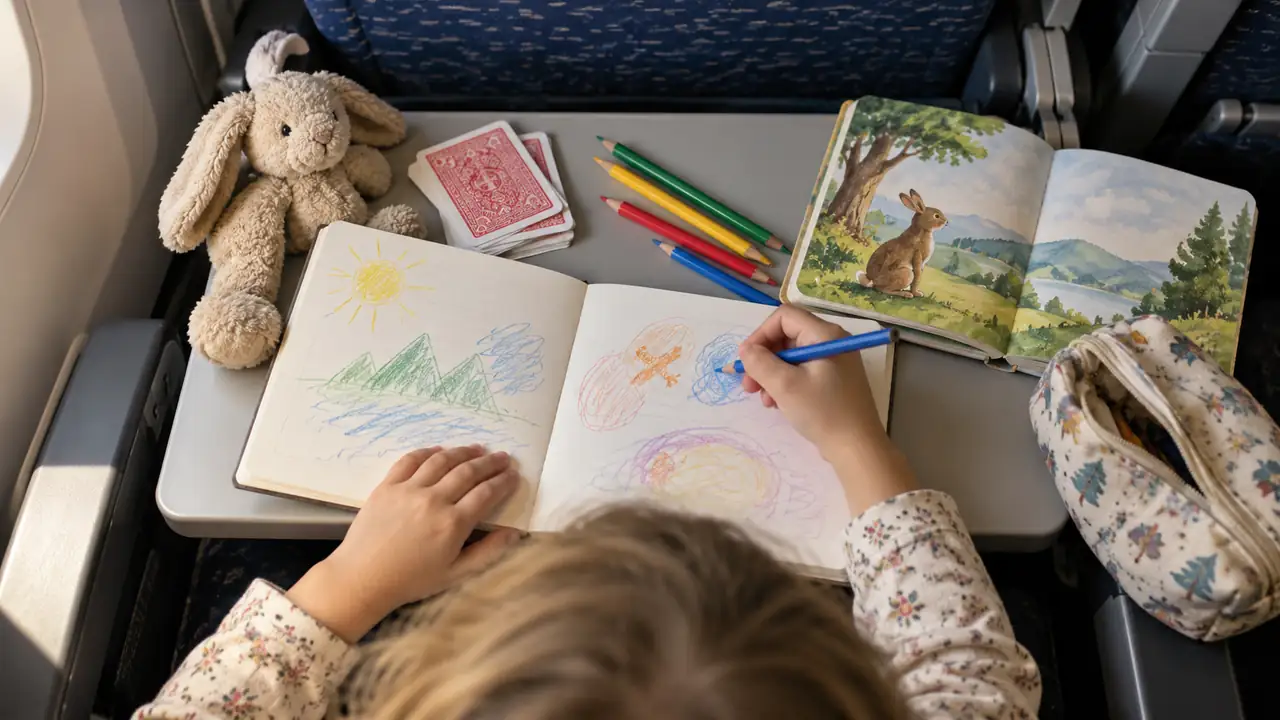
The mistake is not forgetting an activity. The mistake is packing so many activities that getting one out becomes an activity.
A small flight bag for children should be easy to reach, easy to clear away, and familiar enough to work when everybody is tired. It does not need to reproduce the playroom in the space beneath an economy seat.
For the long holiday flights coming up, I would choose a few things that can be used in several ways: paper, a small set of drawing tools, a book, a simple game, and something comforting. Then I would plan to participate, because the most expensive toy in the bag often loses to ten minutes of undivided attention.
This is a practical no-screen option for school-age children, with ways to adapt it for younger travelers. Adjust every item to your child’s age, needs, and safety. A tiny game piece that suits an older child may be completely wrong for a younger sibling.
Choose for Your Child on a Tired Day
Think about what they actually enjoy when they are worn out. The child who loves drawing at home may draw on a plane. The child who has never enjoyed puzzles is unlikely to discover a lifelong passion for them because you bought an airport-themed version.
Ask the child to choose a small part of the bag before departure. Give them a realistic limit: one book, one compact game, or whichever familiar item matters most. A little ownership can prevent the entire kit feeling like an adult assignment.
Do not make every object new. A familiar story or comfort item can be more useful than something that needs instructions. If you bring a surprise, keep it small and suited to the child rather than the advertising age range alone.
For younger children, prioritize simple things that stay in one piece and can be used together with an adult. Avoid sharp parts, loose batteries, or small pieces that create a safety risk. Follow product guidance rather than improvising because the item fits in a pouch.
The aim is not continuous performance. It is having a few good options when the child wants something to do.
The Kit I Would Start With
- A thin notebook or sketchbook that opens comfortably on a small table.
- A few suitable pencils or crayons in a closed pouch, rather than a whole art department.
- One book the child wants, perhaps with a destination connection.
- A simple card game or other compact activity with manageable pieces.
- One familiar comfort item, if the child uses one.
Everything should fit in a small bag the responsible adult can access. The child can carry some items if that works, but do not assume an exhausted child will manage an overstuffed backpack through every connection.
Test the kit on a table at home. Can you put it away quickly? Can the child use it without spreading across someone else’s seat? Does the game require a perfectly level surface and thirty-seven counters? Those are useful discoveries before boarding.
Pack wipes or whatever simple cleaning materials are appropriate for your family, and keep rubbish contained. Avoid sticky, noisy, strongly scented, or elaborate craft activities. The cabin is a shared space with unusually limited cleaning options.
I would also leave a little spare room. Children acquire paper, boarding-pass memories, and small treasures. A pouch that barely closes at departure is already overcommitted.
A Notebook Can Do More Than One Job
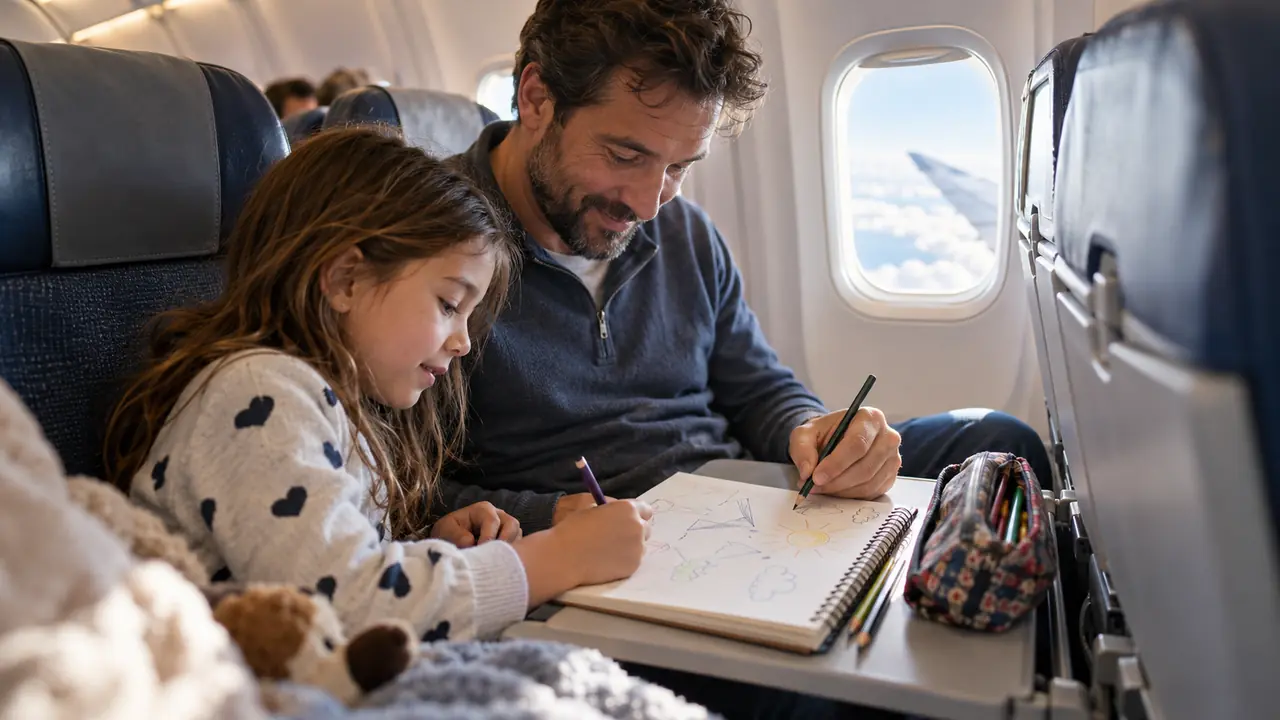
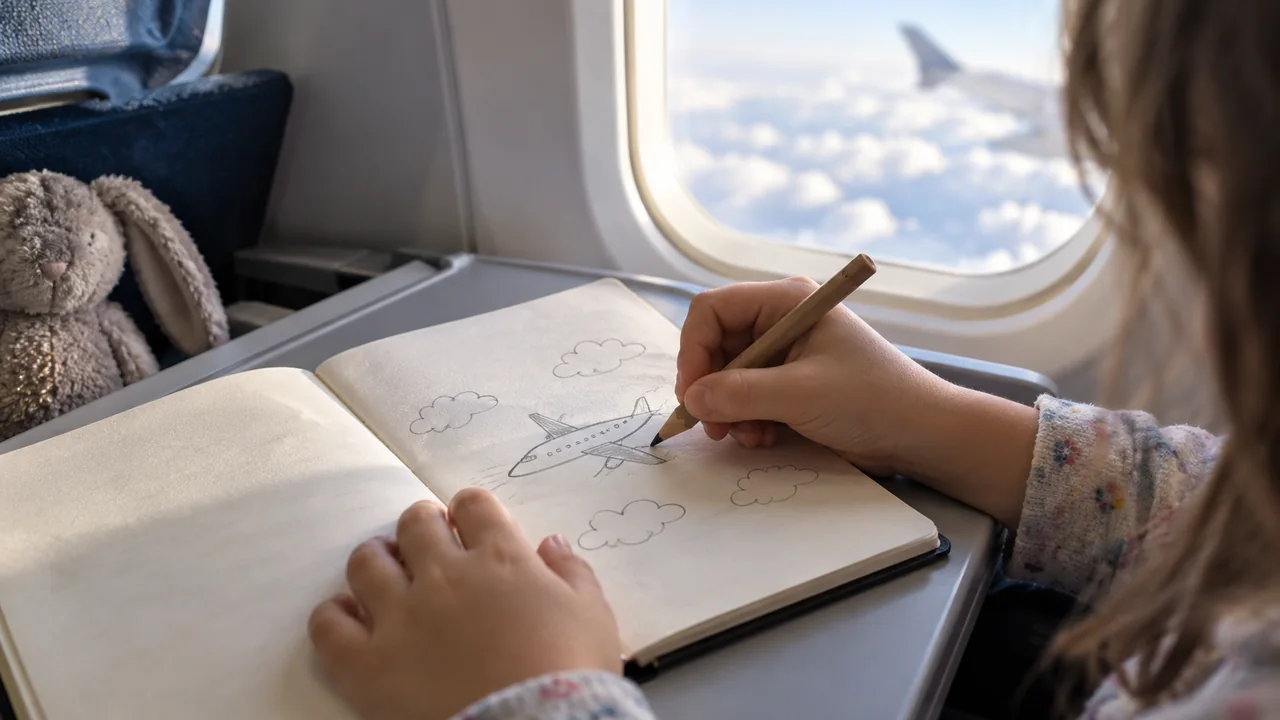
Start with drawing what is visible: a wing, a cloud, a suitcase, or the strangest airport chair. It does not have to look accurate. If your drawing is terrible, congratulations: you have provided free entertainment.
Try taking turns adding one thing to a shared picture. One person draws a house, another adds an absurd vehicle, another decides who lives there. A single page can last longer than a fresh worksheet because everybody has a stake in the nonsense.
Older children can make a small travel journal: what they expect, one thing they noticed, or a question to answer at the destination. Keep it voluntary. Turning the flight into homework is a reliable way to make a notebook less appealing.
You can also make a simple spotting list together before departure. Use things that can be observed safely from seats or waiting areas, and avoid tasks that encourage wandering or disturbing other travelers.
For a destination-focused family trip, a notebook gives questions somewhere to go. The journey becomes part of the visit rather than an unpleasant corridor between home and the good bit.
Games That Need Almost Nothing
“Would you rather” works when the choices are genuinely silly and nobody has to win. Take turns inventing them. An airport powered by hamsters or a plane with a slide instead of stairs is a useful subject for a child and a harmless one for a tired parent.
Try a shared story with one sentence each. Keep the rules minimal. If the story becomes a dragon ordering breakfast at a hotel, let it. This is not a writing assessment.
Guessing games can work quietly if the child enjoys them: a familiar animal, a person from a favorite book, or an object in the room. Match the difficulty to the age and energy available.
For children learning letters or numbers, use gentle observation games they already like. Do not turn every sign or seat number into a teaching opportunity. They can notice the world without being examined on it.
And when nobody wants another game, stop. A parent determined to deliver value from a carefully prepared activity plan can become more exhausting than an empty bag.
Books Work Better When They Are Chosen, Not Assigned
Bring a book your child actually wants to hear or read. A destination theme can be useful, but interest matters more than geographic relevance. A favorite familiar story is perfectly respectable cabin literature.
Read together in short stretches. Let the child point things out, guess what happens next, or stop at a picture. You do not have to finish a chapter because the bookmark has ambitions.
If the book connects with the trip, use it as a conversation starter. What might feel different there? What would the characters notice? What food would they try? My post on how stories help children engage with history explores that approach beyond the flight.
A child who reads independently may still enjoy being read to when tired. An older child may want quiet time instead. Ask rather than assuming the age on the book tells you the whole story.
Keep the book somewhere reachable after the main bag is stowed. An excellent story in an inaccessible overhead compartment is currently a weight allowance problem.
Break the Journey Into Events, Not Promises About Minutes
Children can understand “after boarding,” “after the meal,” and “when the cabin gets quieter” more easily than an abstract block of flight time. Explain the next stage without promising an exact schedule you do not control.
Do not hand over every activity as soon as you sit down. Let the aircraft, window, and boarding process be interesting if the child finds them interesting. Keep the rest available for later.
At level flight, use the tray table when permitted. Put things away promptly for crew instructions, meals, turbulence, and landing. A simple kit should make that easy rather than requiring a small evacuation.
Choose movement breaks only when safe and allowed, and follow crew guidance. An aisle is a working space, not a playground. You can still make the seated parts more comfortable by changing activity and position within what is appropriate.
If sleep is likely, shift toward familiar quiet things rather than introducing the most exciting surprise in the bag. A book and a comfort item may fit that part of the flight better than a competitive game.
Make Boredom Less of an Emergency
A child saying “I’m bored” does not always require a new purchase. Sometimes it means “talk to me,” “I’m tired,” or “nothing is happening and I dislike it.” Ask a small question before opening another compartment.
Look out of the window together, tell a story about your own ordinary day, or sit quietly for a moment. You do not have to convert every gap into enrichment.
Also check the basics. Hunger, thirst, discomfort, and tiredness can make any activity seem wrong. A new game will not fix a shirt soaked in juice.
Adapt if the plan is not helping. Families differ, and so do flights. The kit is there to make the journey easier, not to become a rule everybody must obey at the expense of getting through the day.
One parent doing all the entertaining needs a break too. If another adult is available, trade a clear period of responsibility. “Your turn” works better when it is spoken before resentment becomes the in-flight announcement.
Keep Something for the Queue After Landing
The flight is only part of the travel day. Immigration, baggage, and the journey to accommodation may ask for another round of patience. Keep a familiar small item reachable rather than packing everything away as soon as the aircraft lands.
For a longer family extension, the account of turning a Japan work trip into a family journey shows why the transitions matter as much as the headline attractions. The children experience the whole trip, including the waiting.
Before leaving the aircraft, check the seat area according to crew guidance and count the important objects. Especially the beloved soft one. A missing pencil is a minor loss. A missing lifelong companion made of stuffing is a different operational category.
Then carry the small bag onward. A few things, used well, with an adult willing to join in. That is enough of a plan for a space where nobody has much room anyway.
Rehearse the Bag in a Small Space
A week before departure, sit together at a small table and try one or two of the activities. Use only the space the child is likely to have on the flight. This is a test of the kit, not a test of the child.
Notice what immediately falls, needs adult assembly, or requires spreading out. Replace the awkward item now. Something can be an excellent toy and a poor airplane toy at the same time.
Practice putting everything back in the pouch. Keep the system simple enough that another adult can understand it without a briefing. If each pencil has a special compartment and the cards must be returned in a particular sequence, the bag is asking too much from a tired family.
For a child who likes drawing, choose a few prompts together: invent an airport for animals, design a ridiculous suitcase, or draw the meal you hope to eat after landing. Save the prompts as a short note for yourself rather than carrying a stack of worksheets.
For a child who likes stories, choose a few starting lines or familiar characters. Ask whether they want to tell the story, draw it, or hear you tell it. The same idea can become several activities without requiring several objects.
For an older child who wants independence, agree that some of the flight can be quiet personal time. Offer the book or journal without narrating how well they are using it. An activity does not need an adult commentary track to count.
Then rehearse the interruption. Close the notebook, put the pencils away, and clear the table as though the crew needs the space. If that takes a long time, reduce the kit. Quick cleanup is an unusually valuable feature on a plane.
Keep expectations modest after the rehearsal. Enjoying an activity at home does not guarantee the same response after an early start and a security queue. It simply gives you a better starting point than a bag of untested surprises. Pack the useful things, bring some patience for the rest, and leave room for the flight to be an ordinary part of the journey.
Stories for Curious Travelers
Let a travel story open a conversation about the places the family is about to see.