

Short answer: As of 2026, the UAE runs a Western-style workweek — Monday to Friday, with Saturday and Sunday off. Friday is a short day: federal offices work a half day and break for noon prayers, and the national Friday sermon is now fixed at 12:45 pm (moved earlier from 1:15 pm effective January 2, 2026 — confirm the current time before you book anything tight). Schedule real business Monday through Thursday, treat Friday before 2 pm as untouchable, lean into the long coffee and the relationship-first pace, keep your right hand busy and your left hand quiet, and expect the actual deal to get made after the formal meeting ends. Always confirm prayer times and Ramadan dates on an official UAE source, because they move every year.
I once booked a “quick 30 minutes” in Abu Dhabi for 12:30 on a Friday. My host was gracious about it. He was also, I realized later, skipping Jummah to sit with a guy who’d flown in from Ohio. I have never felt smaller holding a tiny cup of coffee.
The Fact That Trips Up Every First-Timer: The Week Moved
Here’s the landmine. I’m going to step on it so you don’t have to. If you read an old guidebook, an old blog post, or anything written before 2022, you’ll see the UAE described as a “Sunday-to-Thursday” country with a “Friday-Saturday weekend.” That’s wrong now. Delete it from your brain.
On January 1, 2022, the UAE federal government switched to a Monday-to-Friday workweek with a Saturday-Sunday weekend. Friday became a half day for federal entities — government staff work roughly 7:30 am to 12:00 pm, then break for prayers. It was the first country in the world to run a four-and-a-half-day national workweek, and the stated reason was to line up with global markets. Saturday and Sunday are the weekend now, same as back home.
The private sector mostly followed, but here’s the nuance: private companies aren’t legally locked into the half-day Friday. Many run a full five-day Monday-to-Friday week. Some still keep a Saturday. So you confirm with the specific company you’re meeting, every time. The safe mental model for 2026: their week looks like yours now. The thing that doesn’t look like yours is Friday.
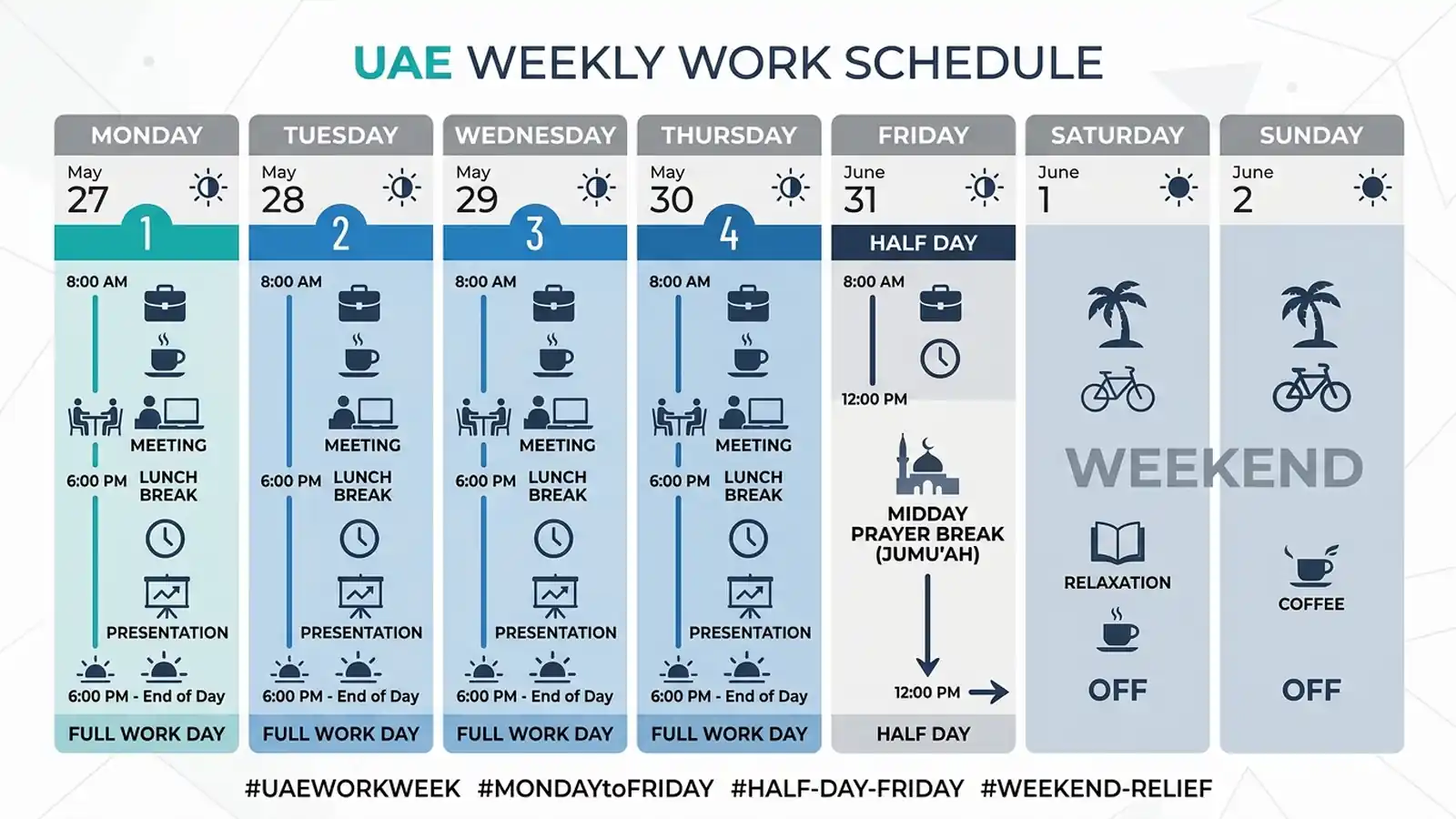
Why does this matter so much for a dad with a packed itinerary? Because if you fly in on the old assumptions, you burn your first day. You’ll treat Sunday as a day off and it’s a full workday. You’ll treat Friday as normal and get a polite “let’s do Thursday instead.” Get the week right and you look like you did your homework. Get it wrong and you’re the guy who showed up on the wrong day.
The 9 Rules I Wish Someone Had Handed Me at Arrivals
I’ve done enough Gulf trips now to have a system. Here it is, numbered, so you can screenshot it.
- Book Monday through Thursday. Treat Friday before ~2 pm as off-limits. The Friday sermon and prayer is now at 12:45 pm (changed from 1:15 pm effective January 2, 2026). Offices, banks, and services slow or stop around midday. Don’t fight it. Push Friday business to late afternoon, or skip the day.
- Confirm prayer times and the workweek with your host, not with me. Times drift through the year and the Friday slot just changed. Ask your contact, “What time works around prayers on Friday?” That one question tells them more than any handshake.
- Lead with your right hand. Always. Shake with the right, pass cards with the right (or both), hold your coffee cup with the right. The left hand is traditionally the “unclean” hand. Handing something over with your left reads as rude, even if nobody says a word.
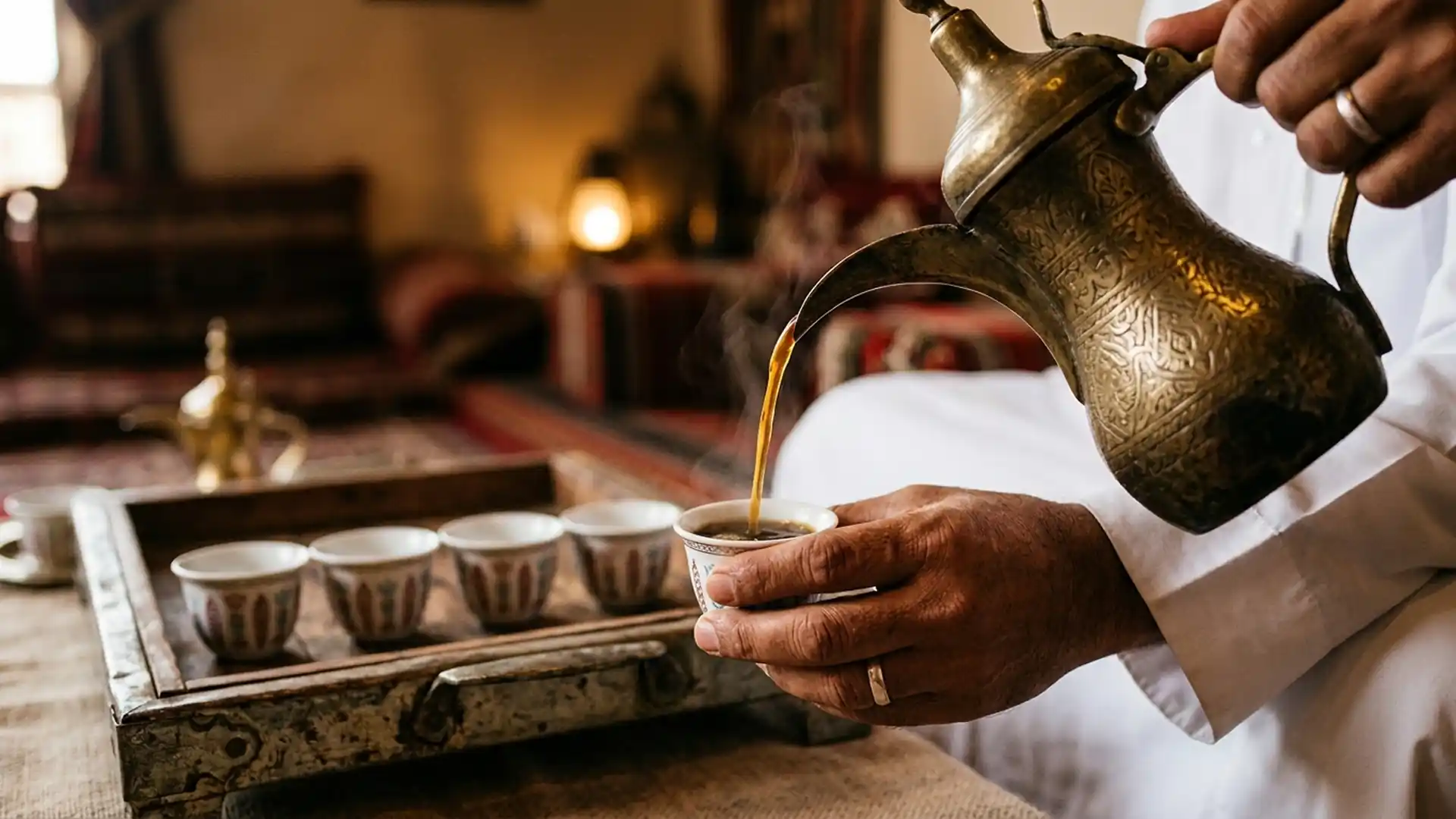
- Drink the coffee. Then drink it again. Arabic coffee — gahwa — is hospitality you can hold. It comes from a dallah pot in a tiny handleless cup called a finjan, filled about a third full. Take it with your right hand. Expect refills. (How to stop is below. It’s a specific move.)
- Slow down. The relationship is the deal. You’re not there to “get to the point.” For the first chunk of every meeting, the point is to prove you’re a human worth doing business with. Small talk about family, the flight, the city — that’s the actual work.
- Dress conservatively, even in 110-degree heat. For a Western dad: a proper suit, or at minimum long trousers and a long-sleeve collared shirt. Jacket on for first meetings and anything government. Covered and a little warm beats casual and underdressed — and the AC is brutal anyway, so you’ll want the jacket.
- Respect Ramadan if your trip lands there. No eating, drinking, or smoking in public during daylight fasting hours. Working hours shrink. Meetings get sleepy and short. Plan around it (full section below).
- Don’t expect the contract at the table. The formal meeting is often a vetting session. The real movement happens after — over more coffee, a meal, the walk to the car. Stay loose and stay late.
- Be patient with titles, hierarchy, and time. Decisions route to the senior person in the room, who may say very little. Meetings start late and run long. They expect punctuality from you and flexibility toward them. That asymmetry is the game.
The Long Coffee and the Majlis: Why Hospitality Is the Meeting
The first time I sat in a majlis, I kept waiting for the “real” conversation to start. The coffee kept coming. We talked about my kids. We talked about his. An hour in, it landed: this was the conversation.
A majlis (literally “a place of sitting”) is a reception space — historically a room in the family home, now echoed in corporate offices, hotels, and government buildings. It’s where guests are received and where, frankly, a lot of business actually gets done. In the majlis, your presence and your patience are the currency.
The coffee ritual has rules, and they’re easy to get wrong:
- Cups are poured about one-third full. That’s correct, not stingy. It keeps the coffee hot and lets the server refill often.
- Take and hold the cup with your right hand.
- Refills keep coming, usually up to three times. Accepting is polite.
- To stop, gently shake or tilt the empty cup side to side as you hand it back. That little wobble means “thank you, I’m done.” Skip it and you’ll get poured another. And another.
That cup-shake is the single most useful thing in this whole article. Nobody tells you, and you can sit there working through your ninth coffee wondering why it won’t stop. It won’t stop because you didn’t do the shake.
If you want the wider picture of how this fits into Gulf and global norms, my international business etiquette cheat sheet lines up the customs country by country, and the full UAE business etiquette hub goes deeper than I can here.
Right Hand, Left Hand, and the Small Stuff That Looms Large
Westerners tend to wave the right-hand thing off as a quaint detail. It isn’t. In the Gulf, the right hand handles food, greetings, gifts, and giving. The left is reserved for, let’s say, bathroom duties. So:
- Shake with the right. If your right hand is full, free it up first.
- Hand over your business card with the right hand or both hands — and actually look at the card you receive before pocketing it. Don’t scribble on it or shove it in a back pocket in front of them.
- Eat with your right hand, especially if food is shared from a communal platter.
- Receive and give gifts with the right hand or both.
One more on greetings. Many Emirati men greet warmly — handshakes can run long, sometimes with a hand on the shoulder or a nose-touch between locals (not something you initiate). With women, follow their lead entirely. Some will extend a hand; many won’t, and a man shouldn’t offer his first. A polite nod with your hand over your own heart is always safe. When in doubt, mirror — don’t initiate.
If Your Trip Lands in Ramadan
Ramadan is a lunar month, so the dates shift earlier by about 11 days each year. Always check the current year’s dates on an official UAE source before you book. If you land during it, three things change.
One: public eating and drinking. Don’t eat, drink, or smoke in public during daylight fasting hours (roughly sunrise to sunset). Historically this carried a fine under the UAE’s public-decency rules, but in early 2024 the UAE relaxed things considerably — restaurants no longer have to screen off their dining areas, and many Dubai and Abu Dhabi venues and mall food courts now serve openly during the day. Enforcement against tourists for an honest mistake was always rare, and the residual legal risk is now minimal. Still: eat in your hotel, in private office areas, or in your car if you’re not visible. Just don’t stroll down the street with a sandwich. It’s courtesy more than law now.
Two: working hours shrink. By law, private-sector working hours are cut by two hours a day during Ramadan — for all employees, regardless of religion — and pay can’t be docked for it. Government hours compress too. Expect shorter, fewer, later-starting meetings.
Three: the rhythm changes. People are fasting. Energy dips in the afternoon. The day comes alive after iftar, the sunset meal. A business iftar invitation is a real honor — accept it if you can, and let your host break their fast before you steer toward anything serious.
Do / Don’t: The UAE Business Cheat Table
| Situation | Do | Don’t |
|---|---|---|
| Scheduling | Book Mon–Thu; keep Friday before ~2 pm clear for prayers | Assume Sunday is a day off (it’s a workday) or book Friday midday |
| Greetings | Shake with your right hand; let women lead on whether to shake | Offer your hand to an Emirati woman first, or use your left hand |
| Coffee (gahwa) | Accept it, hold the cup in your right hand, shake the cup to stop refills | Refuse it outright, or wonder why it won’t stop (you forgot the shake) |
| Pace | Invest in small talk; let the relationship build first | Rush to “the point” or treat hospitality as a delay |
| Dress | Suit, or long trousers + long-sleeve shirt; jacket for first/government meetings | Show up in shorts, sleeveless, or beachy-casual “because it’s hot” |
| Ramadan | Eat/drink privately; expect shorter days; accept iftar invites | Eat or drink in public during daylight fasting hours |
| The deal | Stay after the formal meeting; expect movement over coffee/meals | Push for a signature at the table and leave |
| Hierarchy | Address and defer to the senior person; be patient with decisions | Bulldoze junior staff or demand fast answers |
The Real Meeting Starts After the Meeting
This is the part Western dads — me included — find hardest to swallow. We’re wired to think the meeting is the meeting. You walk in, you present, you discuss, you decide, you leave. Done.
In the Gulf, the formal meeting is frequently the audition. It’s where they decide whether they like you, trust you, and want to keep talking. The yes — the actual yes — tends to form afterward. Over a long lunch. A second coffee. A ride to your hotel. A follow-up the next day. If you bolt the moment the agenda’s done, you walk out right before the important part.
So don’t over-schedule. Leave air in your day. When someone says “let’s get something to eat” or “stay, have more coffee,” that’s not a detour from business. It’s the on-ramp. The dads I know who do well in Dubai and Abu Dhabi treat the trip like the relationship trip it is — the same reason I started adding nights to my work trips so I wasn’t sprinting through every meeting with one eye on the airport clock.

For broader country-by-country prep, the international business etiquette by country guide is the master reference I check before any trip into unfamiliar territory.
FAQ
What is the UAE workweek and weekend in 2026?
Monday to Friday, with Saturday and Sunday as the weekend. The federal government runs a four-and-a-half-day week — full days Monday through Thursday and a half day Friday, breaking for noon prayers. This has been the case since January 1, 2022. The private sector is mostly Monday–Friday but isn’t legally bound to the Friday half-day, so confirm with the specific company.
Can I schedule meetings on Friday in the UAE?
Friday is the trickiest day. Federal offices work only a half day, and the country pauses for the Friday sermon and prayer, now fixed at 12:45 pm (changed from 1:15 pm effective January 2, 2026). Avoid booking anything around midday. Late-afternoon Friday meetings can work, but Monday through Thursday is far safer. Always ask your host, “What works around Friday prayers?”
How do I politely stop the coffee refills?
Gently shake or tilt the empty finjan cup side to side as you hand it back to the server. That small wobble is the signal for “thank you, I’m finished.” Without it, your host keeps refilling — accepting one to three cups is the polite norm, and the shake is how you end the round gracefully.
What should a Western businessman wear in the UAE?
Conservative and covered, despite the heat. A suit for first meetings and anything government-related; at minimum long trousers and a long-sleeve collared shirt. Keep a jacket handy — first impressions favor it, and the air conditioning is genuinely cold indoors. Skip shorts, sleeveless tops, and beachwear in any professional setting.
What changes during Ramadan for business travelers?
Three things. No eating, drinking, or smoking in public during daylight fasting hours (eat privately, in your hotel, or in a screened restaurant). Private-sector working hours are legally cut by two hours a day, so meetings run shorter and start later. And the day shifts toward the evening after iftar. Check the current year’s Ramadan dates on an official UAE source, since they move about 11 days earlier each year.
One last thing, dad to dad: confirm the prayer times, the workweek, and the Ramadan dates on an official UAE government source before you finalize anything. The Friday prayer time just changed in 2026, and these details move. Getting them right is the difference between looking prepared and looking like the guy who showed up on the wrong day.