

Short answer: A business card isn’t paper. It’s the person. When in doubt, use a two-handed exchange: stand, present your card printed-side toward them, read theirs, then set it on the table for the meeting. It’s mandatory in Japan and Korea, appreciated across Asia and the Middle East, and never wrong anywhere. That one habit fixes most mistakes.
I once slid a business card across a table in Singapore the way a poker player slides chips. Six months later I was still trying to recover the relationship. The card is not a piece of paper. It’s the person. Here’s the ritual, country by country.
The Singapore Mistake
I was 36, three years into international work, and feeling competent. The meeting was in a conference room near Raffles Place, the customer was a Singapore-based regional distributor, and the agenda was a mid-sized partnership renewal. Standard stuff.
The deputy director on their side handed me his card with both hands. I took it with one. I glanced at it for half a second. Then I put it on the table near my coffee cup, slid my own card to him with a quick “and here’s mine,” and moved on to the agenda.
The room got quieter. Nobody said anything. The meeting continued.
That night, after dinner, my Singapore colleague — a local who had been at the meeting — pulled me aside in the hotel lobby. He told me, kindly, that the way I’d handled the card had read as dismissive. The deputy director had presented his card with respect. I’d handled it like a flyer at a parking lot. The whole table had noticed, even if nobody mentioned it.
The renewal didn’t fall through. But it took six months and three more visits to fully rebuild the warmth. My colleague said something I’ve never forgotten: “The card represents the person. The way you treat it tells them how you’ll treat the relationship.”
That’s the framing I want you to start with, before any country-specific detail. Forget the rules for a moment. Just understand: the business card, in most of the world, is a small physical proxy for a human being. Treat it that way and the rules will mostly follow.
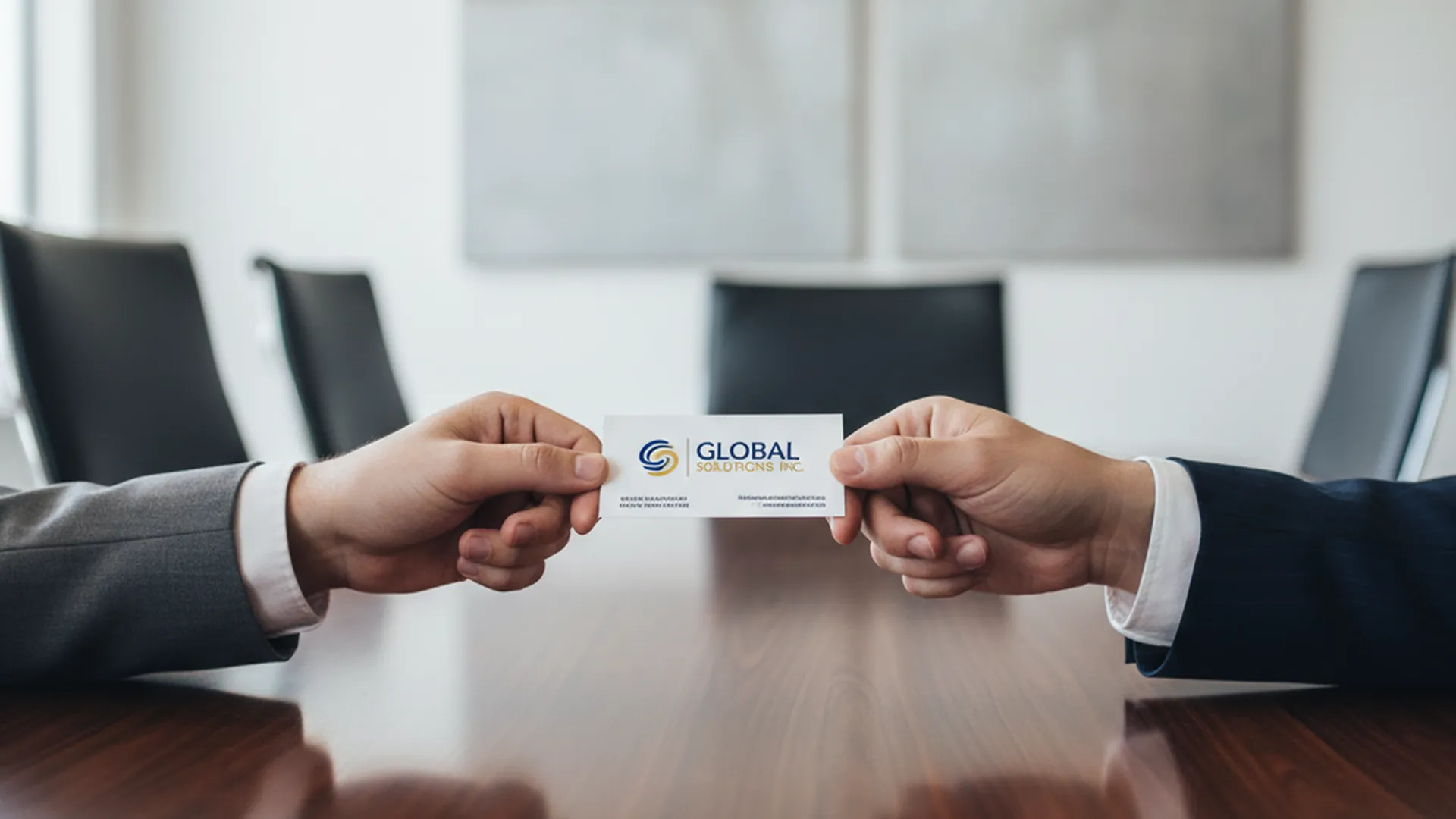
The Two-Handed Exchange (And Why It Works Everywhere)
The single most useful default I’ve adopted is the two-handed exchange. It’s mandatory in some countries, appreciated in many, and never wrong anywhere.
The full ritual:
- Stand. Don’t exchange cards seated if you can help it.
- Hold your card with both hands at the corners, printed side facing the recipient so they can read it without rotating it
- Slight bow or head nod, depending on country
- State your name and company as you present
- Receive their card with both hands
- Pause. Read the card. Acknowledge it — say their name, perhaps their title
- Place the card on the table in front of you for the duration of the meeting, or carefully into your card case
Five seconds longer than the American version. Infinitely more respectful in any country that values it.
Japan: The Strictest Version
Japan is where the meishi koukan ritual is most formal. A few details specific to Japan that go beyond the universal two-handed exchange:
- The card should never be folded, written on, or placed in a back pocket
- If you’re seated at a meeting, the cards from the other side stay on the table in front of you, in roughly the order people are seated, for the duration of the meeting
- You don’t shuffle them, fan them, or play with them while talking
- At the end of the meeting, the cards go into a card case (meishi-ire), not a wallet
- The bow during the exchange is real, even if shallow. Eye contact is brief. The whole thing is calm.
I covered the broader Japan story in the handshake disaster in Tokyo. The card piece of that story is the part I most regret. Of all my early international mistakes, the way I handled cards in Japan is the one that took the longest to undo.
South Korea: Two Hands, Always
Korea is similar to Japan in form but with its own subtle rules:
- Two-handed exchange is non-negotiable
- The receiving hand is sometimes supported under the wrist by the other hand — a sign of additional respect when the other person is significantly more senior
- Read the card on receipt. Acknowledge title and seniority — Korean titles are often hierarchical and matter
- Cards remain on the table during the meeting, the same as Japan
- Senior executives often have cards in two languages — Korean on one side, English on the other. Handle the side facing them when receiving, not your preferred language side
One specific Korean habit I’ve noticed: at large meetings, after the cards have been exchanged and reviewed, the host will sometimes consolidate them into a small pile next to their notebook. The visitor doesn’t do this — leave your stack as is.
China: Formal but Pragmatic
China has a slightly more pragmatic feel than Japan or Korea, but the formal ritual still applies in any first meeting:
- Two-handed exchange, especially in mainland China
- If your card has Chinese on one side, present that side
- Read the card on receipt — Chinese hierarchy is real and the title on the card is informative
- Don’t write on the card
- The card stays on the table or goes into a card case, not the wallet
Hong Kong is slightly more relaxed than mainland China. Two-handed is still appreciated, but a one-handed exchange isn’t fatal. In Beijing, Shanghai, Shenzhen — go full two-handed.
Singapore and the Rest of Southeast Asia
Singapore, where my mistake happened, is multicultural and the conventions vary by who you’re meeting with. The default that works:
- Two-handed exchange. It’s never wrong.
- If meeting with ethnic Chinese counterparts, follow Chinese conventions; with Malay or Indian counterparts, slightly more relaxed but still respectful
- Cards on the table during the meeting
- Don’t put the card in a back pocket — read this once and never again, but it’s surprisingly common among Westerners
In Vietnam, Indonesia, Thailand, and the Philippines, two-handed is again the safe default, with the same on-the-table-during-the-meeting rule.
India: The Card Is the Introduction, Not the Relationship
India treats the card more pragmatically than East Asia. The exchange itself is less ritualized — a handshake plus a single-handed card pass is fine.
What India does take seriously is what the card represents:
- Title is important. Address senior people by their title
- Education and credentials are sometimes printed on the card and matter to the relationship
- The card is the start, not the substance. The actual relationship is built through repeated meetings, follow-ups, and personal investment
I’ve taken Indian cards with one hand many times and never had it land badly. Where I would still default to two hands: any meeting with senior leadership, any first introduction in a region I haven’t worked in before.
The Middle East: Hospitality Plus Formality
In Saudi Arabia, the UAE, Qatar, and Kuwait, the card exchange is part of the broader hospitality:
- Right hand only when presenting or receiving (the left hand is associated with personal hygiene in many Muslim cultures)
- Two-handed is acceptable but right hand alone is more conventional
- Don’t rush the exchange. The greeting, the coffee, the cards, the seating — all part of one slow opening sequence
- Cards remain on the table during the meeting
- Read the card. Titles matter, especially Sheikh, Doctor, Engineer (Mohandis), and others
One specific I’ve seen go wrong: a Western colleague accepted a card with the left hand because his right was holding coffee. Just put the coffee down first.
Europe and the Americas: Flexibility, With Some Tells
Western Europe and the Americas are the most relaxed about the card exchange itself:
- Single-handed is fine
- The card may not be looked at carefully in the moment — sometimes glanced at, sometimes pocketed
- The card is more functional than ritual
Even so, a few small habits transfer well:
- Look at the card before you put it away. Even a brief acknowledgement of name and role lands well anywhere
- Don’t bend, write on, or fold the card during the meeting
- If they hand you a card with care, return the same energy
In Germany, the card is treated more pragmatically than in Asia, but with the same overall respect for hierarchy and title that runs through German business in general.
In France, cards are exchanged simply and the relationship is built through conversation, not ritual.
In Brazil, Mexico, and Argentina, the card exchange is informal but the relationship comes first — you’ll likely have lunch with someone before exchanging cards becomes a memorable moment.
Why I Now Carry a Card Case
For years I kept my cards in my wallet. Pulled out, slightly bent, occasionally damp. The wallet doubled as a card holder, a receipt graveyard, and a credit card slot.
The first card case I bought was a small leather one in Tokyo, after the handshake-and-card disaster. It cost me about $40. It changed how the rest of my international career has gone, and that’s not an exaggeration.
Reasons it matters:
- Your card comes out clean, flat, and presentable, every time
- You have a respectful place to put their card during and after the meeting
- You don’t have to fumble with the wallet, looking for cards mixed in with credit cards and receipts
- The case itself, in cultures that value form, is a small signal that you’ve thought about this
The case lives in my breast pocket, never in my pants pocket. I refill it before every trip. It now holds my cards, room for incoming cards, and one small credit card I use as a backup. That’s it.
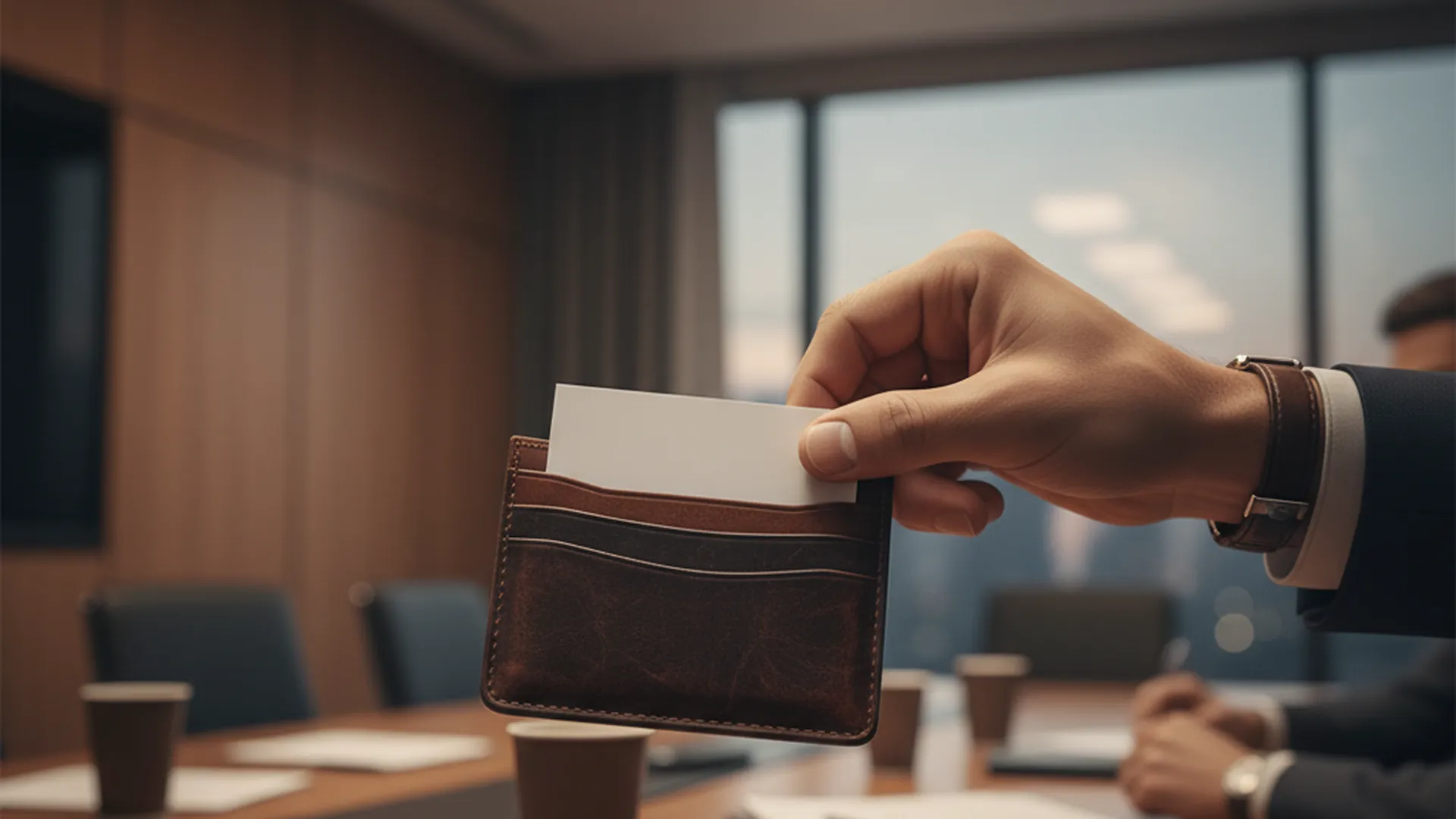
One small detail I picked up from a Korean colleague: the card case opens toward the recipient when you present, not toward you. That tiny choreography — opening the case so the cards face them, removing one with both hands, closing the case before they accept — turns the moment into something that feels deliberate rather than functional. It’s the kind of thing nobody notices when you do it right and everybody notices when you don’t.
What to Do With Cards You’ve Received
The exchange is the visible part. What you do with the cards afterward is the part most Westerners skip.
My system:
During the meeting. Cards stay on the table, in roughly the seating order, in front of me. I refer to them when addressing someone by name and title, especially when I’ve forgotten how a name is pronounced.
End of the meeting. Cards go into the card case, carefully, not stacked in a clump. The deputy director’s card doesn’t get crammed in next to a junior assistant’s card without thought.
Back at the hotel. Same evening, I do two things: take a photo of each new card, and add them to my contacts with a quick note about the meeting. Then I put the originals into a small box at home that I keep specifically for international cards. They’ve never become useless. I’ve gone back to that box more than once to find a contact I needed years later.
What I never do. Throw out a business card. Even from a meeting that didn’t go well. The card is the person. The relationship may come back around.
LinkedIn Doesn’t Replace Any of This
You will hear, often, that “everything is digital now” and the card ritual is obsolete. This is wrong, and the people saying it tend to be people who haven’t done business in Asia, the Middle East, or with senior executives anywhere.
The physical card is still a primary tool in many cultures. LinkedIn is a useful follow-up. It is not a substitute for the face-to-face exchange. Insisting on digital while a senior counterpart is presenting a physical card to you is, in many places, a low-grade insult.
Take the card. Treat it well. Connect on LinkedIn that evening. Both/and, not either/or.
The Smaller, Bigger Lesson
The way I handled cards used to be a small detail of how I did business. After Singapore, after Tokyo, and after a few other small disasters along the way, I came to see it as a measurement of how seriously I take the people I’m working with.
If I can’t be bothered to handle a small piece of paper with care, why would the customer trust me to handle a complicated international partnership with care?
This is the same logic that runs through the broader country-by-country etiquette cheat sheet. Small forms become large signals when you cross enough borders. The form isn’t the point — the form is just visible. The respect is the point.
The card case is one of the best $40 I’ve ever spent. Not because of the leather. Because of what it forced me to slow down and actually pay attention to. And paying attention, it turns out, is most of the job in international business — alongside the harder skill of indirect business communication in Asia, where the lessons keep coming long after the cards are exchanged.

Title: When ‘yes’ doesn’t mean yes
The card is the introduction. The harder skill is reading what comes after — when polite agreement isn’t agreement at all.
Inside:
- The ‘yes’ trap in East Asian business
- How to ask better questions in indirect cultures
- The ‘no’ you have to find without asking for it
Business card etiquette at a glance
| Region | Exchange style | What matters most |
|---|---|---|
| Japan | Two hands, strictest version (meishi koukan); slight real bow | Never fold, write on, or pocket the card. Cards stay on the table in seating order; then into a card case, never a wallet. |
| South Korea | Two hands, non-negotiable; support wrist for very senior people | Acknowledge hierarchical titles. Handle the side facing them. Don’t consolidate the pile — that’s the host’s job. |
| China | Two hands, especially mainland (Beijing, Shanghai, Shenzhen) | Present the Chinese side; read the title. Hong Kong is more relaxed — one hand isn’t fatal. |
| Singapore / SE Asia | Two hands is the safe default | Match your counterpart’s background; cards on the table. Never put a card in a back pocket. |
| India | Handshake plus single-handed pass is fine | The card is the introduction, not the relationship. Title, education, and follow-up meetings matter. |
| Middle East (Saudi, UAE, Qatar, Kuwait) | Right hand only; two hands acceptable | Never the left hand — put the coffee down first. Don’t rush; titles like Sheikh, Doctor, Engineer matter. |
| Europe & Americas | Single hand is fine; more functional than ritual | Still glance at the card before pocketing it. Don’t bend, fold, or write on it. |
And the gear: A roughly $40 leather card case keeps your cards clean and flat, gives you a respectful place for theirs, and signals you’ve thought about it. Keep it in your breast pocket, refill before every trip, and open it toward the recipient when you present.
FAQ
Is two-handed card exchange really necessary?
It’s mandatory in Japan and South Korea, expected in mainland China and the Middle East (right hand there), and appreciated across the rest of Asia. It’s never wrong anywhere. The full version takes about five seconds longer than the American one-handed slide and is infinitely more respectful where it counts.
What should I do with a business card after I receive it?
During the meeting, leave it on the table in roughly seating order so you can address people by name and title. At the end, place it carefully into a card case — not crammed in a clump. That evening, photograph each card, add it to your contacts with a meeting note, and keep the original. Never throw a card out, even from a meeting that went badly.
Has LinkedIn made physical business cards obsolete?
No. In Asia, the Middle East, and with senior executives anywhere, the physical card is still a primary tool. LinkedIn is a useful evening follow-up, not a substitute. Insisting on digital while someone is presenting you a physical card reads as a low-grade insult. Do both — take the card, treat it well, connect online later.