

Short answer: Start in the mountains, not the capital. We did Chamonix (3 days), Paris (5), then London (5) with four families and kids aged 8 to 15. The Alps reset the jet lag, trains beat airport chaos, and one museum per city kept everyone sane. We didn’t see everything. We remember almost all of it.
Why We Started in the Mountains Instead of a Capital City
Last June, we flew into Geneva with our kids. My daughter was 8 and my son was 13. We traveled with three other families who are our neighbors and friends from Florida.
We could have gone straight to Paris or London and started the trip with big landmarks, museums, and the kind of sightseeing that looks great in photos.
Instead, we drove to Chamonix.
Choosing to start in a small mountain town instead of heading straight to a capital city turned out to be one of the smartest moves of our whole trip.
Here’s why it worked:
Chamonix has a slower pace. It’s a small town where you can walk everywhere. There’s no pressure to see everything since there isn’t a long list of major attractions.
Easier jet lag adjustment. Fresh air. Movement. Early bedtimes that felt natural instead of forced. The kids could run around without us worrying about traffic or crowds.
There was no cultural overload. Instead of starting with a museum, we began our trip with a hike.
By the time we got to Paris three days later, everyone was adjusted, rested, and ready for the intensity of a big city.
Chamonix With Kids: The Perfect Jet Lag Reset
We spent three days in Chamonix. Just enough to settle in without getting restless.
Aiguille du Midi Cable Car
This was the big visual experience. The cable car takes you up to 3,842 meters with views of Mont Blanc and the surrounding peaks.
My kids were amazed by the altitude, the glass viewing platform, and the size of the mountains. It’s the kind of experience that stays with them.
Mer de Glace Glacier Train
This was my daughter’s favorite. We took the red mountain train up to the glacier. When we got there, she said it looked like the Ice Queen’s home.
That’s how eight-year-olds see glaciers—not as geological formations, but as ice palaces.
We also watched a 4D movie about Mont Blanc and rode the Chamonix Mountain Coaster Luge, which is basically a summer toboggan run down the mountain. The kids loved it. It was simple fun that didn’t need any cultural background or extra patience.
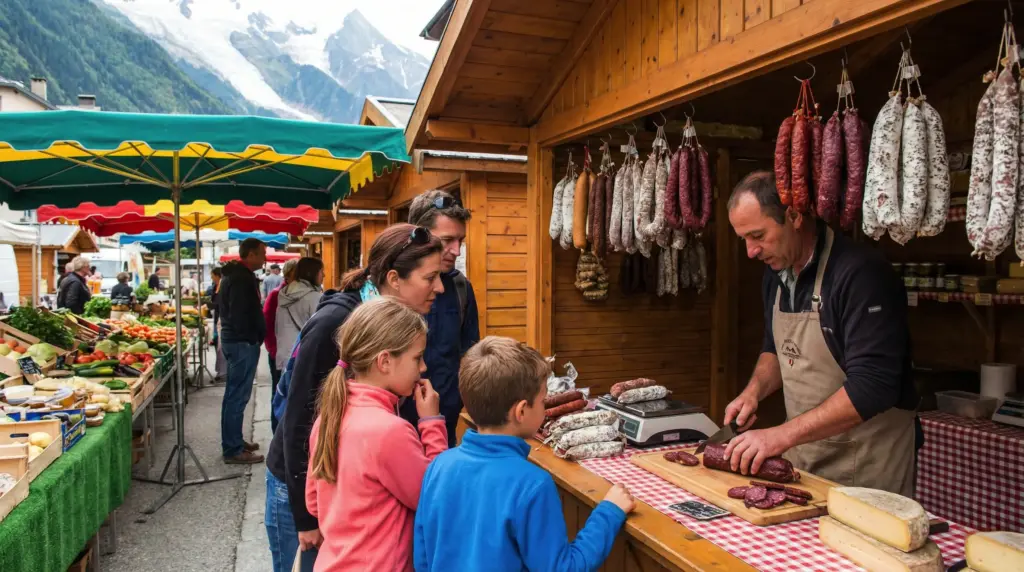
Saturday Farmer’s Market
This is where we really indulged, in the best way.
Fresh vegetables. Berries – including red currants, which my kids had never seen before. Cheeses from local farms. And sausages.
We bought about 15 to 18 different kinds of sausages, each with different meats, spices, and from different regions. It turned into a tasting project for everyone. The kids tried a couple —some they loved, some they didn’t, but they gave it a chance. That market visit set the tone for food during the whole trip: try new things, don’t overthink it, and share everything.ng.
La Diosaz Hike
This hike was just for our family of four. We walked past waterfalls, through gorges and forest paths. It wasn’t strenuous or long—just beautiful and peaceful.
My kids needed that time with just us, moving through nature without the energy of the larger group. It balanced out the group activities.
By the end of three days in Chamonix, everyone had adjusted. Sleeping on local time. Eating well. Ready to move.
Traveling With 4 Families: Why This Actually Worked
Four families. That’s 8 adults and a bunch of kids ages 8 to 15.
Group travel can be tough with too many opinions, a rigid schedule, or too much coordination stress. But this time, it worked. Here’s why:
No rigid group schedule.
We didn’t try to do everything together. We chose a few main activities, like Disneyland or the Harry Potter Studio Tour, and coordinated those. Everything else was flexible.
When our friends wanted to go to Versailles, we stayed in Paris and took our kids to the Paradox Museum instead. While they were in Bath and Stonehenge, we walked around London at a slower pace because our kids wanted to chill.
That flexibility kept everyone happy. There was no resentment or feeling trapped in someone else’s plans.
Built-in kid friends.
This was huge. My kids had their friends with them the whole trip. That meant they weren’t complaining about being bored or dragged to another museum. They were experiencing it together.
At Disneyland, my son had friends to ride the roller coasters with, since I don’t like them. The younger kids had each other for the smaller rides. Traveling as a group gave them independence we couldn’t have provided on our own.
Shared logistics.
In Paris, three of the four families stayed in the same building in Montmartre. Our apartments were on different floors—the 2nd, 3rd, and 4th. The kids ran between apartments, we coordinated breakfast, and we shared wine in the evenings.
That setup made Paris feel less like a hotel stay and more like living in a neighborhood. The kids loved it because they had both freedom and structure.
Group travel works best when it’s relaxed. No one is in charge or forcing everyone to agree. We just coordinated the big things and let everyone have freedom with the rest.
Paris — 5 Days Without Turning It Into a Marathon
We took the train from Geneva to Paris. Boarding was easy, with no airport chaos. The kids could move around, and the city-to-city travel felt like part of the experience, not just a logistical step.
We stayed in Montmartre for five days in an apart-hotel with one bedroom, a living room, and a small kitchenette. There was a washer and dryer combo. It was just enough space to spread out without feeling cramped.
We kept our approach to Paris simple: one major sight each day, one park break, and one good meal. Everything else was optional.
The Louvre
We did the Louvre. Not all of it – just the highlights. Mona Lisa, Venus de Milo, and the Egyptian wing. A few hours, not a full day.
After the museum, we walked along the Champs-Élysées—not to shop, but just to see it and let the kids burn off some energy.
Notre Dame and the Café
We visited Notre Dame. The kids saw the exterior, understood the scale, and asked questions about the fire and the reconstruction.
Afterward, we stopped at a café nearby. It was the same café my wife and I visited a year ago when we came to Paris alone. That meant something to us, even if the kids didn’t realize it.
My 13-year-old son tried escargot and fried frog legs. He’d been wanting to try them. The waiter smiled. Didn’t love the frog, but appreciated the snails.
That’s the kind of moment you can’t plan. It happens naturally when you give kids space to be curious.
Sacré-Cœur and Montmartre
We climbed all the stairs to Sacré-Cœur. My kids recognized them right away because they’d seen John Wick. The church was a movie location, which gave them context and made the climb more interesting.
Then we walked in Montmartre. Narrow streets, artists painting portraits, small squares. Slower pace. We had dinner at a bistro nearby. Nothing fancy. Just good food and time together.
Seine River Cruise and Eiffel Tower
We did a Seine River cruise. Saw the city from the water. Passed under bridges. The kids enjoyed it more than I expected – something about being on a boat made them pay attention.
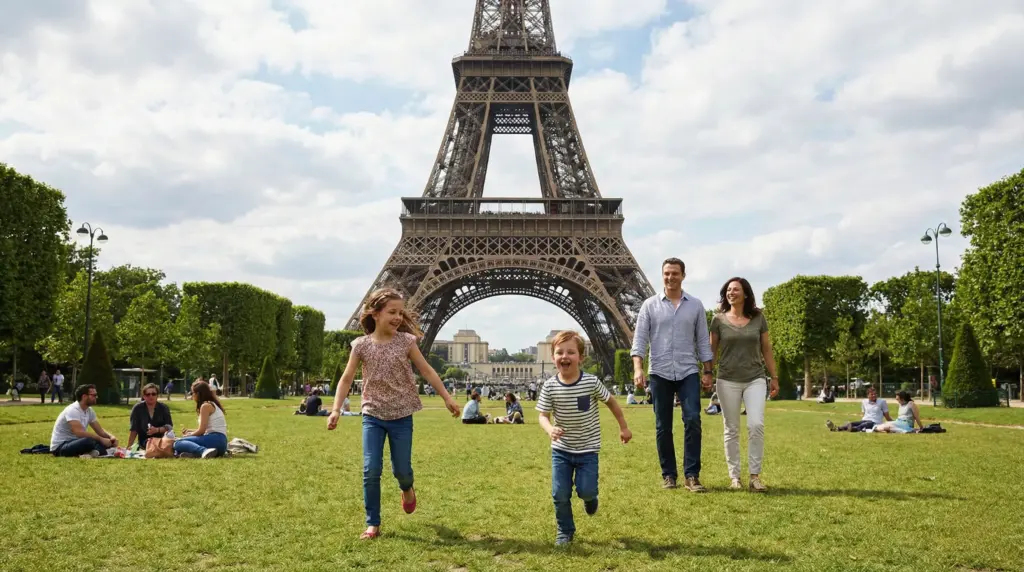
We saw the Eiffel Tower but didn’t go up. We just took photos and let the kids run around the Champ de Mars. Sometimes, seeing the landmark is enough.
Paradox Museum
While our friends were in Versailles, we stayed in Paris and took the kids to the Paradox Museum. Immersive, interactive exhibits that played with perspective and physics.
The kids loved it. It was a break from history and culture. Just fun that didn’t require concentration or patience.
Disneyland Paris: Totally Worth It
We spent a day at Disneyland Paris. It was a hot day, maybe even too hot, but it was worth it.
Why it worked:
Shorter lines than Orlando.
The lines weren’t dramatically shorter, but they were noticeably better. We didn’t have to wait an hour for every ride, and the park felt less crowded even in summer.
Better food than Orlando.
This surprised me—the food was actually good, not just good for a theme park. French standards seem to apply even at Disneyland.
Kids had their friends.
This made the biggest difference. My son and the other older kids went on roller coasters together. I didn’t have to force myself to ride the ones I hate. The younger kids had company for the gentler attractions.
It was a good reset day. After museums, history, and walking, Disneyland gave the kids pure fun. No learning objectives. No cultural context. Just rides and characters.
That kind of balance is important on a two-week trip to Europe with kids.
London — 5 Days of Energy
We took the train from Paris to London through the Channel Tunnel. The whole group traveled together. The kids were excited about going underwater.
London felt different from Paris—faster, bigger, and louder. It was more chaotic, but in a way that felt energizing instead of overwhelming.
We stayed in a hotel across the river from Parliament for five days. Walkable to major landmarks. Easy Tube access. Good base.
Why London Worked With Kids
No language barrier. That mattered more than I expected. My kids could read signs, ask questions, and order food without hesitation. It reduced friction.
Transportation was clear and easy. The Tube is simple to navigate with color-coded lines and frequent trains. We moved around London with less stress than on the Paris metro. landmarks. Tower Bridge, Big Ben, Buckingham Palace. Things the kids recognized immediately. That made them feel oriented.
What We Actually Did
London Eye. Madame Tussauds wax museum. The Paddington Experience and Shrek Experience – both touristy, but the younger kids loved them. London Aquarium. The older kids did a Jack the Ripper Experience tour.
We saw the Tower of London, rode a double-decker bus, walked through Piccadilly Circus, and visited the British Museum briefly—just for the highlights.
We had breakfast at Sky Garden one morning. A glass-enclosed space at the top of a building with panoramic views. The food was excellent. The kids were engaged because of the height and the view.
When our friends went to Bath and Stonehenge for a day, we stayed in London because our kids just wanted to walk around and relax. So that’s what we did—no agenda, no pressure.
Harry Potter Studio Tour: The Real Highlight
This deserves its own section because it was the most memorable single activity of the London portion.
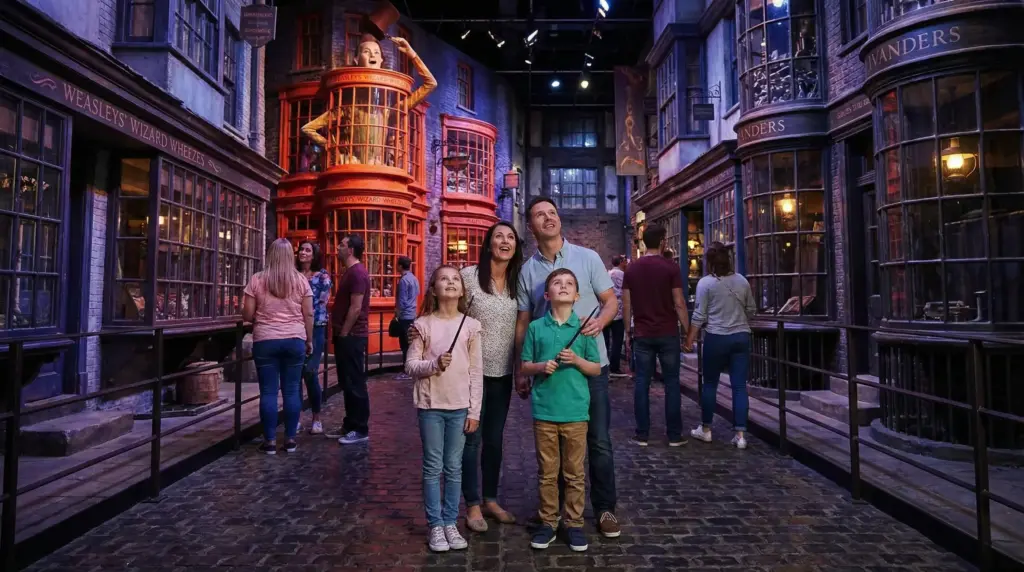
We spent a full day at the Harry Potter Studio Tour. The actual sets, costumes, and props from the films. Diagon Alley. The Great Hall. Dumbledore’s office.
Why it worked:
It was immersive without being overwhelming. The pacing was good, and you could move through at your own speed. There was no rushing or crowds pushing you forward.
Well organized. Clear flow. Good signage. Easy to navigate even with a large group.
Both kids and adults enjoyed it. It wasn’t just the kids tolerating it while adults were bored, or the other way around. Everyone was engaged.
My kids remember specific details from that day. The Hogwarts Express. The model of Hogwarts Castle. Butterbeer in the café. Those are the memories that stick.
What We Learned About Multi-City Travel With Kids
Two countries in one trip works.
France and the UK felt like the right amount. Visiting three cities—Chamonix, Paris, and London—over two weeks kept things varied without feeling rushed. Any more cities would have meant too much moving around.
Trains reduce stress.
We took the train from Geneva to Paris, then from Paris to London through the Channel. There was no airport security or baggage claim—just board and arrive in the city center. That makes a big difference when traveling with kids.
I did have my pocket knife (a souvenir from Chamonix) confiscated at the Paris-London train. You go through the same type of security as you would on a plane, but having a knife in my luggage didn’t help, since you have access to it on the train.
4-5 days per city is ideal.
We spent three days in Chamonix, five in Paris, and five in London. That rhythm worked well—enough time to settle in without getting restless, but short enough to keep up our energy.
Starting slow makes the rest easier.
Starting in Chamonix was the key. Beginning in a small mountain town instead of a capital city meant everyone was adjusted, rested, and ready for Paris. Without that buffer, jet lag would have ruined the first few days.
What I Would Do Slightly Differently
Even slower first two days.
Starting in Chamonix worked well, but I’d make the first two days even lighter next time. We’d do more walking around, less planning, and just let everyone fully decompress before getting busy.
More park downtime.
We included park breaks, but we could have added more. Kids need unstructured time to run around and reset, which is just as important as seeing landmarks.
Maybe skip one museum.
We did the Louvre and the British Museum. Both were good. But in hindsight, one major museum would have been enough. The second felt like an obligation more than a genuine interest.
These aren’t major regrets. Just small adjustments that would make it even better next time.
Why This Trip Worked
Good friends traveled together, with flexibility instead of rigid planning. We started slow in the mountains and kept a simple daily rhythm: one major activity, one break, and one good meal.
We didn’t try to maximize every day or obsess over seeing everything. We didn’t turn the trip into a checklist.
We didn’t see everything. But we remember almost all of it.
My kids remember 15 different sausages at a French farmer’s market. The Ice Queen’s glacier. Climbing John Wick stairs. My son is trying snails and frog legs at the same café my wife and I visited a year ago. The Harry Potter sets.
Those are the moments that stayed with us—not the landmarks we checked off, but the experiences we shared.
If you’re planning a trip to Europe with kids, consider starting small and building up. Big cities are easier to enjoy after some time in the mountains.
Before you go, spend some time looking at maps and talking about history with your kids. When they arrive, the places will already feel familiar.
Related posts:
→ The 2-3 Trips a Year Dad: How to Travel for Work Without Losing Your Edge
→ Why I’m Finally Bringing My Family on a Work Trip
I write about this regularly.
Practical systems for dads who travel occasionally and want to stay sharp at work, connected at home, and not burned out in between.
Key takeaways
- Open in a small town, not a big city. Three days in Chamonix knocked out the jet lag before we ever hit Paris. Glaciers and a mountain coaster beat a museum line while everyone’s still half-asleep.
- Trains over planes between cities. Geneva to Paris and Paris to London through the Channel Tunnel meant no airport chaos. Heads up: Eurostar security took my pocket knife souvenir. Don’t pack one.
- Three to five days per city. Enough to settle in, not so much you’re constantly packing. Less moving around, more actually being somewhere.
- One major museum per city. One. At the Louvre we hit the Mona Lisa, Venus de Milo, and the Egyptian wing, then left. Same with the British Museum — highlights only.
- Build in unstructured time and a pure-fun day. Disneyland Paris was the reset after the museums. Kids need to run around between the cultural stuff.
- Group travel works when nobody’s in charge. Four families, flexible plans, no forcing everyone to agree. That’s why it worked.
FAQ
Should I start a family trip to Europe in Paris or somewhere smaller?
Somewhere smaller. We started with three days in Chamonix and it reset the jet lag before the big cities. Cable car up to the Aiguille du Midi, the glacier train, a mountain coaster — low-pressure stuff that works on tired kids. Paris and London came after, when everyone was actually awake.
How many days should I spend in each city traveling with kids?
Three to five. We did Chamonix three days, Paris five, London five, over two weeks. Enough time to settle in without turning it into a marathon, and not so much moving around that you’re living out of a suitcase.
Is Disneyland Paris worth it on a culture-heavy trip?
Yes. We gave it one day and treated it as the reset after all the museums. The kids needed pure fun between the Louvre and the next city, and honestly the food was better than Orlando. Pair the heavy days with a fun day and everyone holds up.