

Short answer: Going from a 7-day work trip to a 2-week one is not about packing twice as much. It’s about adding a laundry system. For 7 days I carry about 4 shirts, 2 pants, and a wash kit, and I do one sink-laundry session midweek. For 2 weeks I add one shirt, one pant, a second compression cube, and a second wash session. The bag barely grows, because the clothes get recycled instead of stockpiled. Length changes the system, not the size of the pile.
The first time I packed for 12 days, I brought 12 of everything. My carry-on weighed as much as my kid, the wheels groaned the whole length of O’Hare, and I still wore the same three shirts the entire trip because they were the ones sitting on top. That’s the trip that taught me trip length doesn’t multiply your packing list. It just changes the math.
Heads up: some links below are affiliate links — I may earn a small commission at no cost to you. I only point you toward stuff I’d actually use.
The Core Idea: Length Changes the System, Not the Pile
Nobody tells you this when you start traveling for work, so I’ll tell you. The difference between a 7-day trip and a 2-week trip is not a bigger suitcase. It’s a decision about laundry.
Once you accept that you’re going to wash clothes on the road — in a sink, in a hotel machine, at a wash-and-fold around the corner — your packing list stops scaling with the calendar. A 2-week trip needs maybe one or two more items than a 7-day trip. Not seven more. One or two. I’ve done it both ways, and the over-packed version just gives you a heavier bag and the same three favorite shirts.
If you’ve already read my 3-day carry-on packing list, this is the sequel. That post owns the short-haul, one-bag, no-laundry sprint. This one is about what happens when you cross the line where laundry stops being optional, which lands somewhere around day five.
Below: two side-by-side numbered checklists, a comparison table showing exactly how the list shifts as trips get longer, and the sink-laundry routine that lets me do two weeks out of a carry-on and a small backpack.
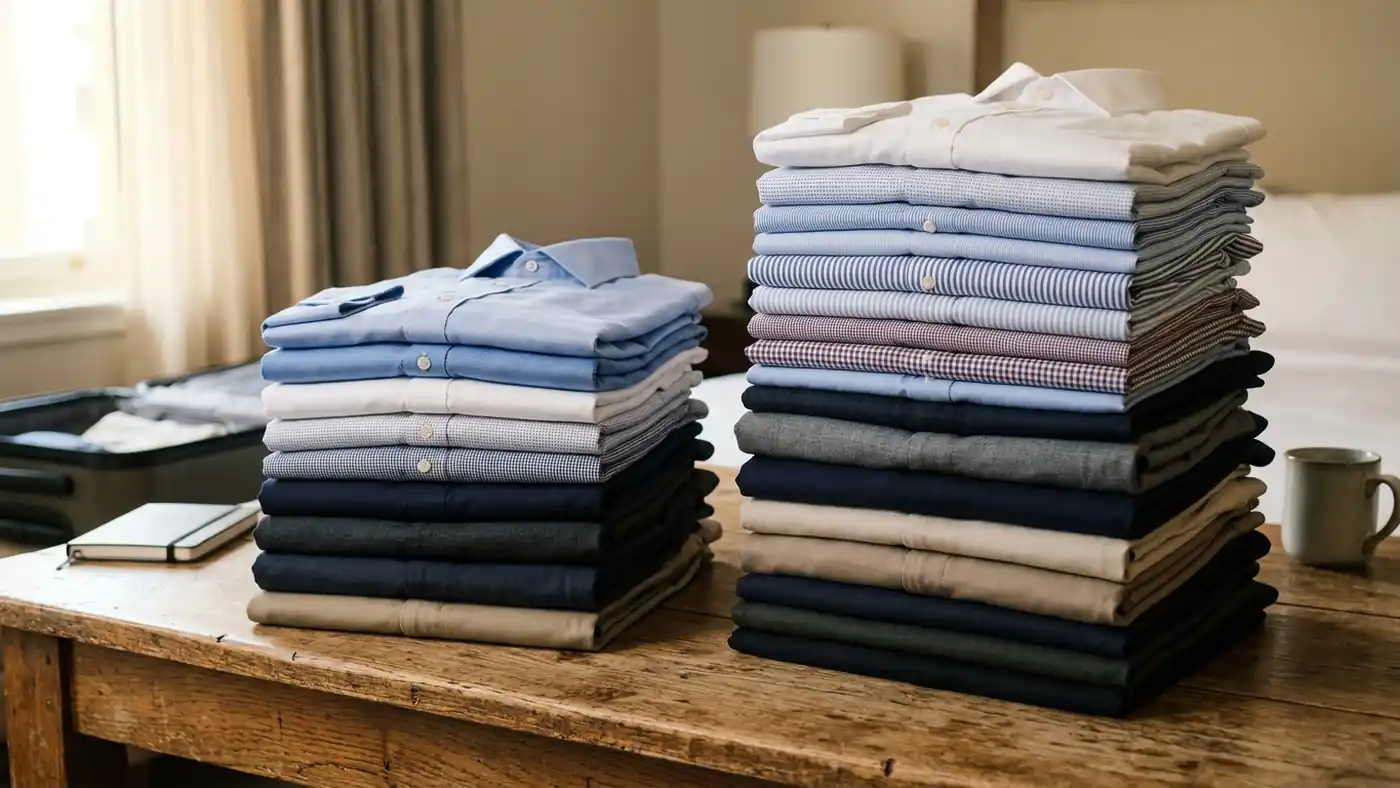
The Comparison Table: How My List Changes by Trip Length
This is the table I wish someone had handed me a decade ago. The 3-day column is the baseline — the carry-on sprint. The 7-day and 2-week columns show the deltas: what gets added, and what stays exactly the same.
| Item | 3-Day (baseline) | 7-Day (+delta) | 2-Week (+delta) |
|---|---|---|---|
| Dress/work shirts | 3 | 4 (+1) | 5 (+1) |
| Pants / trousers | 1–2 | 2 | 3 (+1) |
| Underwear / socks | 4 pairs | 5 pairs | 6 pairs |
| Undershirts | 3 | 4 | 5 |
| Sweater / layer | 1 | 1 | 1–2 (climate) |
| Shoes | 1 pair (+worn) | 1 pair (+worn) | 1 pair (+worn) |
| Laundry plan | None | 1 sink session | 2 sessions |
| Detergent | None | Sheets | Sheets |
| Compression cube | Optional | 1 | 1–2 |
| Bag size | Carry-on | Carry-on | Carry-on + daypack |
Read across the rows and the pattern jumps out. From 7 days to 14 days, almost everything holds steady. Shirts go up by one. Pants go up by one. The real change sits in the laundry row: one session becomes two. That’s the whole secret. You’re not packing more clothes. You’re packing a way to clean the clothes you already have.
Checklist 1: The 7-Day Work Trip
This is my standard week list. It fits in a single carry-on with room to spare, and it assumes exactly one mid-trip laundry session — usually a Wednesday-night sink wash. Wear your bulkiest items on the plane.
- 4 work shirts. Wear one, pack three. Merino or a wrinkle-resistant blend, so they survive a sink wash and a hanger overnight.
- 2 pants / trousers. One worn, one packed. Dark colors hide more sins. A pair that dresses up or down covers dinner and the conference floor.
- 5 pairs underwear + 5 pairs socks. Five, not seven, because of the midweek wash. Quick-dry fabric matters here more than anywhere.
- 4 undershirts. These are your laundry buffer — the cheapest, fastest-drying thing to rinse in a sink.
- 1 sweater or mid-layer. Doubles as plane warmth and evening cover. Wear it through security.
- 1 pair of dress shoes plus the sneakers on your feet. Two pairs of shoes is the line. Cross it and your bag balloons.
- Wash kit with detergent sheets. A few travel detergent sheets weigh nothing and aren’t a liquid (more on why that matters below).
- 1 compression cube. Squashes the clean clothes down and quarantines the dirty ones.
- Toiletries under 3.4 oz each, in one quart bag. The TSA 3-1-1 rule still applies — verified current as of 2026, but always confirm at tsa.gov before you fly. (At airports with the newer CT scanners, you may not have to pull the bag out of your carry-on anymore, but the 3.4 oz limits haven’t budged.)
- Chargers, adapters, a small power bank. One pouch. If you want the cheap stuff that actually works, I rounded it up in my travel gear under $50 post.
Checklist 2: The 2-Week Work Trip
Same list, stretched to 14 days. Look at how little actually changes. The additions are in bold. Everything else is identical to the 7-day list, because the laundry system does the heavy lifting instead of the suitcase.
- 5 work shirts (one more than the 7-day list). That single extra shirt buys you breathing room between wash sessions.
- 3 pants / trousers (one more). Rotate three across two weeks and nothing hits that beaten-down, third-wear look.
- 6 pairs underwear + 6 pairs socks. One extra pair each, because you’ll do two laundry sessions instead of one.
- 5 undershirts. Your sink-wash workhorses.
- 1–2 mid-layers, climate-dependent. Two weeks often means crossing a weather line. See the layering note below.
- The same two pairs of shoes. This does not change. Ever. Two pairs handle 3 days or 30.
- Detergent sheets — bring extra. They’re paper-thin, so a dozen costs you nothing in weight or space.
- 1–2 compression cubes. A second cube earns its keep over two weeks: clean in one, dirty in the other.
- A small daypack. The only real bag upgrade. It carries the laptop, doubles as a laundry-run tote, and turns into your weekend bag if you bolt a few leisure days onto the end.
- A garment folder for the one outfit that has to look sharp. If there’s a board dinner or a client pitch, a garment folder keeps one shirt and one pair of trousers genuinely crease-free.
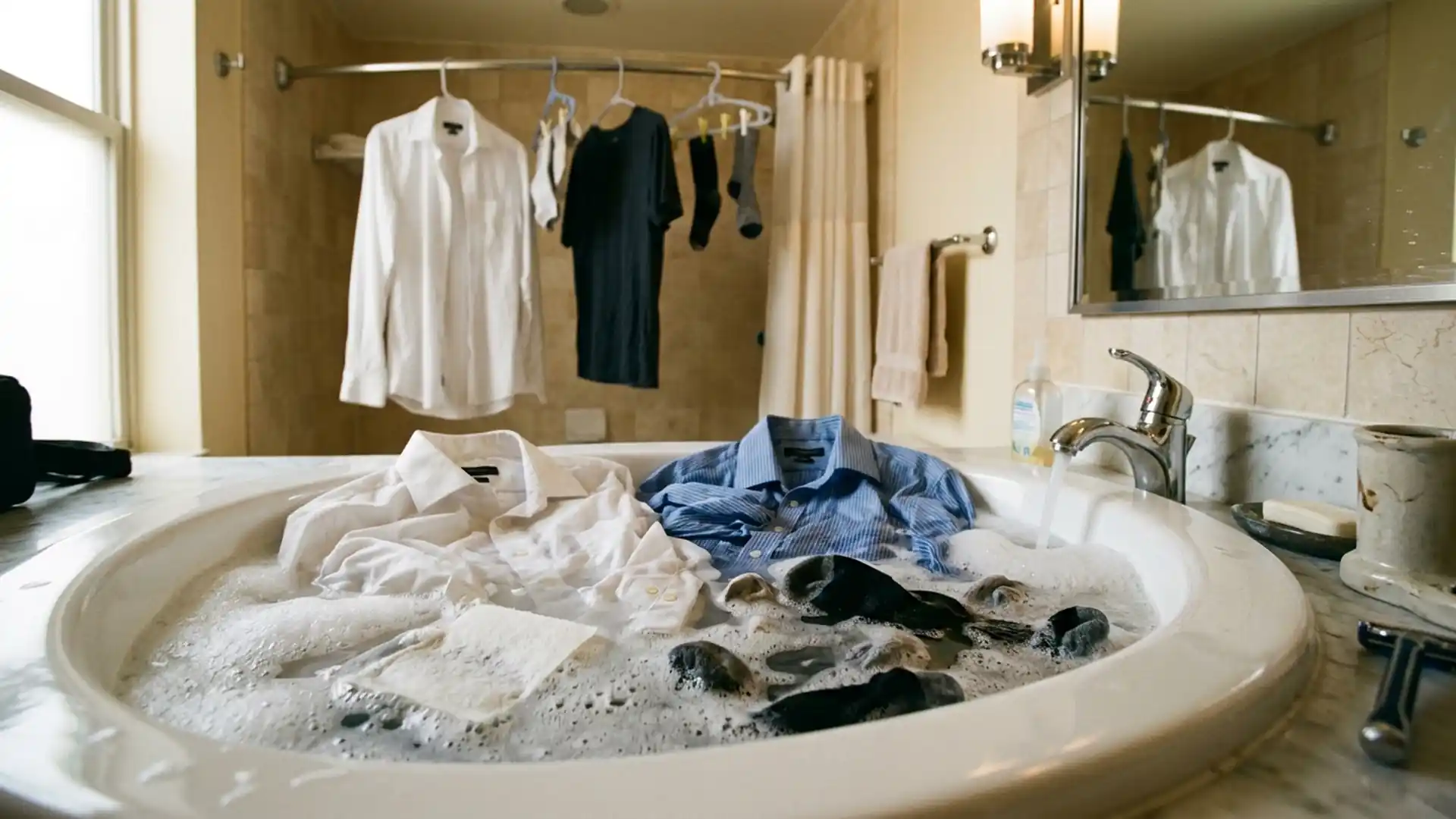
The Sink-Laundry System (The Whole Reason This Works)
This is the engine. Without it, a 2-week trip really would mean a checked bag and a sore shoulder. With it, two weeks fits in the same space as one.
Here’s my exact routine, refined over an embarrassing number of hotel bathrooms:
- Plug the sink. If the stopper’s broken — and it always is — a flat sink stopper or a wadded plastic bag does the job.
- Drop in one detergent sheet. Hot water, swish until it dissolves. No measuring, no leaking bottle, no liquid for TSA to confiscate.
- Wash the small stuff. Underwear, socks, undershirts, one shirt. Two minutes of agitation, then a five-minute soak while you answer email.
- Rinse and roll. Rinse clean, lay each item flat on a bath towel, roll the towel tight, then stand on it like a maniac. That wrings out most of the water without twisting your clothes into rope.
- Hang to dry. Shower rod, hooks, anywhere with air. Quick-dry fabrics are bone-dry by morning. Cotton may need the full day, which is exactly why I don’t pack much of it.
Why sheets instead of a travel bottle? Because TSA treats laundry sheets as a solid, so they skip the 3-1-1 quart-bag math entirely — verified TSA-friendly as of 2026, though I’d still glance at the official TSA liquids rule before a trip. One warning: detergent pods don’t get the same pass. There’s gel inside, so TSA counts them as a liquid. Sheets are the move. A liquid travel detergent eats into your one quart bag and can leak all over your shirts at altitude. Ask me how I know.
Two sessions across two weeks — say, day 5 and day 10 — keep a six-shirt rotation feeling fresh the whole trip.
The Climate-Layering Delta
The one place a 2-week trip genuinely demands more than a 7-day trip is weather. A week usually lives in one climate. Two weeks often crosses a line — a humid coastal Monday and a cold continental Friday, or a trip that runs straight into a season change.
My rule: I don’t pack a second wardrobe, I pack one more layer. A packable insulated vest or a thin merino quarter-zip adds versatility for almost no volume. The same three shirts read completely differently with a layer thrown over them, which is how you stretch a small pile of clothes across changing weather.
What I refuse to do is pack a bulky coat “just in case.” If I’m genuinely heading somewhere cold, the coat goes on my body through the airport, never in the bag. A coat in a carry-on is a coat that just ate your packing cube.
Compression Cubes: Where the Space Actually Comes From
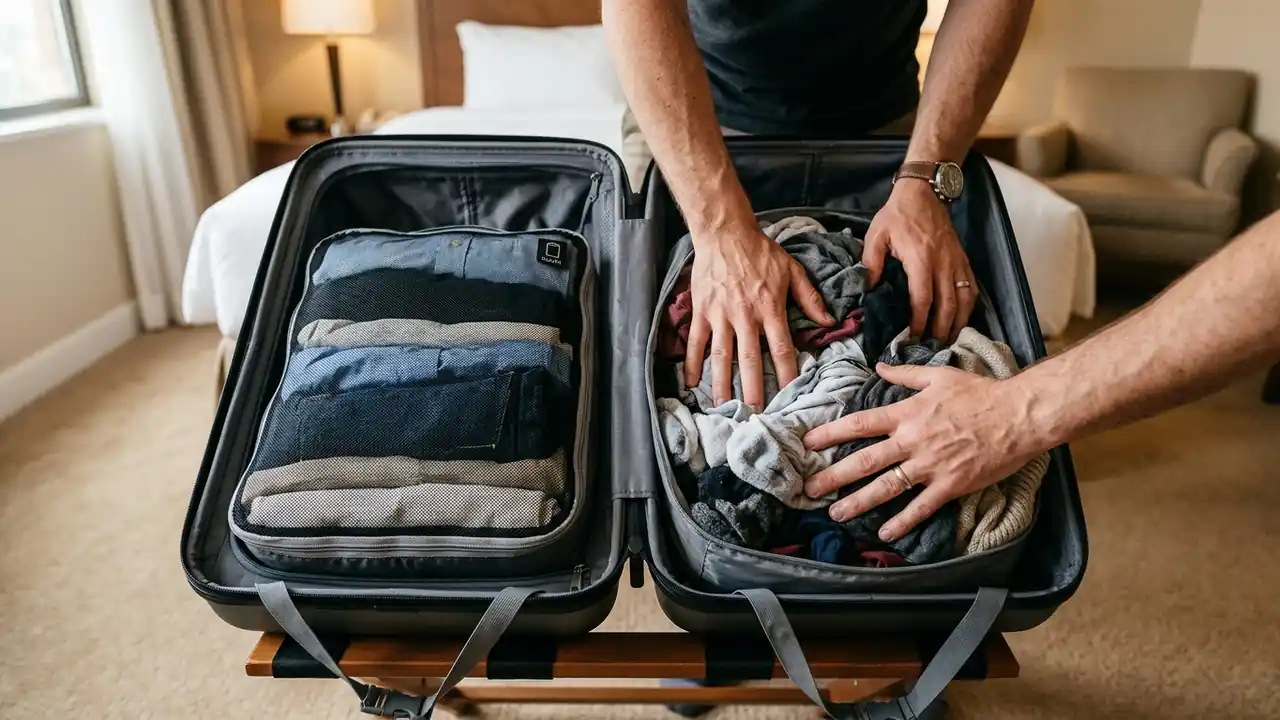
People assume a 2-week trip needs a bigger bag. It needs better compression. Compression packing cubes squeeze the air out of your clothes — testing and user reports put the volume reduction somewhere in the 20–50% range depending on the fabric, with fluffy stuff like sweaters compressing best and stiff denim compressing least (as of 2026; your results will vary by cube and by what you cram into it).
My setup for two weeks is dead simple. Compression cubes — one for clean, one for dirty. The dirty cube also keeps the smell of a Wednesday gym session away from your Thursday board meeting. That alone is worth the price of admission.
The clean cube gets re-compressed each morning. The dirty cube grows, then shrinks again after each laundry session. The bag stays the same size the entire trip. That’s the part that still feels like cheating.
A Few Hard-Won Rules That Apply at Any Length
These don’t care whether you’re gone three days or thirty. They’ve each saved me from a specific, stupid mistake.
- Wear your heaviest items on the plane. Boots, sweater, jacket. The plane is cold anyway, and your bag thanks you.
- Pack one outfit that makes you look like you have your life together. One. For the dinner or the pitch. The garment folder protects it.
- Everything should pass the “can I rinse it in a sink” test. If it can’t survive a sink wash, it’s the wrong fabric for a long trip.
- Two pairs of shoes. Full stop. This is the single biggest space mistake I see. A third pair is a vanity tax on your back.
- If you’re adding leisure days, the daypack is your friend. A work trip that turns into a long weekend with the family is a good problem to have, and the same bag handles it. I make that case in why I started adding 2–3 nights to work trips, if you want the sales pitch for guilt-free bleisure.
FAQ
How many outfits do I actually need for a 2-week business trip?
About five shirts, three pants, and a layer — not fourteen of everything. With two sink-laundry sessions, a six-day rotation comfortably covers 14 days. The clothes get recycled, not stockpiled, which is exactly why the bag barely grows from a 7-day trip.
Can I really do two weeks out of a carry-on?
Yes, if you commit to laundry. A carry-on plus a small daypack handles two weeks easily once you’re washing clothes midweek. Compression cubes and quick-dry fabrics are what make it possible. The laundry system simply replaces the volume you’d otherwise pack.
Are laundry detergent sheets allowed through airport security?
Yes. TSA treats detergent sheets as a solid, not a liquid, so they don’t count against the 3-1-1 quart-bag limit — verified TSA-friendly as of 2026, though you should always confirm on the official TSA site before flying. One catch: detergent pods are treated as a liquid because of the gel inside, and liquid travel detergent counts against your quart bag and can leak at altitude. Stick with sheets.
What’s different about packing for 7 days versus a 3-day trip?
The crossover is laundry. A 3-day trip needs zero washing — see the dedicated 3-day carry-on packing list for that sprint. Around day five, sink laundry becomes smarter than packing more clothes, and that one decision is what keeps your bag from doubling in size.
Do I need a bigger suitcase for a longer trip?
Almost never. You need better compression and a laundry plan, not more cubic inches. The only genuine bag upgrade I make for two weeks is adding a small daypack for the laptop and laundry runs. The main carry-on stays exactly the same size.